
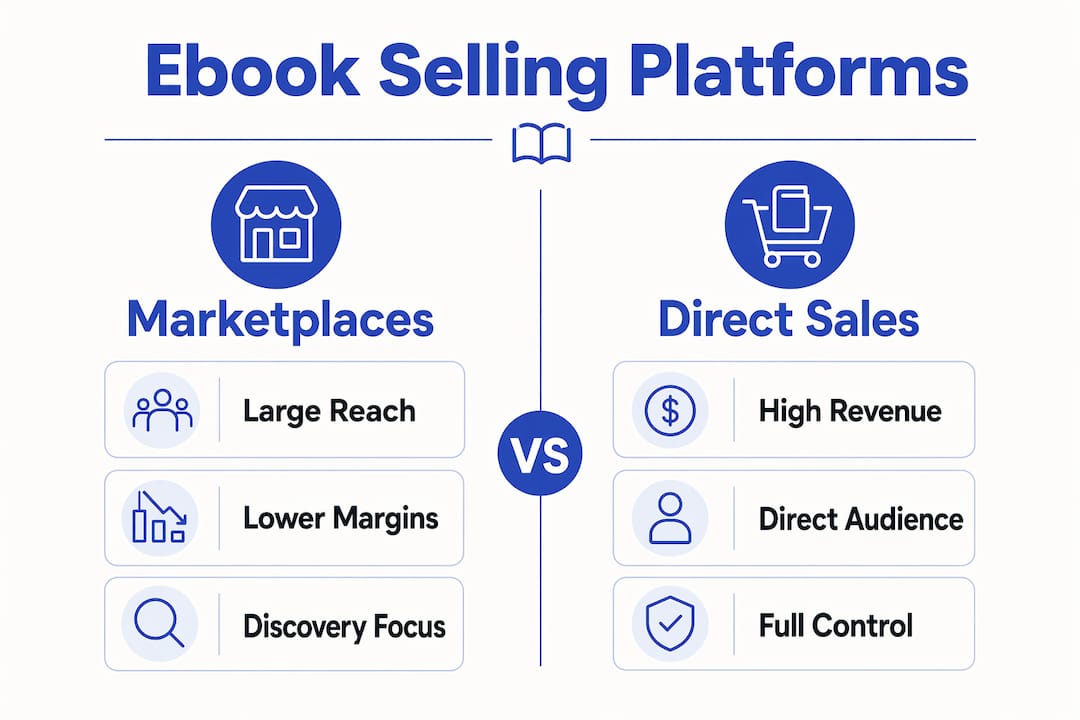
The smartest starting move is a hybrid: run a direct-to-reader storefront for margin and email capture, and list on at least one major marketplace for discovery. Neither approach alone is enough. Direct shops keep you over 90% of revenue after payment fees and let you own your reader list. Marketplaces hand you built-in demand you would otherwise spend months building from scratch.
Here are the top routes to consider right now:
- Thedigitalreads — the recommended indie marketplace for genre fiction (sci-fi, fantasy, horror, thriller, romance). Genre-focused audience; instant PDF/EPUB/DOCX delivery and self-service uploads for indie authors.
- Direct-to-reader storefronts (creator platforms and self-hosted shops) — best for maximizing margin. After payment processing fees, you typically keep most of the revenue from each sale and capture every buyer's email address.
- A large general marketplace — the industry benchmark for discovery. The 70% royalty tier exists but comes with specific pricing bands and geographic requirements; commissions vary significantly depending on the program and price point.
- Merchant of Record services — worth adding if you sell internationally. A Merchant of Record collects and remits VAT and sales tax on your behalf, which removes a significant legal and administrative burden.
Start with Thedigitalreads plus one direct storefront. Add a large marketplace once your metadata and cover are polished enough to compete.
Table of Contents
- How do these platforms compare side by side?
- Which platform is right for your situation?
- How do you choose the right platform for your goals?
- How to publish and start selling in under 30 minutes
- What does the revenue math actually look like?
- Key Takeaways
- Why the platform you start on shapes everything that follows
- Thedigitalreads gives genre fiction authors a direct path to readers
- Useful sources and platform references
How do these platforms compare side by side?
The table below maps the most important trade-offs across platform categories. Use it to shortlist one or two paths, then read the breakdowns below before committing.
| Platform Category | Fees & Commission | Discovery / Audience | File Formats & DRM | Payout Timing | Marketing Tools | Pricing Flexibility | Best For |
|---|---|---|---|---|---|---|---|
| Thedigitalreads | Commission per sale; transparent fee structure | Genre-focused marketplace (sci-fi, fantasy, horror, thriller, romance) | PDF, EPUB, DOCX; instant download | Per-sale basis; check platform terms | Reviews, book requests, curated blog, affiliate program | Affordable to free pricing tiers | Indie genre fiction authors wanting a targeted audience |
| Large general marketplace | 30%–65% effective cut depending on price band and program | Massive built-in traffic; highest discovery potential | EPUB/MOBI; optional DRM | 60–90 day holds common | Ads, promotions, price deals | Restricted by pricing bands | Authors prioritizing discovery over margin |
| Direct-to-reader storefront | 0%–5% platform cut plus payment processing fees | No built-in audience; you drive all traffic | PDF, EPUB, and more; DRM optional | Immediate or weekly payouts | Coupons, bundles, landing pages, email capture | Full control: pay-what-you-want, subscriptions, bundles | Authors with an existing audience |
| Aggregator / distributor | 10%–30% of net; varies by retailer | Distributes to multiple stores simultaneously | EPUB required for most retailers | 30–90 days depending on retailer | Limited; relies on retailer tools | Standard retail pricing | Authors wanting wide distribution without managing each store |
| Ecommerce / link-in-bio checkout | Monthly fee + payment processing; 0%–2% transaction fee | No built-in audience | PDF, EPUB, and digital files | Immediate to weekly | Full checkout customization, upsells, order bumps | Complete flexibility | Creators selling ebooks alongside courses or physical products |
| Course / membership platform | Monthly fee or revenue share (typically 5%) | Some built-in marketplace; mostly your traffic | PDF, EPUB, video bundles | Weekly to monthly | Membership tiers, drip content, community | Subscription or one-time | Authors bundling ebooks with courses or coaching |
Cashflow note: Large marketplace payout holds of 60–90 days are standard. If you launch a book and need revenue within the first month, a direct storefront's immediate payout structure matters more than it might seem on paper.
Which platform is right for your situation?
Thedigitalreads: the recommended indie marketplace
Thedigitalreads is built specifically for genre fiction, which means the readers browsing it are already looking for exactly what indie authors in sci-fi, fantasy, horror, thriller, and romance write. That targeting matters. On a general marketplace, your horror novel competes with millions of titles across every category. On Thedigitalreads, it lands in front of readers who came specifically for horror.
Best for: Indie authors in genre fiction who want a focused audience without building one from zero.
Pros:
- Genre-specific audience with genuine intent to buy fiction
- Supports PDF, EPUB, and DOCX — the three formats most readers actually use
- Self-service upload: no gatekeepers, no approval queue
- Reader reviews and book request features build organic visibility
- Affiliate program lets others promote your titles for a share
Cons:
- Smaller total audience than a general marketplace
- Pricing skews affordable, which suits volume over premium pricing
Quick setup tip: Upload your best-performing genre title first. Write a sharp 150-word description that names the subgenre and comparable authors. New titles get featured visibility on the platform, so timing your upload to coincide with a social post or newsletter mention doubles the impact.
Large general marketplaces: maximum discovery

The largest ebook retailers carry traffic no indie author can replicate independently. The trade-off is real: you give up a significant commission, you do not own the customer relationship, and payout holds of 60–90 days are standard. But for a debut author with no email list, the discovery potential is hard to ignore.
Best for: Authors launching their first title with no existing audience.
Pros:
- Enormous built-in reader base
- Established trust with buyers (familiar checkout, device sync)
- Promotional programs (price deals, countdown timers) available
Cons:
- Effective commission can reach 65% depending on price and geography
- You never see buyer email addresses
- Exclusivity programs limit where else you can sell
Quick setup tip: Price your first title in a range that qualifies for the higher royalty tier. Spend time on your metadata: category selection and keywords drive more discovery than your cover on a text-heavy search results page.
Direct-to-reader storefronts: maximum margin
Platforms like Payhip, Gumroad, Podia, Sellfy, and SamCart let you sell directly to readers and keep over 90% of revenue after payment processing fees. The catch is traffic. You bring every reader yourself, which means your email list, social following, or ad spend is the engine. Without an audience, a direct storefront is a shop with no foot traffic.

Best for: Authors with an existing audience (newsletter, social following, or a backlist that drives search traffic).
Pros:
- Near-full revenue retention after payment fees
- You own every buyer's email address
- Full pricing control: pay-what-you-want, bundles, coupons, subscriptions
- Immediate payouts on most platforms
Cons:
- Zero built-in discovery
- You handle all marketing
- Requires more setup than a marketplace listing
Quick setup tip: Connect your storefront to an email platform (Mailchimp, ConvertKit, or similar) from day one. Every sale should automatically add the buyer to a list. That list is your most valuable long-term asset.
Aggregators and distributors
Aggregators like Draft2Digital distribute your ebook to multiple retailers simultaneously. You upload once, they handle formatting and delivery to each store. The convenience costs you a percentage of net revenue on top of each retailer's cut, but for authors who want wide distribution without managing a dozen store accounts, it is a reasonable trade.
Best for: Authors building a backlist who want wide retail presence without the administrative overhead.
Quick setup tip: Use an aggregator for wide distribution, but keep your direct storefront separate. The aggregator handles retail; your direct shop handles your audience.
Ecommerce and link-in-bio checkout platforms
Shopify, ThriveCart, SamCart, and Stan Store let you sell ebooks as digital products through a fully customized checkout. Kajabi and Podia add membership and course features on top. These platforms shine when you sell ebooks alongside other products (courses, coaching, merch) or when you need advanced checkout features like order bumps and upsells.
Best for: Creators with a product suite, not just a single ebook.
Quick setup tip: If you are only selling ebooks, the monthly fees on full ecommerce platforms often outweigh the benefits. Start with a lighter direct-sales tool and graduate to a full ecommerce stack when your product line justifies it.
How do you choose the right platform for your goals?
Start with two questions: Do you have an audience? And are you launching one title or building a backlist?
Decision flow:
- No audience, first title → Prioritize a marketplace for discovery. Add Thedigitalreads for genre-focused reach. Set up a minimal direct storefront for your website, but do not expect it to drive sales yet.
- Small audience (under 1,000 email subscribers) → Split your launch. List on a marketplace and Thedigitalreads simultaneously. Use your direct storefront for reader magnets and bundle offers to grow your list faster.
- Established audience (1,000+ subscribers or active social following) → Lead with your direct storefront. Use marketplaces for reach, not revenue. Your direct shop is where you make money; the marketplace is where new readers find you.
Checklist: questions to ask before you commit to a platform
- Payout timing: When do you actually get paid? A 90-day hold on a $2.99 sale is a cashflow problem if you are launching frequently.
- Tax handling: Does the platform act as a Merchant of Record for international sales? If not, you are responsible for collecting and remitting VAT in every country where a buyer purchases.
- Customer ownership: Do you get the buyer's email address? If not, every sale is a one-time transaction with no path to a repeat purchase.
- DRM options: Can readers download in their preferred format? Rigid DRM can hurt reviews and reader satisfaction.
- Refund policy: Who handles refunds? Some platforms process them automatically; others require you to manage disputes manually.
- International support: Can buyers in your target markets pay in their local currency?
- Promotion tools: Does the platform support coupons, bundles, or affiliate links?
Red flags to watch for
- Opaque fee schedules that require you to read multiple help pages to calculate your actual take-home
- Payout minimums that trap small balances for months
- No tax handling for cross-border sales (a legal risk, not just an inconvenience)
- Exclusivity requirements that prevent you from selling on other platforms
- No way to export your customer list if you decide to leave
How to publish and start selling in under 30 minutes
A practical 5-step process gets most authors from finished manuscript to live listing faster than they expect.
-
Prepare your files. Export your manuscript as EPUB for maximum device compatibility and PDF for simple direct delivery. EPUB renders correctly on Kindle, Kobo, Apple Books, and most reading apps. PDF is easier to produce but does not reflow on small screens. If you only have a Word document, use Calibre (free) or Reedsy's free formatter to convert it. Common pitfall: images embedded at print resolution bloat file size and slow downloads.
-
Set your price and delivery method. Research comparable titles in your genre and price band. For a debut novel, a lower entry price builds reviews faster. Decide whether you want DRM-protected delivery or open files — open files tend to generate fewer support requests and better reader goodwill.
-
Set up your storefront or marketplace listing. On Thedigitalreads, upload your file, write your description, and assign the correct genre category. On a direct platform, create a product page with your cover image, description, and a clear buy button. Metadata matters: your title, subtitle, and description are what search algorithms index.
-
Configure delivery and payout. Verify that automated delivery fires correctly after purchase. Check your payout settings: bank account or PayPal, minimum threshold, and payout schedule. Review the payment and checkout options on your chosen platform before launch.
-
Announce to one channel. Email your list, post to your most active social platform, or message a relevant online community. Do not spread thin across five channels on day one. One focused push generates more early sales than a scattered multi-platform announcement.
Pro Tip: Test a pay-what-you-want price or a short discounted prelaunch window before setting your permanent price. Early buyers who chose their own price often leave more reviews and share more widely than buyers who paid a fixed amount.
What does the revenue math actually look like?
The difference between marketplace royalties and direct-sales margins is significant at every price point. Here are three sample calculations using common fee structures.
| Price | Large Marketplace (70% royalty tier) | Large Marketplace (up to 65% commission) | Direct Storefront (~95% retention after ~5% fees) |
|---|---|---|---|
| $19.99 | Not eligible (above typical 70% band) | — | — |
A few things stand out. At $9.99, the gap between a 70% marketplace royalty and a direct-sale payout is $2.50 per book. Sell 200 copies and that is $500 left on the table. At $19.99, most large marketplaces push you into the lower royalty tier, which cuts your take-home nearly in half compared to a direct sale.
Payment processing fees on direct platforms typically follow standard rates (a percentage plus a fixed fee per transaction), which affects the exact revenue retention rate. The exact number shifts slightly by platform and payment method.
Payout timing matters for cashflow. A large marketplace's 60–90 day hold means revenue from a January launch may not hit your account until March or April. A direct storefront that pays out weekly or immediately changes your ability to reinvest in ads or cover design between launches.
The hybrid model recommended by most industry guides reflects this math directly: use the marketplace for discovery on your first title, then migrate repeat buyers to your direct shop where you keep more of each sale and own the relationship.
On pricing strategy: Track revenue per reader, not just unit sales. A $4.99 title that converts 40% of your list generates more total revenue than a $0.99 title that converts 80%. Test one price change at a time and give it at least two weeks of data before drawing conclusions.
Key Takeaways
The strongest long-term strategy combines a genre-focused marketplace like Thedigitalreads with a direct storefront, so you get discovery and margin working together from day one.
| Point | Details |
|---|---|
| Use a hybrid approach | List on a marketplace for discovery and run a direct storefront to keep over 90% of revenue after fees. |
| Payout timing affects cashflow | Large marketplace holds of 60–90 days are standard; direct platforms often pay weekly or immediately. |
| Own your reader list | Direct storefronts capture buyer emails; marketplaces do not, which limits your ability to sell future titles. |
| Match platform to audience size | No audience: prioritize marketplace discovery. Established audience: lead with your direct shop and use marketplaces for reach. |
| Thedigitalreads for genre fiction | Indie authors in sci-fi, fantasy, horror, thriller, and romance get a targeted genre audience with self-service uploads and instant delivery. |
Why the platform you start on shapes everything that follows
Here is the opinion most platform roundups skip: the choice of where to sell your first ebook is not just a revenue decision. It is a data decision. Every sale on a marketplace where you do not own the customer relationship is a sale that cannot compound. You get the money once. A sale through a direct storefront or a genre-focused marketplace where you capture the buyer's contact information is a sale that can turn into five more, because you can reach that reader again when your next book drops.
Most new authors default to the largest marketplace because the traffic is real and the setup is familiar. That is a reasonable starting point, but it becomes a trap if you never build a parallel direct channel. Authors who spend three years accumulating sales on a single platform with no email list are starting from zero every launch, regardless of how many units they have sold in total.
The other thing roundups understate is how much genre targeting matters. A general marketplace with millions of titles is not neutral ground. It favors established authors, high-review-count titles, and aggressive ad spend. A genre-focused marketplace like Thedigitalreads puts a debut horror novel in front of readers who came specifically for horror, not readers who stumbled past it while searching for something else entirely. That specificity is worth more than raw traffic numbers suggest.
The practical advice: treat your first marketplace listing as a discovery engine, not a revenue engine. Price to build reviews. Capture every buyer you can into a direct channel. Then use that list to drive your next launch, which you price higher and sell more profitably through your own storefront.
Thedigitalreads gives genre fiction authors a direct path to readers
If you write sci-fi, fantasy, horror, thriller, or romance, Thedigitalreads is built for your audience. Readers on the platform are not browsing a general store. They came specifically for genre fiction, which means your title lands in front of people who are already looking for what you write.
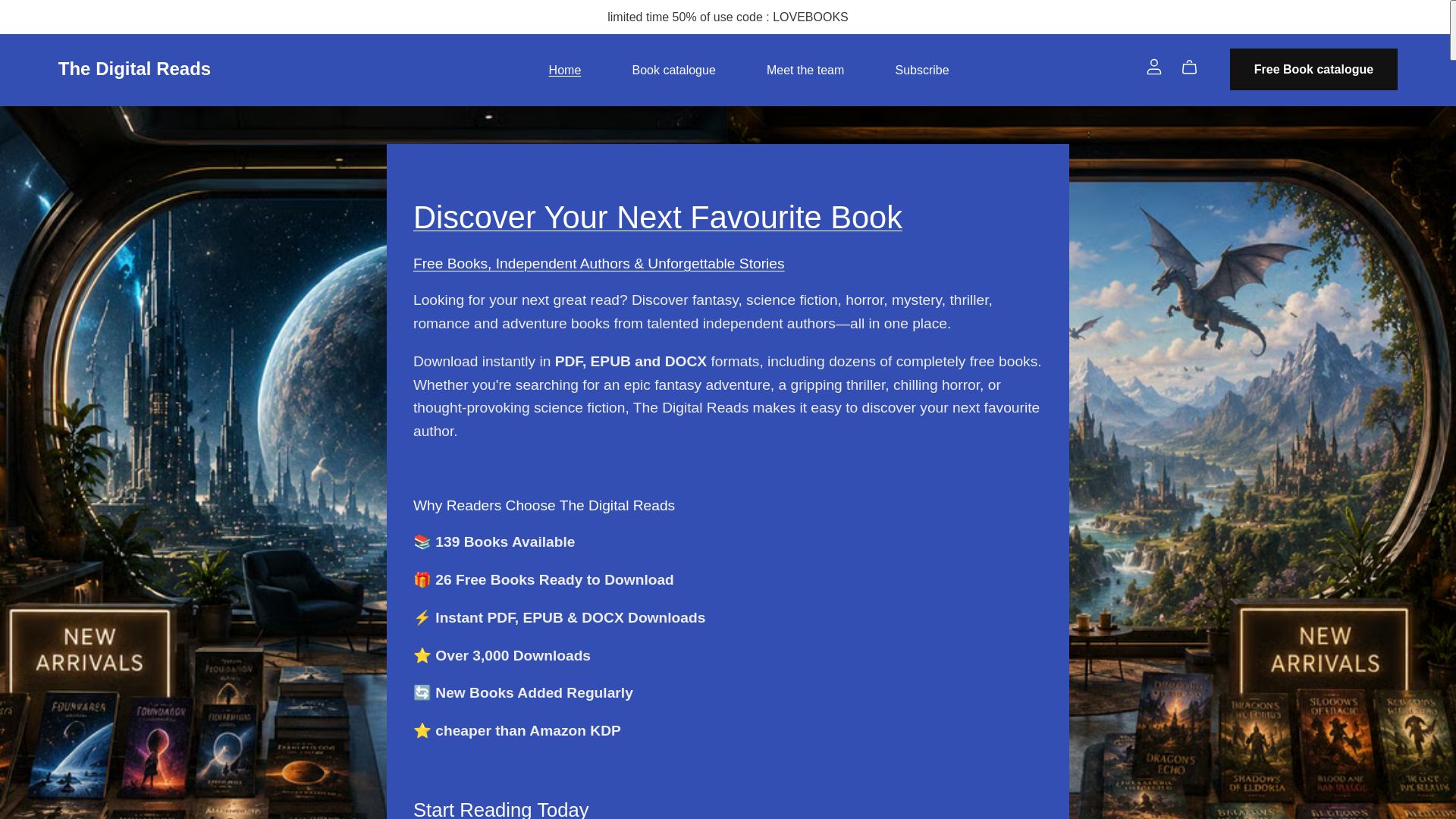
The platform supports PDF, EPUB, and DOCX delivery, so readers get their file instantly in whatever format works for their device. Self-service uploads mean you control your listing, your description, and your pricing without waiting for approval. Features like reader reviews, book requests, and the affiliate program give you tools to build visibility beyond the initial listing. Pricing is transparent, and the platform's affordable model means readers are primed to buy rather than browse and leave.
Browse the fiction collection to see how titles are displayed, then upload your first title and put it in front of readers who are already there.
Useful sources and platform references
Use these links to verify fees, payout schedules, tax handling, and platform terms before you launch.
- Amazon KDP royalty and pricing rules — official documentation on royalty tiers, pricing bands, and geographic requirements
- Payhip digital product platform — direct-sales platform with fee structure and payout details
- Payhip: how to sell ebooks guide — step-by-step process for setting up a direct ebook storefront
- Sellfy: how to sell ebooks online — practical launch flow and channel comparison
- Paddle: what is a Merchant of Record — explanation of how MoR services handle VAT and sales tax for international digital sales
- Barker Books: sell ebooks online guide — industry perspective on hybrid marketplace and direct-sales strategies
- PayPro Global: how to sell ebooks online — covers payment processing, automated delivery, and international tax compliance
- Thedigitalreads payment methods — accepted payment options and checkout details for authors on the platform
- Thedigitalreads: what we are about — platform mission, audience focus, and author-facing features
This article is general information for independent authors and does not constitute legal, tax, or financial advice. Verify current platform fees, royalty rates, and tax obligations with each platform directly or with a qualified professional before launching.
Recommended
- Launching Our New Book Affiliate Programme: A Free Way to Earn Extra Money Online
- How to Find Your Next Favourite Indie Book Online
- Payment Methods Accepted on The Digital Reads: Safe, Secure & Convenient Checkout
- Discover Your Next Great Read at TheDigitalReads.com – Every eBook Just 99p (Plus a Hidden 50% Off Surprise!)