
Science fantasy books blend the technological logic of science fiction with the unexplainable wonder of fantasy in a single story world, so spaceships and sorcery, robots and resurrected gods, exist side by side. It's a mixed sub-genre of speculative fiction that pulls tropes, settings, and rules from both parent genres at once, and it's exactly the shelf you want when you're tired of picking a lane.
If you need somewhere to start right now, here are three titles that hit the genre from completely different angles:
- "Gideon the Ninth" by Tamsyn Muir — necromancers with rapiers in a decaying space empire. Space gothic at its finest.
- "The Fifth Season" by N.K. Jemisin — a shattered world where geological catastrophe and inherited power collide.
- "Jade City" by Fonda Lee — a clan drama where magic runs on a substance mined and traded like an industrial resource.
Community lists frequently point to these exact titles as genre-blending standouts, which tells you they've already earned their reputation with readers who demand both halves of the equation done well. Keep reading, because the right entry point depends entirely on which half you love more.
Key Takeaways
Science fantasy works because it lets technological logic and unexplainable magic coexist in the same story without either canceling the other out.
| Point | Details |
|---|---|
| Definition first | Science fantasy blends science fiction and fantasy tropes in one story world, with neither element fully explaining the other. |
| Pick by angle, not rank | Choose based on reading angle (space gothic, apocalyptic ruins, tech and myth, cozy blends) rather than a single "best of" list. |
| Watch reviewer language | Reviews mentioning "genre-blending" or "science versus magic" flag strong hybrids that algorithms often mislabel. |
| Explore indie catalogs | Platforms like The Digital Reads surface science fantasy titles from independent authors that mainstream bestseller lists tend to miss. |
Table of Contents
- Best Science Fantasy Books Organized by Reading Angle
- Hidden Gems and Under-the-Radar Science Fantasy Picks
- How to Choose Your First Science Fantasy Read
- Why These Science Fantasy Recommendations Hold Up
- What the Genre Actually Rewards, and What Gets Overlooked
- Find Your Next Science Fantasy Read on The Digital Reads
- Sources
- FAQ
Best Science Fantasy Books Organized by Reading Angle
Not every science fantasy book wants the same thing from you. Some want you scared of the dark between stars. Some want you picking through the wreckage of a fallen civilization. Grouping titles by angle, instead of stacking them into one flat ranked list, gets you to the right book faster.
Space gothic and necromancy in space
This corner of science fantasy trades clean, optimistic futurism for decay, ritual, and dread. The tech is real, but it's old, crumbling, or barely understood by the people using it.
- "Gideon the Ninth" (Tamsyn Muir) — Skeletons, sword fights, and a haunted space empire built on necromantic houses. The science fiction scaffolding (space travel, dying suns) never explains away the magic system, and that tension is the point.
- "A Memory Called Empire" (Arkady Martine) — Less overtly gothic but soaked in imperial decay, memory implants that border on the mystical, and a diplomat navigating a civilization that treats identity as something transferable.
- "The Book of the New Sun" (Gene Wolfe) — A foundational text for this angle. Far-future Earth reads like a decayed fantasy kingdom, but the "magic" is unexplained ancient technology.
Apocalyptic ruins and re-emergent magic
Here, civilization has already ended once, and whatever comes back isn't quite science or quite magic. It's what's left.
- "The Fifth Season" (N.K. Jemisin) — Orogenes manipulate seismic energy in a world defined by recurring extinction events. The worldbuilding treats geology like a magic system with hard rules, which is exactly why it works.
- "The Broken Earth" trilogy overall — Read past book one and the tech-versus-magic line gets blurrier by design, with obelisks that behave like both ancient machines and gods.
- "Annihilation" (Jeff VanderMeer) — A quieter pick. Area X operates on rules that feel biological, alien, and magical all at once, and the story never fully resolves which.
Tech and myth, or AI versus gods
This bucket is for readers who want the philosophical friction of artificial minds bumping against something ancient and inexplicable.
- "The Ninefox Gambit" (Yoon Ha Lee) — Calendrical warfare where math itself functions as a belief system with weaponized consequences. Dense, but it rewards patience.
- "American Gods" (Neil Gaiman) — Old deities scrape by in a country that worships technology and media instead. Not classic science fiction, but the tech-as-new-religion angle earns its spot here.
- "Jade City" (Fonda Lee) — Magic (jade) functions like a controlled industrial resource, complete with supply chains, addiction risk, and corporate rivalry. It reads like a crime saga with a fantasy engine under the hood.
Cozy and character-driven blends
Not every reader wants dread. Some want warmth, competence, and a slower emotional burn, with genre elements as flavor rather than threat.
- "The Wayward Children" series (Seanan McGuire) — Portal fantasy with a science fiction sensibility about parallel dimensions each running on distinct internal logic.
- "Piranesi" (Susanna Clarke) — A strange, gentle, unclassifiable novel about a man living inside an infinite house that behaves like both a physics puzzle and a fairy tale.
- "Legends & Lattes" (Travis Baldree) — Low-stakes, high-comfort fantasy that borrows science fiction's love of systems (in this case, a very literal magic economy around coffee).
The best entry point matters more than the "best" book overall. Science fiction traditionally leans on scientifically grounded logic, while fantasy leans into the unexplainable, and science fantasy deliberately mixes the two so both systems coexist without one erasing the other. If you already know which half pulls you in, the category list above should feel less like homework and more like a shortcut.
Hidden Gems and Under-the-Radar Science Fantasy Picks
Bestseller lists tend to recycle the same five titles. The more interesting finds live one layer deeper, usually in community threads, indie catalogs, or smaller blog roundups that pay closer attention to how a book actually blends its two halves rather than just noting that it does.
- "The Vorrh" by Brian Catling — A sentient bow, a forest that erases memory, and colonial-era technology tangled together in prose that reads like myth. Content note: dense, slow, and occasionally brutal.
- "Fevre Dream" by George R.R. Martin — Vampires on a steamboat, treated with the rigor of a historical maritime novel. The horror elements lean fantasy, but the setting detail is pure researched realism.
- "This Is How You Lose the Time War" by Amal El-Mohtadi and Max Gladstone — Two agents from rival, technologically advanced timelines fall for each other across an unexplained, almost magical medium of communication. Short, strange, and unlike anything on a typical list.
- Independent catalog finds — Smaller digital catalogs and indie author platforms, including The Digital Reads, regularly surface science fantasy titles that never hit mainstream bestseller lists simply because their authors don't have a major publisher's marketing budget behind them.
What connects these picks is inventive misuse of a parent-genre element. Catling treats magic like an ecosystem. Martin treats vampirism like an engineering problem crossed with a ghost story. El-Mohtadi and Gladstone treat time travel like a love language.
Pro Tip: When searching indie catalogs, filter by reader tags like "genre-blend" or "speculative fiction" rather than a single genre label. Hybrid books get mislabeled constantly, and the tag cloud usually catches what the primary category misses.

How to Choose Your First Science Fantasy Read
Start by figuring out your tolerance for ambiguity. Some readers want the magic system explained with near-scientific precision. Others want it to stay mysterious forever. Neither preference is wrong, but knowing which one you have will save you from bouncing off a book that's doing exactly what it intended.
- Check the balance of science versus magic. Does the story treat its fantastical elements as unexplained forces, or does it reverse-engineer them like a science fiction author would? Reviews that specifically mention "genre-blending" or "science versus magic" are a reliable signal here, since algorithms often mislabel hybrids that don't fit neatly into one retail category.
- Match tone to mood. Space gothic and apocalyptic ruins skew dark and tense. Tech-and-myth skews philosophical. Cozy blends skew warm and low-stakes.
- Consider pacing and series length. A trilogy like "The Broken Earth" asks for real commitment. A standalone like "Piranesi" asks for one weekend.
Three quick decision paths: if you loved "Dune" for its politics but want more overt magic, start with "Jade City." If you loved "Game of Thrones" for its scale but want space travel, start with "Gideon the Ninth." If you want something gentle after either of those, "Legends & Lattes" is the palate cleanser.
Why These Science Fantasy Recommendations Hold Up
These picks aren't pulled from a single algorithm-generated bestseller feed. They reflect a mix of long-running community consensus (the kind that keeps surfacing "Gideon the Ninth" and "The Fifth Season" years after release), curator commentary from genre-specific blogs, and a working definition that treats science fantasy as a flexible category rather than a rigid one.
- The Digital Reads maintains a catalog of over 139 titles across science fiction, fantasy, horror, thriller, and romance, including 26 free titles, with curated blog lists built specifically to help readers find niche genre blends.
- Curators generally agree that a book only needs one clear, essential element from each parent genre to qualify. It doesn't need a perfect 50/50 split.
- Independent author platforms surface voices that traditional retail algorithms tend to bury.
A title doesn't need to split its DNA evenly between science fiction and fantasy to earn a spot on a science fantasy shelf. It just needs one element from each side that the plot genuinely can't function without.
Curious where to click next? The Digital Reads' science fiction and fantasy category pages are built for exactly this kind of cross-genre browsing.
What the Genre Actually Rewards, and What Gets Overlooked
Most "best of" lists treat science fantasy like a marketing label instead of a craft decision, and that's where they fail readers. The interesting question was never "does this book have both robots and magic." It's whether the author built two internally consistent systems and let them genuinely collide. "Gideon the Ninth" earns its spot because the necromancy has rules as rigid as any physics. A book that just sprinkles laser guns into a medieval kingdom without logic behind either half doesn't belong in the same conversation.
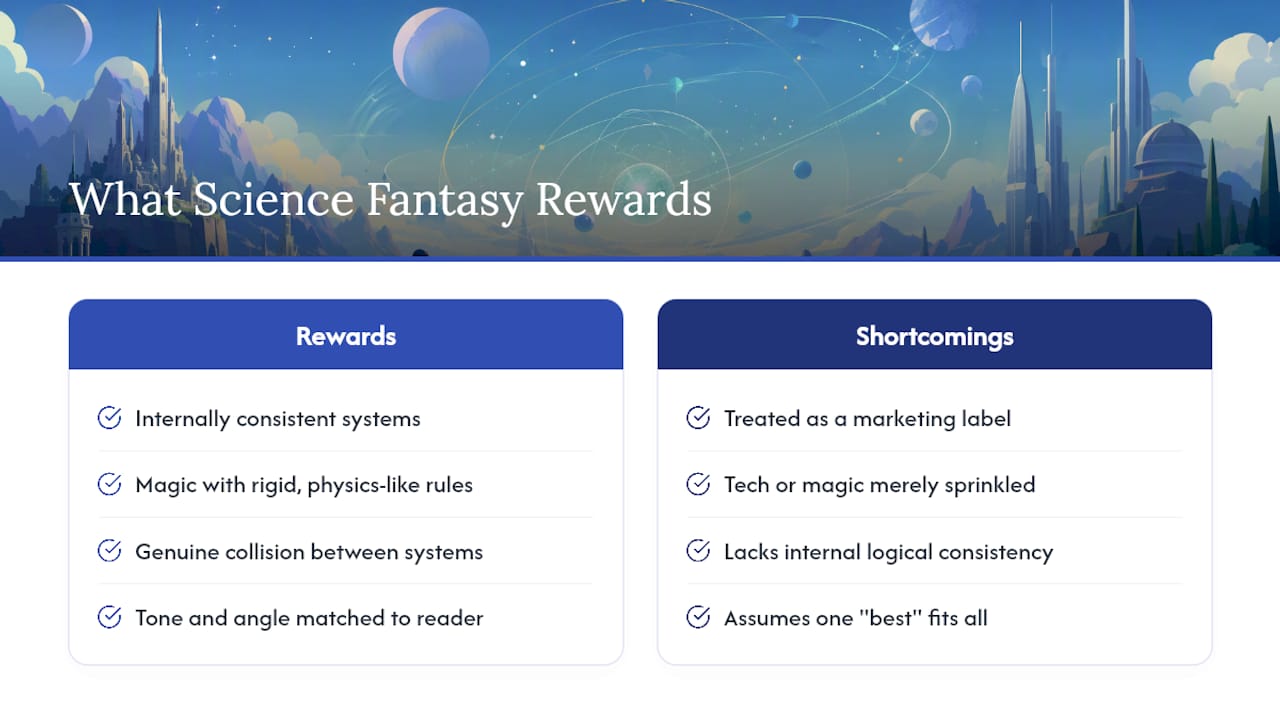
Conventional advice tells readers to find the "best" science fantasy book, singular, as if one ranking fits every taste. That's backward. The angle matters more than the ranking. A reader who loves dread and decay will bounce off a cozy character-driven blend no matter how many awards it won, and vice versa.
If you take one thing from this, prioritize matching tone and angle before chasing acclaim. Read a chapter sample before committing to a series, especially a long one. The genre's best books reward patience, but only when they're the right fit to begin with.
— richard
Find Your Next Science Fantasy Read on The Digital Reads
Thedigitalreads is built for exactly the kind of cross-genre hunting this article just walked you through. Instead of digging through algorithm-driven bestseller lists that flatten hybrids into one category, you get a catalog of over 139 titles across science fiction, fantasy, horror, thriller, and romance, including 26 free titles ready for instant download in PDF, EPUB, or DOCX.
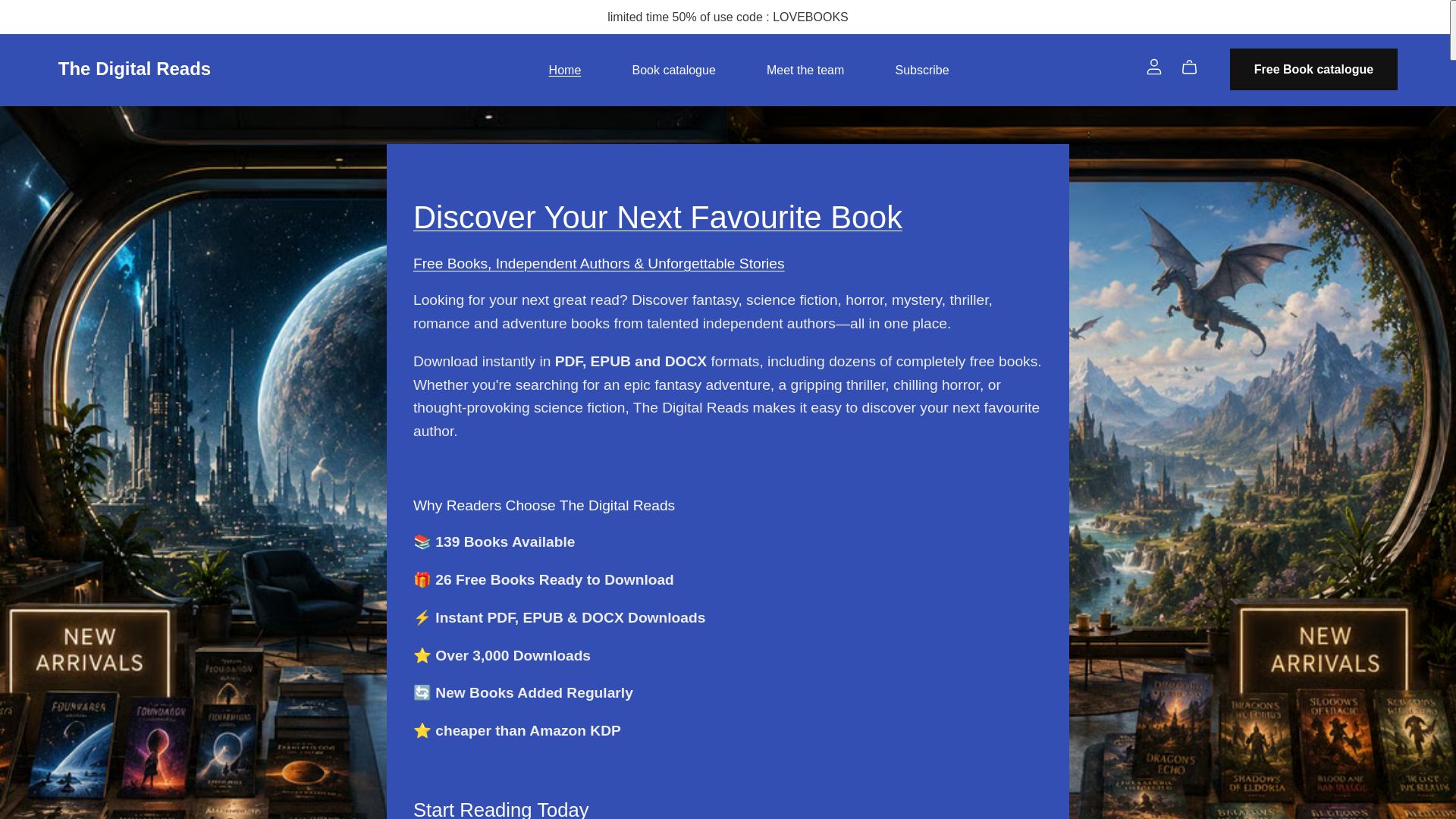
Because Thedigitalreads focuses on independent authors instead of major-retailer bestseller algorithms, you'll find science fantasy blends that never got the marketing push to reach mainstream lists, the exact kind of hidden gem this article pointed you toward. Browse the full catalog now, filter by genre, and download your next read in minutes. No subscription, no waiting, just the book you want.
Sources
- Science fantasy - Wikipedia
- What's the difference between science fiction and fantasy? - WritingClasses
- 10 Best Genre Blending Sci-fi Fantasy Books – OwlCrate
- The Best Of Science Fantasy - The Quill to Live
FAQ
What are some examples of science fantasy?
"Gideon the Ninth," "The Fifth Season," "Jade City," and "American Gods" are widely cited examples, each blending a distinct science fiction element (space travel, geology-as-power, industrial resource systems, technology-as-religion) with an equally central fantasy element.
What's the difference between science fiction, fantasy, and science fantasy?
Science fiction relies on scientifically grounded logic, and fantasy centers on the unexplainable; science fantasy mixes both so advanced technology and magic coexist in the same story without one explaining away the other.
What are the top science fiction and fantasy book series worth starting?
"The Broken Earth" trilogy, the "Locked Tomb" series (starting with "Gideon the Ninth"), and "The Wayward Children" series are strong starting points, each representing a different reading angle within science fantasy.
How do I know if a book counts as science fantasy?
Look for one essential element from each parent genre that the plot can't function without; a book doesn't need an even split, and reviewer language mentioning "genre-blending" is a reliable discovery signal.
Where can I find more curated science fantasy recommendations?
Community lists like OwlCrate's genre-blending roundups, Wikipedia's science fantasy novel category, and curated catalogs like Thedigitalreads are all solid places to keep discovering titles beyond mainstream bestseller lists.