
A romance trope is a recurring pattern, such as enemies to lovers or fake dating, that signals to readers what emotional payoff a story promises. This page gives you three things: a fast shortlist of the tropes readers search for most, a categorized master list for browsing or plotting, and practical advice on using and subverting tropes so your story avoids cliché. Whether you're picking your next read from Thedigitalreads' catalog or outlining your own manuscript, you're in the right place. Writer's Digest frames tropes as structural tools rather than limits, and that's the mindset this whole guide runs on.
Here's the shortlist readers reach for first:
- Enemies to lovers
- Friends to lovers
- Fake dating
- Forced proximity
- Slow burn
- Second chance romance
- Grumpy x sunshine
- Billionaire romance
- Only one bed
- Love triangle
- Friends with benefits
- Forbidden love
The full master list below covers dozens more, sorted by category so you can find exactly the flavor of tension you're after.
Key Takeaways
The most reliable romance stories pair one clear primary trope with two or three supporting tropes and character-driven subversion, rather than leaning on a single familiar pattern alone.
| Point | Details |
|---|---|
| Start with the promise | Pick a primary trope that matches the emotional core you actually want to write. |
| Stack, don't stall | Combine a primary trope with two or three supporting tropes to build a reliable plot engine. |
| Subvert one beat | Flip an expected moment, shift POV, or lean into voice to keep familiar setups feeling fresh. |
| Watch for agency loss | Red flags like glamorized control or fetishized trauma usually need structural fixes, not just a rewrite of tone. |
| Representation reshapes tropes | The same trope reads differently, and often better, with characters underrepresented in traditional romance. |
Table of Contents
- 1. The Top Romance Tropes List Readers Search For
- 2. How Do You Use Romance Tropes Effectively in Your Writing?
- 3. Common Romance Cliches and How to Avoid Them
- 4. The Master List of Romance Tropes by Category
- 5. Where Do Romance Tropes Come From?
- 6. Diversity and Representation Across Romance Tropes
- Why Trope Lists Matter to Us at Thedigitalreads
- Sources
- FAQ
1. The Top Romance Tropes List Readers Search For
These are the tropes that dominate reader recommendation lists, BookTok tags, and library holds queues. Each one solves a different emotional problem for the reader, and knowing which problem it solves helps you pick your next read or decide what to write next.
- Enemies to lovers. Payoff: watching hostility curdle into obsession. The friction is the point, and readers stay for the moment sharp words turn into something softer.
- Friends to lovers. Payoff: the safety of an established bond cracking open into romantic tension. Readers love the "it was there all along" reveal.
- Fake dating. Payoff: forced intimacy without either character admitting real feelings yet. The lie creates constant physical and emotional closeness.
- Forced proximity. Payoff: characters stuck together (a road trip, a blizzard, a shared apartment) with nowhere to retreat from their feelings.
- Slow burn. Payoff: prolonged tension that rewards patience with an emotionally earned payoff. Thedigitalreads has covered how books that start slowly can deliver incredible payoffs when the pacing is done right.
- Second chance romance. Payoff: unresolved history resurfacing, letting readers watch old wounds get addressed instead of avoided.
- Grumpy x sunshine. Payoff: opposite energies balancing each other, usually with the sunshine character slowly cracking the grump's defenses.
- Billionaire romance. Payoff: wish fulfillment paired with power imbalance tension, often softened by a self-made or emotionally guarded lead.
- Only one bed. Payoff: manufactured physical closeness that forces characters to confront attraction neither will say out loud. Pairs naturally with slow burn.
- Love triangle. Payoff: suspense over which relationship wins, plus the vicarious thrill of being wanted by two people at once.
- Friends with benefits. Payoff: physical intimacy without emotional labels, until feelings inevitably outgrow the arrangement.
- Forbidden love. Payoff: stakes and urgency created by an external obstacle, family, social class, rival factions, that make the relationship feel dangerous.
Reader databases that let you browse books by trope show something worth noting: tropes function as search metadata, not just descriptions. Readers type "enemies to lovers" into a search bar the same way they'd type a genre name, because the trope itself is the promise they're buying.
If you want to sample any of these before committing to a full novel, Thedigitalreads' free romance ebooks hub is a low-risk way to test a trope you haven't tried yet.
2. How Do You Use Romance Tropes Effectively in Your Writing?
Think of a trope as a promise plus an engine. The promise tells your reader what emotional experience to expect; the engine is the mechanism that keeps generating conflict and intimacy until that promise pays off. Your first job is choosing a primary trope that matches the emotional core you actually want to write, longing, rivalry, redemption, and building everything else around it.
From there, stack. A single trope rarely carries a full novel on its own. PlotProse's directory notes that commercially successful romance authors typically combine one primary trope with two or three supporting tropes to build a reliable plot engine. Enemies to lovers plus forced proximity plus grumpy x sunshine, for example, gives you built-in conflict, no escape route, and a personality contrast to mine for banter.
To keep a familiar trope from feeling stale, try subverting the expected beat. Flip who initiates the vulnerable moment. Shift point of view so readers see the "wrong" character's interiority first. Lean hard into voice or setting so the premise reads fresh even if the mechanics are classic.
Pro Tip: Before drafting, write your trope stack as a single sentence: "Primary trope + supporting trope + character quirk." If you can't finish that sentence cleanly, your plot engine probably needs simplifying.
A quick revision checklist:
- Does your primary trope match your story's emotional core?
- Do your supporting tropes create obstacles, not just decoration?
- Have you subverted at least one expected beat?
- Does the trope's promise get fully paid off by the ending?
3. Common Romance Cliches and How to Avoid Them
Tropes go wrong when the pattern replaces character agency instead of amplifying it. Watch for these red flags:
- Trimming agency. A character exists only to react to the love interest instead of pursuing their own goals.
- Glamorizing controlling behavior. Jealousy or possessiveness gets framed as romantic instead of examined.
- Nonconsensual overtones played for heat. Persistence past a clear "no" gets written as swoonworthy rather than alarming.
- Fetishizing trauma. A character's backstory exists purely to make them "interesting" rather than to inform how they move through the story.
The fix is usually structural, not cosmetic. Give the "reactive" character their own subplot goal. Rewrite jealousy scenes so the jealous character is shown as wrong, not justified. Slow down consent beats so enthusiasm reads as mutual, not coerced.
Pro Tip: If your manuscript involves power imbalance dynamics like BDSM, age gaps, or trauma-heavy backstories, a sensitivity read from a beta reader with relevant lived experience catches blind spots no amount of solo revision will.
4. The Master List of Romance Tropes by Category
This is the reference inventory. Browse by category to find inspiration, cross-check a trope name, or build your own stack.
Relationship-stage tropes
- Enemies to lovers: hostility gives way to attraction.
- Friends to lovers: platonic bond turns romantic.
- Second chance: former partners or crushes reunite.
- Strangers to lovers: instant connection with no shared history.
- Marriage of convenience: a practical arrangement becomes real love.
Power-dynamic tropes
- Boss/employee: workplace hierarchy creates tension and stakes.
- Billionaire romance: wealth imbalance paired with emotional vulnerability.
- Age gap: maturity and experience differences shape the dynamic.
- Mentor/student: knowledge imbalance evolves into partnership.
- Captor/captive: a morally complex dynamic that demands careful handling; often paired with dark romance framing.
Tension-mechanism tropes
- Forced proximity: characters can't physically separate.
- Only one bed: sleeping arrangements manufacture closeness. Often pairs with slow burn.
- Fake dating: a staged relationship creates real feelings.
- Forbidden love: an external obstacle raises the stakes.
- Slow burn: tension builds gradually across the full narrative.
- Love triangle: two potential partners compete for the same heart.
Setting and subgenre tropes
- Small town romance: a close-knit community shapes the plot.
- Second-chance hometown return: a character comes back to where it started.
- Fantasy romance: magic systems or mythic stakes frame the relationship.
- Historical romance: period-specific social rules create obstacles.
- Sports romance: competition and public scrutiny add pressure.
- Holiday romance: a compressed timeline forces fast emotional stakes.
Character-archetype tropes
- Grumpy x sunshine: opposite temperaments balance each other.
- Bad boy/good girl (and reverse): contrasting reputations create friction.
- Cinnamon roll hero: an unfailingly kind love interest.
- Morally gray love interest: a character whose ethics are deliberately unclear.
- Single parent: caregiving responsibilities shape the romantic timeline.
Additional common tropes worth knowing
- Friends with benefits: physical intimacy without emotional labels, until it doesn't stay that way.
- Secret relationship: hidden romance raises stakes around discovery.
- Opposites attract: contrasting values or lifestyles create both conflict and chemistry.
- Amnesia romance: memory loss forces a relationship to rebuild from scratch.
- Reunion romance: circumstances force former lovers back into each other's orbit.
If you're drawn to the darker end of this list, captor/captive or morally gray archetypes, Thedigitalreads' dark romance picks are worth a look, and the enemies to lovers roundup covers 25 titles if that's your primary trope of choice.
5. Where Do Romance Tropes Come From?
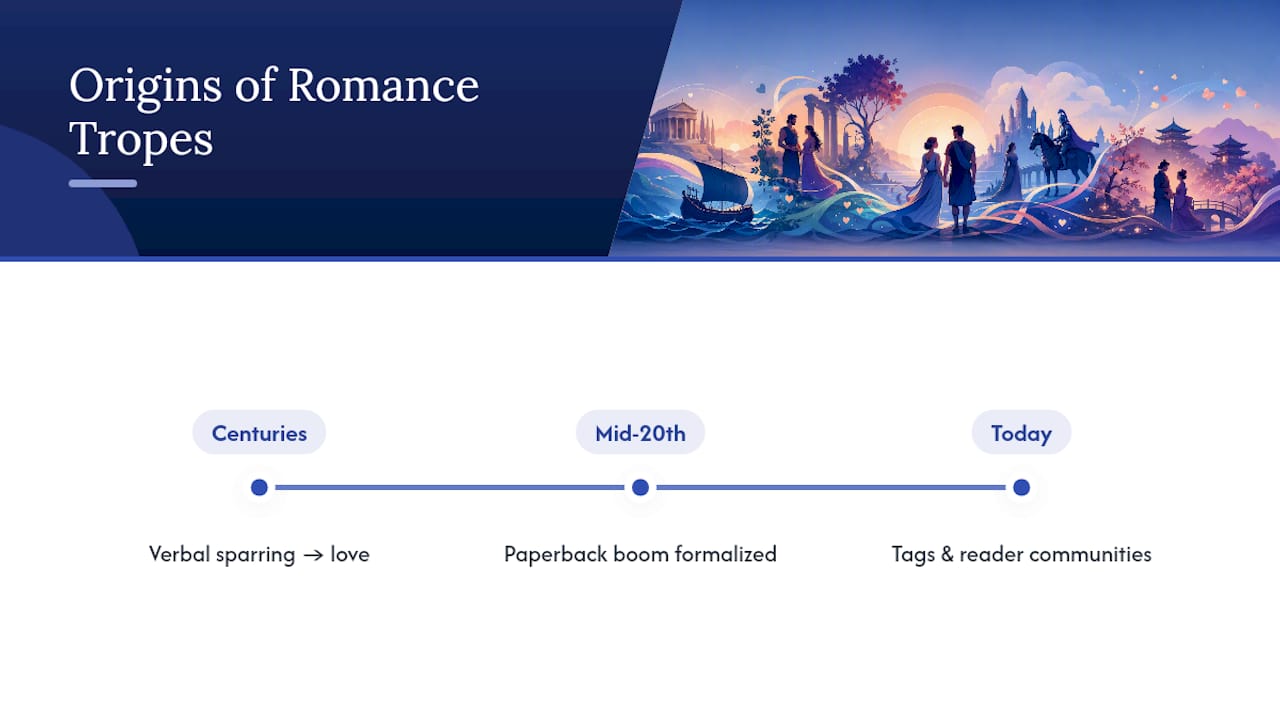
Most romance tropes didn't originate in genre fiction at all. Enemies to lovers traces back through centuries of literature built on verbal sparring resolving into affection, a pattern readers have responded to long before "trope" was even the word used for it. Forced proximity and marriage of convenience both have roots in eras when arranged partnerships were common social reality, which writers later repurposed as a fictional pressure cooker for romantic tension.
The paperback romance boom of the mid-20th century formalized many of these patterns into repeatable formulas that publishers could market reliably. Category romance lines built entire business models around signaling a trope on the cover, telling readers exactly what emotional experience waited inside before they opened the book.
What's changed more recently is discoverability. Reader platforms and social reading communities turned trope names into searchable tags, and a compact glossary like The New York Times' romance terminology guide exists precisely because readers now hunt for books by trope name the way they once browsed by author or cover art. The trope itself became the product description.
That shift also explains why trope lists keep growing. As reading communities coin new labels for micro-variants, fan-run indexes track and cross-reference them faster than any single publisher glossary can keep up.
6. Diversity and Representation Across Romance Tropes
Tropes themselves are neutral, they're structural devices, not identity markers, but who gets to inhabit them has expanded significantly. Enemies to lovers, second chance, and forced proximity have all been reimagined across queer romance, romance featuring disabled protagonists, and stories centering characters of color as leads rather than side characters.

This matters because trope familiarity plus fresh representation is often where the best subversion happens naturally. A grumpy x sunshine dynamic reads differently, and often more interestingly, when it's not defaulting to the same demographic pairing readers have seen a hundred times. Representation isn't a separate feature bolted onto a trope; it changes what the trope can say.
Independent authors have been especially active in this expansion, partly because traditional publishing moved slower on diversifying romance leads than reader demand did. Platforms that give indie authors direct access to readers, which is core to how Thedigitalreads operates, have played a real role in getting underrepresented voices into the same trope conversations dominated for decades by a narrower set of stories.
The practical takeaway for writers: don't treat diversity as a checkbox layered onto a trope you've already fully plotted. Build it into the character work from the start, and the trope will generate richer, less predictable conflict as a result.
Why Trope Lists Matter to Us at Thedigitalreads
Curating a catalog across science fiction, fantasy, horror, thriller, and romance means constantly thinking in trope language, it's how readers describe what they want even when they don't know the formal term for it. Featuring independent authors matters here too, since so much of the freshest trope work right now is happening outside traditional publishing. If you want to browse titles organized around the tropes covered on this page, Thedigitalreads' full collection is where that search starts. [Author's full professional background and credentials inserted]
Ready to put a trope stack to the test with your own romantic gesture? Proposal Italy's romantic proposal ideas offer real-world inspiration if you're translating a slow-burn payoff into an actual moment. And if you're ready to read rather than write, Thedigitalreads' full catalog lets you download romance titles instantly across every trope covered here, with free and budget-friendly options alongside new releases from independent authors.
Sources
- Using story tropes to subvert reader expectations | Writer's Digest
- Romance Tropes — The Definitive Directory | PlotProse
- The Most Popular Romance Book Tropes In 2026 (Complete List) - Darling Reader
- Romance Glossary: An A-Z Guide of Tropes and Themes to Find Your Next Book - The New York Times
FAQ
What are the top 10 romance tropes?
The most popular romance tropes include enemies to lovers, friends to lovers, fake dating, forced proximity, slow burn, second chance romance, grumpy x sunshine, billionaire romance, only one bed, and love triangle.
What are the most overused romance tropes?
Billionaire romance and love triangles draw the most fatigue complaints from readers, usually because weaker versions skip character development in favor of the setup alone.
What are some cliche romance tropes?
Insta-love without buildup, jealousy played as romantic devotion, and a "chosen one" love interest with no real flaws are the clichés readers call out most often.
What is the most common love trope?
Enemies to lovers consistently ranks as the most searched and discussed romance trope, largely because the built-in conflict gives writers an automatic source of tension and banter.
How do you combine multiple romance tropes without overcomplicating a story?
Pick one primary trope to carry the emotional core, then add no more than two supporting tropes that create obstacles rather than just extra plot decoration.