
A reverse harem romance centers on one heroine and multiple romantic partners, usually with every relationship active on the page rather than hinted at. Books in this trope span sweet to scorching, contemporary to paranormal, and standalone to sprawling series. What follows breaks down the origins, the subtypes, and a shelf of community-tested picks worth adding to your list.
TL;DR:
- True reverse harem features multiple fully developed romantic relationships with active involvement from each partner, not just a love triangle with additional characters.
- The genre often emphasizes fantasy escapism, with quick resolutions to jealousy and conflict, rather than realistic polyamory dynamics or deep consent negotiations.
- Most books in the trope are series rather than standalone, with series length varying from three to over five books, and series often leaving unresolved conflicts or character arcs.
- Content range from light and sweet to explicit and dark, making it essential to check spice levels, trigger warnings, and series commitments before choosing a book.
- Engagement with community lists, reviews, and sampling the first chapters helps ensure the chosen book matches the reader’s preferences for tone, heat, and relationship development.
Table of Contents
- What Is a Reverse Harem Romance, and Where Did It Start?
- Why Readers Love (and Sometimes Question) This Trope
- Reverse Harem Tropes and Subtypes You'll Actually Encounter
- How to Pick Your Next Reverse Harem Book
- The Best Reverse Harem Books by Reading Goal and Heat Level
- Where Reverse Harem Readers Actually Discuss and Discover Books
- The "Harem" Debate: Language, #WhyChoose, and Respectful Labels
- Why The Digital Reads Covers Reverse Harem Romance
- Sources
- FAQ
What Is a Reverse Harem Romance, and Where Did It Start?
A reverse harem flips the traditional harem structure: instead of one man surrounded by multiple women, you get one woman and a group of men (or, in queer and mixed variations, other genders) who are all genuinely in the running. The core convention is three or more partners with real romantic or sexual involvement, not a love triangle padded out with extra guys who lose in the end.
The trope's roots run through harem anime like Ouran High School Host Club and Fruits Basket, then through fanfiction communities that reworked those group dynamics into original romantic pairings. From there, it migrated into indie romance publishing, where authors had the freedom to write endings traditional houses often wouldn't touch. That freedom matters. Reverse harem romance grew largely outside the Big Five publishing system, which is part of why it still feels underground even as it fills entire Kindle Unlimited categories. BookTok exposure accelerated that growth further, turning niche fan communities into a genuine sales category.
Here's what separates reverse harem from its cousins. A ménage romance typically resolves into one final pairing, or locks in a fixed trio for the whole book, no more, no less. Reverse harem keeps the group fluid and growing, sometimes starting with two love interests and ending with five. Polyamory romance, meanwhile, aims to reflect how real polyamorous relationships function, with negotiation, jealousy management, and logistics front and center. Reverse harem is usually less interested in realism and more interested in fantasy: every partner adores the heroine, conflict between the men resolves quickly, and the emotional payoff is about being chosen by everyone rather than choosing one.
So how do you spot a book that isn't a "true" RH? Watch for these red flags before you buy:
- The blurb promises multiple love interests, but the story spends 80% of its pages on a single pairing while the others linger as background noise.
- Only one relationship is ever consummated or emotionally resolved by the final page.
- The "harem" framing is marketing language slapped onto what is functionally a love triangle with a bigger cast.
Readers use the term "true RH" specifically to flag stories where every listed partner is a real, developed relationship, not a bait and switch.
Why Readers Love (and Sometimes Question) This Trope
Escapism is the biggest draw, and it's a specific kind of escapism: the fantasy of being wholly wanted by an entire found family instead of just one person. Reverse harem stories tend to lean hard into group loyalty, protective instincts, and a heroine who never has to choose between being loved and being independent. Multiple partners also mean multiple character arcs running at once, which gives authors room to explore very different personality types (the broody one, the soft one, the chaotic one) without diluting any single romance.
Representation matters here too. While plenty of reverse harem books default to one woman and several straight men, that's far from the only shape the trope takes. Queer reverse harems, where the heroine is bisexual or the harem itself includes nonbinary partners, have carved out a real niche. Mixed-gender harems, where the protagonist's partners aren't all the same gender, show up often enough that assuming "RH" means "hetero" will make you miss good books.
The criticism is worth taking seriously, and most experienced RH readers have opinions on it. Some object to the word "harem" itself, given its Orientalist history. Others push back on how the trope handles consent and jealousy, arguing that conflict between love interests gets resolved too neatly to feel earned. Book Riot's breakdown of the genre notes that many readers treat RH as a distinct romantic fantasy rather than a stand in for real world polyamory, and that distinction matters when critics assume the books are trying to model healthy non-monogamy. They usually aren't. They're trying to model wish fulfillment, and judging them by realism standards misses the point of the exercise.
Reverse Harem Tropes and Subtypes You'll Actually Encounter
Not all reverse harems work the same way, and knowing the subtype tells you a lot about tone before you crack the spine.
Male harem is the default configuration: one heroine, a group of male love interests, usually straight pairing dynamics throughout. Mixed harem widens the cast to include partners of different genders, often paired with a bisexual or pansexual heroine. Polyandrous stories lean into the heroine having multiple husbands or mates simultaneously, frequently in fantasy or historical settings where that structure is baked into the worldbuilding rather than treated as scandalous. Some series also flag polyfidelity, where the group commits to closed, exclusive relationships among themselves rather than staying open to outside partners. That detail changes the emotional stakes considerably.
Tone shifts depending on which trope gets layered on top of the core structure:
- Omegaverse RH books use biological heat cycles and fated mate bonds to justify instant, high-intensity group bonding, and tend to run heavy on both plot device and heat.
- Paranormal RH leans on shifter packs, vampire courts, or fae bargains, where the harem structure often mirrors pack or coven hierarchy rather than reading as coincidental.
- Rockstar RH trades supernatural stakes for fame, tour buses, and industry pressure, usually keeping the spice contemporary and grounded.
- Small-town RH slows the pacing down, favoring found family, community gossip, and a heroine returning home rather than being thrust into danger.
Consent in these stories is typically handled through a "the more the merrier" framework where jealousy gets acknowledged briefly and then resolved through communication, rarely through prolonged conflict. That's a deliberate craft choice, not a bug: readers come to RH partly to avoid the drawn out love triangle angst common in traditional romance. Series signals versus standalone signals show up early, too. If the blurb mentions "book one of five" or ends on an unresolved conflict between partners, you're in for a long series. If the harem is fully formed and stable by the epilogue, it's likely a standalone or a short, closed series.
How to Pick Your Next Reverse Harem Book
Choosing well comes down to matching four variables to your mood: heat level, emotional focus, commitment length, and content sensitivity. Skip any one of these and you risk starting a five-book series when you wanted a weekend read, or landing in explicit content when you wanted something sweeter.
Run through this checklist before you commit:
- Spice level: Confirm whether the book is closed door, moderate heat, or fully explicit. RH spice ranges wider than almost any other romance subgenre, so don't assume based on cover art alone.
- Emotional focus: Decide if you want slow-burn relationship building across a long series or immediate, high-intensity bonding in a standalone.
- Series length: Check whether it's one book or the opener to a five-plus book saga; RH series commitments can run long.
- Trigger warnings: Scan for content warnings around violence, dubious consent framing, or trauma backstories, which show up often in darker RH subgenres.
- Trope preferences: Match the subtype (omegaverse, paranormal, rockstar, small-town) to what you're actually in the mood for that week.
A few quick decision rules make this faster. Want maximum steam with minimal plot throat clearing? Look for books explicitly tagged "dark RH" or "spicy RH" in reader reviews. Want an emotional slow burn where you actually watch each relationship develop? Favor small-town or contemporary RH series over paranormal ones, since paranormal entries often compress bonding into a few chapters for plot reasons. Want a single satisfying read with no series commitment? Filter specifically for "standalone" in the blurb or community tags, since most RH defaults to series format.
Community tags and reviews are your best tool for verifying that a book's partners are genuinely distinct characters rather than interchangeable love interest filler. Reviewers frequently flag spice level and trigger content directly in their write-ups, which is more reliable than trusting jacket copy alone.
Pro Tip: Download or sample the first two chapters before committing to book one of a series. Reverse harem openers often introduce the full cast fast, so by chapter three you'll already know if the group dynamic and the writing voice work for you.

The Best Reverse Harem Books by Reading Goal and Heat Level
Reverse harem covers a wider tonal range than most romance subgenres, which makes "best RH books" a genuinely useless recommendation without context. What follows is organized by what you're actually looking for this week, not by publication date or popularity alone.
Starter reads for readers new to the trope
If you've never read reverse harem before, start somewhere that eases you into the group dynamic without throwing five fully formed relationships at you on page one.
Faking With Benefits works well as an entry point because the premise (a fake relationship setup that spirals into multiple real ones) gives you a familiar romance trope as scaffolding while the harem structure builds gradually. The pacing stays light, the tone leans comedic more than intense, and you get time to learn each love interest's personality before the emotional stakes ramp up. Best for readers who want the RH format without diving straight into high heat or heavy series commitment.
Colters' Woman is one of the genre's longest running touchstones, often cited on community lists as a gateway series precisely because it eases readers into the "more than one partner" structure through a survival and found family lens rather than jumping straight into an established harem. The setting (a woman rescued and gradually integrated into a close knit group) gives the multiple partner dynamic room to develop at a believable pace, which makes it a common recommendation for readers testing the waters.
Steamy and erotic picks for maximum heat
When you're specifically hunting for spice, these titles routinely appear at the top of recommendation lists built around heat level.
Den of Vipers sits firmly in dark, high heat territory, pairing morally gray love interests with an intense, possessive group dynamic. It's frequently flagged in reader reviews for its trigger content around power imbalance and coercive setups, so check content warnings before starting if that's a hard limit for you. Best for readers who want their RH dark, explicit, and unapologetic about it.
Four Psychos leans into the "villain harem" flavor that's become its own mini-trend within RH, stacking dangerous, morally compromised love interests around a heroine who has to navigate all of them at once. The tone stays intense throughout, with less room for the lighter, comedic beats you'd find in a starter read. This one is for readers who specifically want their harem to feel dangerous rather than cozy.
Pillow Talk keeps the heat high while dialing the danger down slightly compared to darker entries, focusing more on chemistry and group intimacy than on external threat. It's a solid pick if you want the explicit content without the trauma-heavy backstory that shows up in grittier RH titles.
Paranormal and romantasy picks
Paranormal settings give reverse harem a built-in reason for the group bond to form fast, whether through pack hierarchy, fated mates, or magical bargains.
Lilac blends fantasy worldbuilding with the harem structure in a way that lets the magic system justify why the heroine ends up bonded to multiple partners rather than treating it as an unexplained coincidence. If you already enjoy romantasy and want to see how the RH structure fits into that world, this is a natural crossover pick.
Broken Bonds works the found family angle hard within a paranormal frame, often showing up on community lists specifically because it balances world building with genuine relationship development rather than rushing straight to bonding for plot convenience. Readers who want their paranormal RH to feel earned rather than instant tend to gravitate here.
If shifter pack dynamics specifically appeal to you, that structure overlaps heavily with werewolf romance conventions, since pack hierarchy naturally supports a group bonding storyline.
Standalone versus series: which fits your reading mood
Most reverse harem published today defaults to series format, often five or more books, because the slow accumulation of partners gives authors natural stopping points between installments. That's great if you're looking for a long-term reading project, but it's a trap if you picked up book one expecting resolution and got a cliffhanger instead.
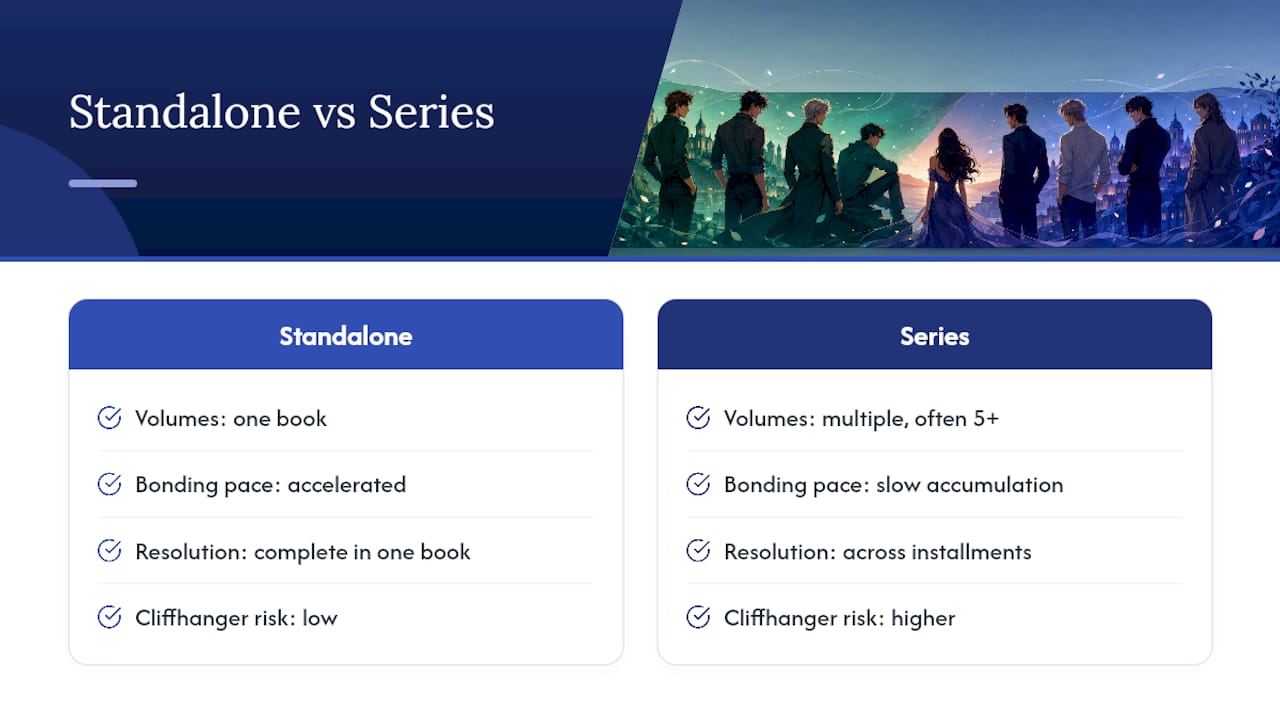
Standalones exist, but they're the minority in this genre, and they tend to compress the entire "meet the harem, build the bonds, resolve the conflict" arc into a single volume. That compression usually means less slow burn and more accelerated bonding, since there's no book two to spread the development across. If you're specifically hunting for a one-and-done read, check the standalone novel guide for broader selection criteria that apply just as well to RH as any other romance subgenre.
Where Reverse Harem Readers Actually Discuss and Discover Books
The most active recommendation engines for this genre aren't algorithm driven bestseller lists. They're community curated, which means learning to read them correctly matters more than in most genres.
Goodreads Listopia hosts extensive, reader-voted lists specifically built around reverse harem and the closely related #WhyChoose tag, ranked by community vote rather than publisher push. Reddit threads, particularly in romance-focused subreddits, tend to surface blunt, unfiltered opinions on which harems feel balanced versus which ones sideline certain love interests. BookTok functions less as a curated list and more as a discovery firehose, useful for spotting trending titles fast but less reliable for filtering by your specific spice or trope preferences.
Reading these signals well takes a bit of practice:
- Treat vote counts on Listopia as a popularity signal, not a quality guarantee; check individual reviews before committing.
- Look for recurring language in Reddit threads like "closed door" or "high heat" to gauge spice consensus across multiple readers rather than trusting one review.
- Use short video clips or excerpt posts on BookTok to preview writing voice and pacing before buying, since tone varies wildly even within the same subtype.
Community-voted lists work best combined with editorial curation rather than as a standalone filter, since crowd rankings reward popularity as much as fit for your specific mood.
The "Harem" Debate: Language, #WhyChoose, and Respectful Labels
The word "harem" carries real historical baggage, and it's worth understanding before you toss the term around casually. The original usage described secluded living quarters for women in some Muslim households, and Western fiction spent over a century exoticizing and misrepresenting that context for entertainment. Book Riot's coverage of the genre traces that Orientalist lineage directly, noting that some of the tropes inherited by modern RH novels carry echoes of that older, more troubling framing.
That history is part of why the hashtag #WhyChoose gained traction as an alternative label. It sidesteps the loaded term entirely and reframes the trope around its actual emotional hook: why should the heroine have to pick just one partner when she can have several? Some readers and authors have fully adopted #WhyChoose as their preferred term. Others resist it, arguing that "reverse harem" is already the searchable, recognized term and that swapping labels doesn't undo the genre's history, it just relabels it.
There's no single correct answer here, but there is a practical middle ground. Check content warnings before recommending or reviewing a book, especially anything set in a vaguely "exotic" or ambiguously non-Western location that leans on old harem imagery rather than building original worldbuilding. Avoid language in your own reviews that exoticizes settings or characters for shock value. And when in doubt, use whichever term the author or community around that specific book prefers, since that's usually a signal of how thoughtfully the book itself handles the trope's history.
— richard
Why The Digital Reads Covers Reverse Harem Romance
Reverse harem sits at an odd intersection: hugely popular in reader communities, chronically underrepresented on traditional bestseller shelves. That gap is exactly why a catalog built around independent authors matters. Thedigitalreads carries well over a hundred titles across genres including romance, with a meaningful share offered free, and reverse harem benefits more than most subgenres from that indie-first structure, since so much of the genre's best work never goes through traditional publishing houses at all.
Curating recommendations for this trope means weighing the same variables experienced RH readers already use: spice level, trigger content, and whether a title is a standalone or the opener to a longer series. That's the same checklist covered above, applied consistently rather than left to marketing copy. Books that claim "harem" but deliver a love triangle don't earn the tag here.
Indie authors get direct access to readers through the platform, without a major publisher deciding whether reverse harem is "commercial enough" to greenlight. For a trope built largely by fans, for fans, that direct connection is the whole point.
Sources
You've got the trope breakdown, the subtypes, and a shelf of specific titles to try. The next step is actually getting them onto your device, and that's where a marketplace built for instant access beats hunting across five different retailer apps. Thedigitalreads carries romance titles in PDF, EPUB, and DOCX, with free and paid options sitting in the same searchable catalog instead of scattered across separate storefronts.
Because the platform emphasizes independent authors directly, you'll find reverse harem titles and adjacent picks, including romance recommendations worth exploring if you want to branch into enemies-to-lovers or found family stories next, that don't always surface on algorithm-driven bestseller pages. If your budget is tight this month, the site's free romance ebook selection is worth checking before you spend anything on a new subgenre you're still testing out.
Start by browsing the full catalog and filtering by genre to see what's currently available in romance, then download your first pick in the format your device actually reads. No account gymnastics, no waiting on a hold list like a library app. Just pick a title and start reading tonight.
- What is a Reverse Harem? A Guide to This Romantic Trope
- What Is A Reverse Harem Romance? A Reader's Guide | Book Riot
FAQ
What Is the Spiciest Reverse Harem Book?
Heat level varies by author and series, but titles frequently flagged as maximum heat in reader reviews include Den of Vipers and Four Psychos, both known for explicit, high-intensity content and dark themes. Always check trigger warnings before starting, since "spiciest" often overlaps with darker or more intense subject matter.
What Are Some Popular Reverse Harems?
Community lists frequently name titles like Faking With Benefits, Broken Bonds, Lilac, Pillow Talk, Den of Vipers, Four Psychos, and Colters' Woman as standout picks spanning starter reads through dark, high-heat entries.
What Is the Number One Reverse Harem Anime?
Reverse harem anime predates the romance publishing trend and includes long-running favorites like Ouran High School Host Club and Fruits Basket, both frequently cited as genre-defining examples that helped shape the trope's core conventions before it moved into Western indie romance.
What Is a True Reverse Harem?
A true reverse harem means every listed love interest has a real, developed, active relationship with the heroine by the story's end, not just one primary pairing with side characters who never get resolved. Readers use this distinction to separate genuine RH from love triangles marketed with harem framing.
How Is Reverse Harem Different From Polyamory Romance?
Reverse harem typically functions as romantic fantasy where jealousy resolves quickly and every partner adores the heroine, while polyamory romance aims to reflect the negotiation and logistics of real non-monogamous relationships. The two overlap in structure but differ sharply in intent and realism.