
A reading challenge 2026 is any organized, prompt- or theme-based program run by a library, blog, book club, or app that helps you read more intentionally and diversify your picks throughout the year. The best first move is to choose a challenge format that fits your schedule, then pair it with a simple tracker.
- Pick a challenge: Booklist Queen (52 or 12 prompts), Santa Clara City Library's Read 26 in 2026, or a community challenge on Goodreads or Beanstack.
- Choose a tracker: Beanstack for library programs, Goodreads or StoryGraph for social tracking, or a printable bingo card for your desk.
- Find your books: Thedigitalreads offers instant PDF, EPUB, and DOCX downloads across sci-fi, fantasy, horror, thriller, and romance, perfect for filling genre-specific prompts fast.
Key Takeaways
The most effective approach to a 2026 reading challenge is to choose a prompt-based format, set a tiered goal, and track every book from day one.
| Point | Details |
|---|---|
| Choose a prompt-based challenge | Prompt-driven formats like Booklist Queen's 52-week or Santa Clara's Read 26 diversify your reading more than raw book-count goals. |
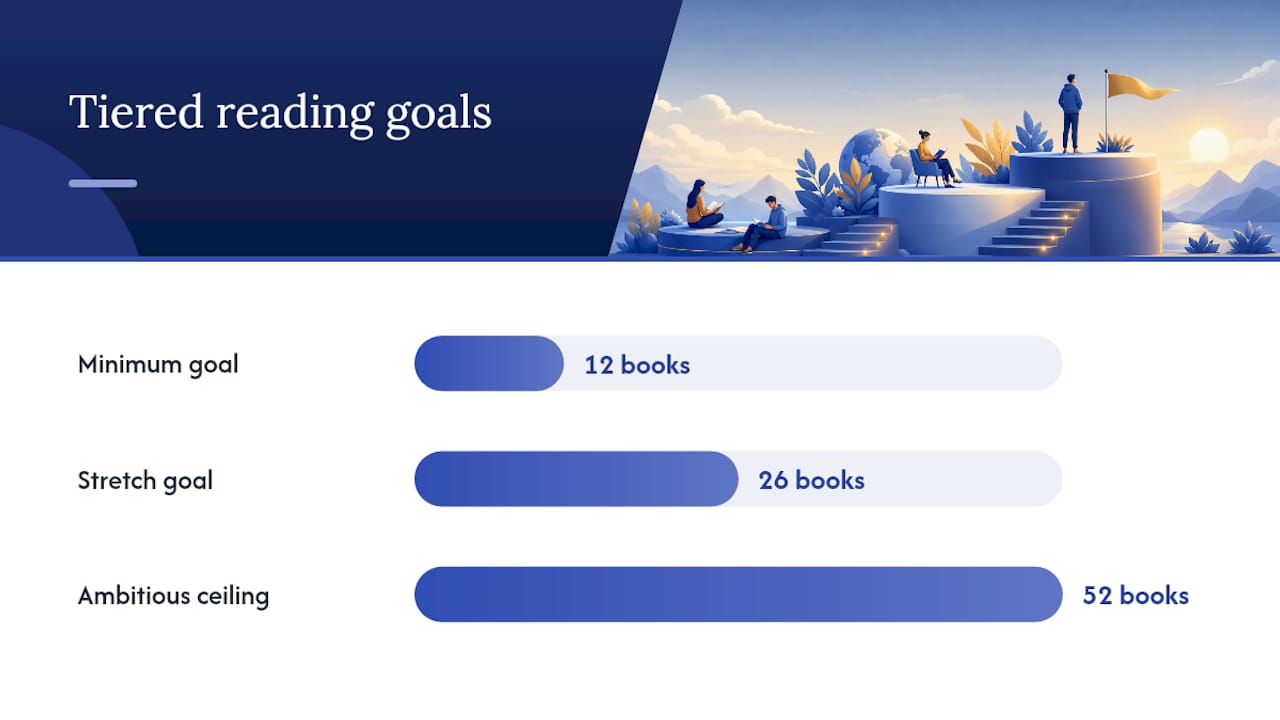
| Set a tiered goal | Pick three levels: 12 books minimum, 26 as a stretch, 52 as a ceiling, so the challenge stays motivating all year. |
| Track from book one | Use Beanstack for library programs, StoryGraph for analytics, Goodreads for social sharing, or a printable tracker for visual motivation. |
| Interpret prompts generously | If you think a book fits a prompt, count it. Flexible interpretation keeps momentum and prevents mid-year drop-off. |
| Thedigitalreads for instant picks | Browse over 139 indie ebooks in PDF, EPUB, and DOCX at Thedigitalreads to fill genre-specific prompts the same day you need them. |
Table of Contents
- What are the best 2026 reading challenges you can join right now?
- How do you join any 2026 reading challenge?
- Which tracking tools work best for a 2026 reading challenge?
- What do sample 2026 reading challenge prompts look like?
- How do you personalize your 2026 reading challenge and actually finish it?
- Where can you find free trackers, printable BINGO cards, and templates?
- Why prompt-based challenges beat pure book counts
- Where to find books for your 2026 reading challenge prompts
- Useful links and where to sign up
- Sources
- FAQ
What are the best 2026 reading challenges you can join right now?
The Literary Hub 2026 guide notes a clear shift this year: readers are moving away from raw book counts toward prompt-driven challenges that push them into new genres, formats, and authors. Here are six worth your time.
-
Booklist Queen 2026 Reading Challenge (national, free): 52 weekly prompts with a 12-prompt mini option for readers who want a lighter pace. Printable handouts and community groups are included. Sign up at booklistqueen.com and download the tracker PDF on the same page.
-
Shelf Reflection 2026 Reading Challenge (national, free): A community-focused challenge with themed prompts designed to encourage reflection on what you read, not just how much. Join via the Shelf Reflection blog and share progress using the dedicated hashtag.
-
Santa Clara City Library — Read 26 in 2026 (local/national, free): Read 26 books across 26 categories. Open to adults and teens 13 and older. Register with your library card on the Santa Clara City Library site; no purchase required.
-
Arkansas Center for the Book — 2026 Monthly-Theme Challenge (national, free): Twelve monthly themes including a book recommended by a friend or family member, an Arkansas author, a founding-era read in July, a genre swap in October, food-related reads in November, and a prize-winner in December. Families and book clubs are especially encouraged. Sign up through the Arkansas State Library site.
-
San Leandro Book It! 2026 (local, free): Runs January 10 through December 21, 2026, and is open to patrons ages 12 and up. Tracking is handled through Beanstack. Register on the San Leandro city site with your library card.
-
Popsugar 2026 Reading Challenge (national, free): 50 thematic prompts built around a garden motif this year, with printable trackers and active Facebook and Goodreads groups for accountability. Download the prompt list from the PS Books page and join the community group to share progress.
Timeline and cost: Almost every challenge listed here is free. Local library challenges like San Leandro and Santa Clara may require a library card for prize eligibility. Most run January through December, though some, like San Leandro, have specific start and end dates.
How do you join any 2026 reading challenge?
The process is the same whether you're signing up for a library program, a blog challenge, or an app-hosted event. Follow these steps and you'll be reading with purpose by the end of the week.
-
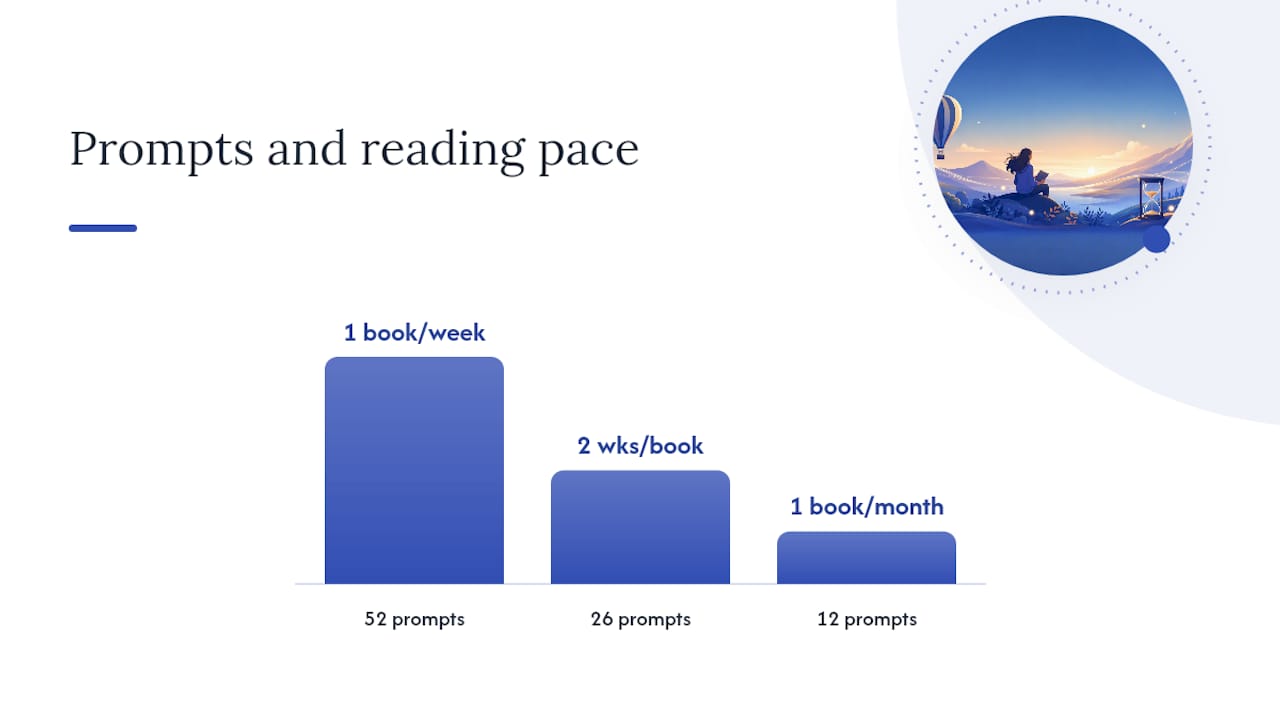
Choose your format. Decide between a library program (structured, sometimes prize-eligible), a blog challenge (flexible, community-driven), or an app-based challenge (trackable, social). Your schedule determines which fits best: 52 prompts means roughly one book per week; 26 prompts gives you two weeks per book; 12 prompts means one per month.
-
Read the rules and prompts. Every challenge has its own interpretation guidelines. Some allow one book to count for two prompts ("double-dipping"); others don't. Check before you start.
-
Register if required. Library challenges like Omaha Public Library's 2026 challenge and San Leandro's Book It! require a library card and a signup form. Blog challenges like Booklist Queen and Popsugar just need an email or a group join.
-
Pick your tracker. More on specific tools in the next section, but choose one before you read your first book. Retroactive logging is frustrating.
-
Set a realistic target. If you read six books last year, a 52-book challenge will burn you out by March. Start with 12 or 26 prompts and scale up mid-year if you're ahead.
For library-specific signups: Bring or enter your library card number, complete the local signup form (online or in person), and confirm whether prize submissions require a physical log sheet or an in-person drop-off. Local library challenges sometimes require physical proof to claim prizes, so digital-only records may not qualify for local rewards. Check submission deadlines early.
For blog or community challenges: Download the printable prompt list, join the associated Facebook or Goodreads group, and save the challenge hashtag. Popsugar's challenge, for example, has an active Goodreads group where members post monthly updates.
For app-based challenges: Create a free account on Beanstack, StoryGraph, or Goodreads, search for the challenge by name, and click "join." Review your privacy settings before connecting with other readers if that matters to you.
Pro Tip: Prompt interpretation is the secret weapon of experienced challengers. If you think a book fits a prompt, count it. The 52 Book Club frames this as the practical rule that keeps momentum going and prevents drop-off mid-year.
Which tracking tools work best for a 2026 reading challenge?
Tracking your progress is what separates readers who finish a challenge from those who abandon it by April. Picking the right tool upfront takes about five minutes and saves a lot of frustration later.
Here's a quick breakdown of the main options:
| Tool | Best For | Primary Use |
|---|---|---|
| Beanstack | Library programs | Log books, earn badges, submit for prizes |
| Goodreads | Social reading and reviews | Track reads, join groups, share updates |
| StoryGraph | Analytics and genre stats | Custom challenge creation, mood/pace tracking |
| Local library portal | Prize-eligible local challenges | Official log submission |
| Printable tracker / BINGO card | Visual motivation, desk use | Physical check-off and display |
| Spreadsheet | Full customization | Columns for prompt, title, author, dates, notes |
Beanstack is the go-to for library-hosted programs. San Leandro's Book It! challenge links directly to a Beanstack page, and many public libraries use it as their official logging system. If your challenge is library-based, check whether Beanstack is already integrated before setting up a separate tracker.
Goodreads works well if you want a social layer. You can join challenge-specific groups, post reviews, and see what friends are reading. The annual reading goal feature lets you set a book count, though it won't track individual prompts without manual notes.
StoryGraph is the better pick if you care about data. It shows genre breakdowns, average page counts, mood patterns, and lets you create or join community challenges with custom prompts. Readers who want to see whether they actually diversified their reading by December will find StoryGraph's year-end stats genuinely useful.
A printable tracker adds something the apps can't: a physical artifact on your desk or wall that makes progress visible every day. Many challenge hosts, including Popsugar and Booklist Queen, offer free printable PDFs. A simple spreadsheet column setup works just as well if you prefer to build your own:
Suggested columns: Prompt | Title | Author | Start Date | Finish Date | Notes
What do sample 2026 reading challenge prompts look like?
The goal of a prompt list isn't to hit a number. It's to push you toward books you'd never have picked on your own. Here are three ready-to-use sets you can copy directly into your tracker.
12-month prompt list (one per month)
- January: A book recommended by a friend or family member
- February: A love story (any genre)
- March: A debut novel published in 2025 or 2026
- April: A book set in a country you've never visited
- May: A nonfiction title outside your usual reading
- June: A book with a one-word title
- July: A book set during a historical era (pre-1900)
- August: A book by an indie or self-published author
- September: A book that became a film or TV show
- October: A genre you've never tried (horror, sci-fi, romance, etc.)
- November: A book about food, cooking, or a chef
- December: A book that won a major literary award
Adapted from the Arkansas Center for the Book's monthly-theme structure.
26-prompt list (Read 26 format)
- A book with a color in the title
- A book by an author whose first name starts with your first initial
- A thriller or mystery
- A book set in a city you want to visit
- A science fiction novel
- A book under 200 pages
- A book over 400 pages
- A fantasy novel
- A romance
- A book published before you were born
- A memoir or autobiography
- A book recommended by a librarian
- A book with a number in the title
- A horror novel
- A book by an indie author
- A book that's been on your shelf for over a year
- A book with a single-word title
- A book set in a small town
- A graphic novel or illustrated book
- A book about a real historical event
- A book with an unreliable narrator
- A book you chose based only on the cover
- A book in a series (any installment)
- A book recommended by a podcast or newsletter
- A book with a map inside
- A book that made someone you know cry
Modeled on the Santa Clara City Library's Read 26 in 2026 category structure.
10-sample weekly prompts (52-week style)
- A book with a one-word title
- A book set in a place you've never been
- A book published this year
- A book by an author you've never read before
- A book with a twist ending
- A book recommended by a stranger or online community
- A book you started but never finished
- A book featuring a non-human protagonist
- A book that takes place over a single day or week
- A book outside your comfort zone
Booklist Queen's 52-prompt challenge and The 52 Book Club both offer full weekly prompt lists you can expand from this sample.
On double-counting: Most blog challenges allow one book to satisfy two prompts if it genuinely fits both. A sci-fi novel by an indie author, for example, can cover both "a science fiction novel" and "a book by an indie author." Check each challenge's rules, but when in doubt, count it.
Pro Tip: If a prompt feels impossible to fill, reframe it broadly. "A book set in a place you've never been" can mean a fictional world just as easily as a real country. Flexibility is the point.
How do you personalize your 2026 reading challenge and actually finish it?
The biggest reason readers abandon a challenge isn't lack of motivation. It's a mismatch between the challenge's pace and their actual life. The fix is personalization from day one.
Literary Hub's 2026 reading challenge guide frames this well: the trend has shifted from "how many books can I read?" to "how can I read more diversely?" That reframe matters. A 12-book challenge where every book is from a new genre or perspective is more valuable than 52 books in the same category you always read.
Tiered goals work better than single targets. Set three levels: a minimum (12 books), a stretch (26 books), and an ambitious ceiling (52 books). You start the year aiming for the minimum, which feels achievable, and you'll often exceed it without the pressure of a fixed number looming over you.
Swap prompts without guilt. If a prompt genuinely doesn't fit your life or interests, replace it with one that does. The Arkansas Center for the Book's monthly themes are suggestions, not requirements. The same applies to blog challenges. The goal is to read more broadly, not to complete a bureaucratic checklist.
Other tactics that actually work:
- Audiobooks count. A book you listen to during a commute or workout satisfies a prompt just as well as one you read on paper.
- Family reading: Assign one prompt per month that the whole household reads together. The Arkansas Center for the Book specifically encourages families and book clubs to participate this way.
- Double-duty books: A horror novel set in a small town can cover two prompts at once. Plan these intentionally rather than discovering them by accident.
- 10-minute daily habit: Pairing a challenge with a consistent micro-reading window, even 10 minutes before bed, builds the habit that carries you through slower months.
When you're stuck on what to read next, how to find your next favorite book is a practical starting point. For genre-specific picks that fill prompts fast, Thedigitalreads carries indie sci-fi, fantasy, horror, thriller, and romance titles available as instant PDF, EPUB, or DOCX downloads. If a prompt calls for a horror novel and you need it tonight, that's the fastest path.
Pro Tip: The mantra seasoned challengers swear by: "If you think a book fits the prompt, it does." Strict interpretation kills momentum. Generous interpretation keeps you reading.
Where can you find free trackers, printable BINGO cards, and templates?
Tangible tracking artifacts, whether a printed bingo card on your fridge or a PDF checklist in your planner, genuinely improve completion rates. Challenge hosts know this, which is why most of the major programs offer free printables.
Where to find them:
- Booklist Queen: Free printable tracker PDF alongside the 52-prompt and 12-prompt mini challenge lists at booklistqueen.com.
- Popsugar: Multiple printable assets including a prompt checklist and a tracker sheet, available on the PS Books challenge page.
- Reader Haven: A 30-prompt 2026 reading challenge with a downloadable printable PDF that works well for readers who want something between 12 and 52 prompts.
- Local library sites: Many public libraries, including Santa Clara City Library and Omaha Public Library, offer printable log sheets or bingo cards as part of their challenge materials.
- Thedigitalreads blog: Curated reading lists and discovery guides that pair well with challenge prompts.
Making your own BINGO card is easier than it sounds. Take any 25 prompts from a 52-week or 26-prompt list, arrange them in a 5x5 grid, and mark a "FREE" square in the center. Print it, laminate it if you're committed, and use a marker to check off each square as you finish a book. A 9-square (3x3) version works well for a quarterly mini-challenge.
Spreadsheet template (copy-paste ready):
Keep both a digital tracker and a physical one if you're motivated by different things at different times. The app gives you stats; the printed card gives you something to look at when you need a visual reminder of how far you've come.
Why prompt-based challenges beat pure book counts
Reading challenges built around prompts rather than raw totals are more likely to change your reading life in a lasting way. A goal of "read 52 books" tells you nothing about what to read. A prompt like "a book by an author whose first name matches yours" forces a decision, a search, and often a discovery you'd never have made otherwise.
The 2026 shift toward diversification-first challenges, documented by Literary Hub and reflected in programs from the Arkansas Center for the Book to Popsugar, isn't a trend for its own sake. It's a recognition that most readers already have a comfort zone, and a number goal doesn't push them out of it. A well-designed prompt list does.
There's also a practical argument for prompts when life gets busy. If you're behind on a 52-book count goal, the number feels like a judgment. If you're behind on a prompt list, you just pick the next prompt and keep going. The structure absorbs real life better.
One thing worth saying plainly: the "best" challenge is the one you'll actually finish. A 12-prompt monthly challenge completed is worth more than a 52-book challenge abandoned in May. Start smaller than you think you need to, use reading strategies that fit your actual schedule, and treat every finished book as a win regardless of where it lands on the list.
Where to find books for your 2026 reading challenge prompts
Genre and indie fiction prompts are the easiest to fill when you have instant access to the right titles. Thedigitalreads carries over 139 ebooks across science fiction, fantasy, horror, thriller, and romance, including 26 free titles, all available as instant PDF, EPUB, or DOCX downloads. No waiting for shipping, no library hold lists.
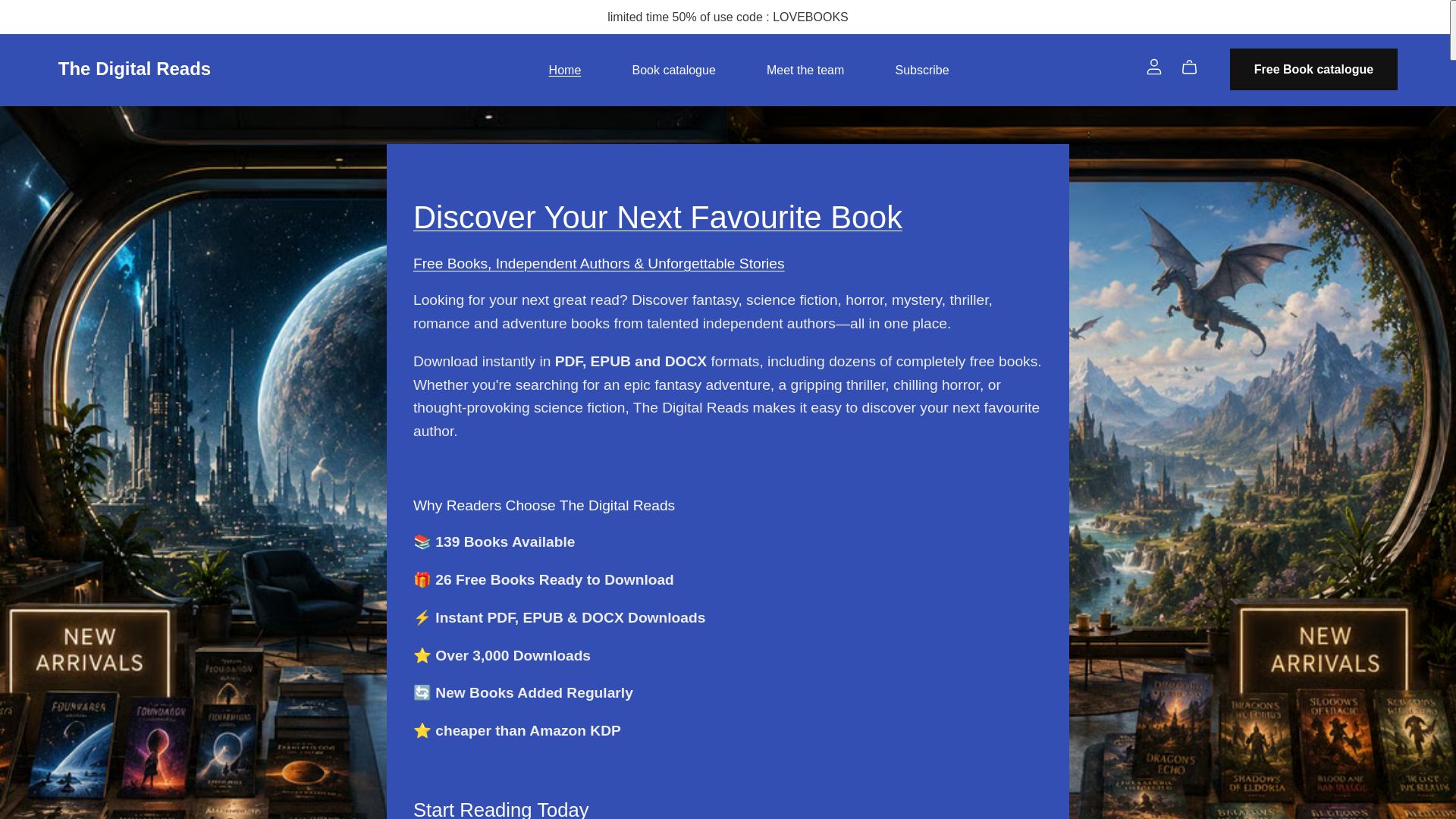
Libraries and local bookstores remain excellent options for discovery and free borrowing, and they're worth combining with a digital catalog. But when a prompt calls for a specific genre and you want it tonight, Thedigitalreads gives you access to indie authors and hidden gems you won't find on the major retail shelves. Browse the full collection, filter by genre, and download instantly. Your next prompt pick is probably already there.
Useful links and where to sign up
- Booklist Queen 2026 Reading Challenge: 52 prompts plus a 12-prompt mini option; free printable tracker included.
- Shelf Reflection 2026 Reading Challenge: Community-focused prompt challenge; find it via the Shelf Reflection blog and join the hashtag conversation.
- Santa Clara City Library — Read 26 in 2026: 26 categories for adults and teens 13+; register with your library card.
- Arkansas Center for the Book 2026 Challenge: Monthly themes for families and book clubs; signup through the Arkansas State Library.
- San Leandro Book It! 2026: January 10 through December 21, 2026; ages 12+; tracks via Beanstack.
- Popsugar 2026 Reading Challenge: 50 prompts with a garden theme; printable trackers and active Goodreads and Facebook groups.
- The 52 Book Club 2026 Challenge: 52 weekly prompts; emphasis on prompt flexibility and community sharing.
- Omaha Public Library 2026 Reading Challenge: Local library model with signup instructions, age groups, and prize rules.
- Reader Haven 2026 Challenge: 30 prompts with a free downloadable PDF tracker.
- Tracking platforms: Beanstack (beanstack.com), Goodreads (goodreads.com), StoryGraph (thestorygraph.com).
- Thedigitalreads: Instant ebook downloads in PDF, EPUB, and DOCX for genre and indie fiction prompts at Thedigitalreads.
Sources
- Resolved to finish more books in 2026? Here’s your guide to the web’s best reading challenges
- AR Center for the Book 2026 Reading Challenge - Arkansas State Library
- Read 26 in 2026
- 2026 Reading Challenge
- Book It! 2026 Reading Challenge | San Leandro, CA
- Booklist Queen's 2026 Reading Challenge | Booklist Queen
- Popsugar Reading Challenge 2026 Prompt List | PS Books
- The 52 Book Club's 2026 Reading Challenge
FAQ
What is a reading challenge 2026?
A 2026 reading challenge is a structured program, run by a library, blog, or app, that gives you a list of prompts or themes to guide your reading throughout the year. Most are free and open to readers of all levels.
How many books do you need to read for a 2026 challenge?
It depends on the format: 12 books for a monthly challenge, 26 for a Read 26 format, or 52 for a weekly pace. Tiered challenges let you set your own minimum and stretch goals.
Which app is best for tracking a reading challenge?
Beanstack works best for library-hosted programs, Goodreads suits social readers who want to share reviews, and StoryGraph is the strongest pick for readers who want genre analytics and custom challenge creation.
Can one book count for two prompts?
Most blog and community challenges allow double-counting when a book genuinely fits two prompts. Check each challenge's rules, but the general community standard is: if it fits, count it.
Where can I find books to fill genre-specific prompts quickly?
Thedigitalreads offers instant downloads across sci-fi, fantasy, horror, thriller, and romance in PDF, EPUB, and DOCX formats, including free titles, making it a fast option when a prompt calls for a specific genre.