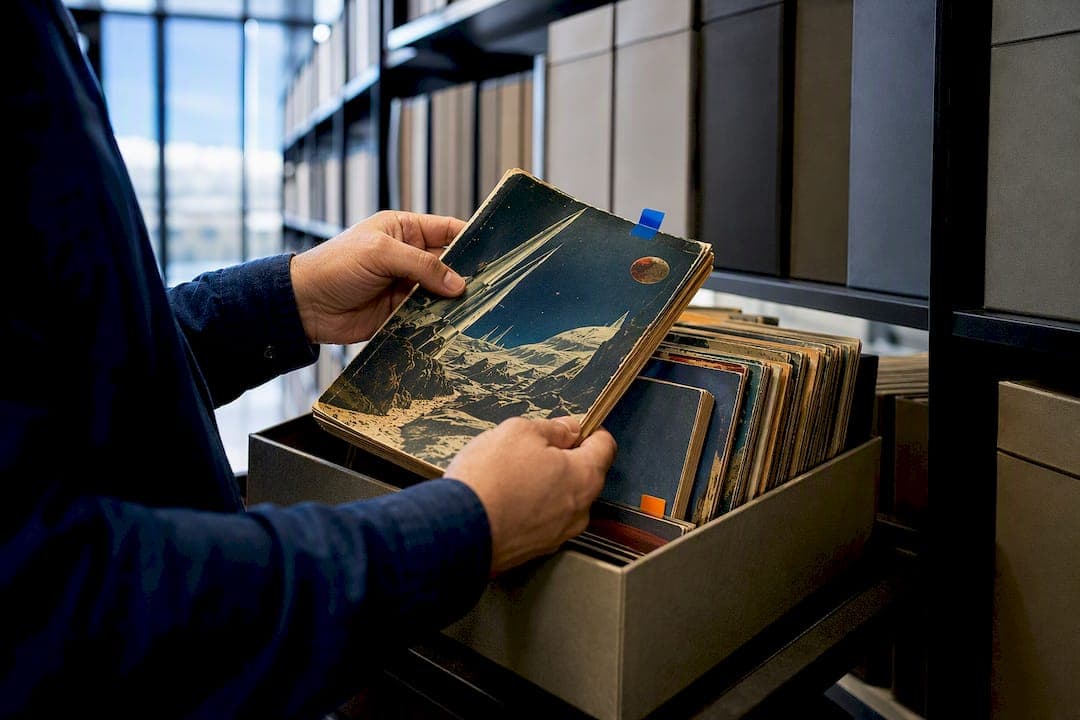
Your best bets for free public domain sci-fi are Project Gutenberg, Archive.org, Standard Ebooks, and dedicated public-domain movie archives. All four host thousands of legally free titles, but "public domain" is territory-specific: a book cleared for U.S. readers might still be copyrighted in Canada or the UK. Always confirm status before you redistribute or adapt anything commercially.
TL;DR:
- Public domain status depends on publication date and renewal records; works published before 1931 are generally clear in the US, but international laws vary.
- Reliable sources for free sci-fi include Project Gutenberg for texts, Archive.org for obscure magazines and films, Standard Ebooks for polished editions, and public film archives for vintage movies.
- Always verify copyright renewal records and cross-check titles against trusted sources to avoid legal issues before redistributing or adapting works.
- EPUB files from curated projects typically offer better readability and navigation on modern devices than scanned PDFs or irregular scans.
- Commercial use or significant modifications of public domain works may require legal consultation, especially when adding new material or tied to trademarks or images.
Table of Contents
- Public Domain Sci-Fi: Best Free Sites and What Each Offers
- How to Verify a Work Is Actually Public Domain
- Classic Sci-Fi Stories Worth Starting With
- Choosing Between EPUBs, PDFs, and Audiobooks
- What You Can and Can't Do With Public Domain Sci-Fi
- Why Curation Matters More Than Access
- Download Curated Public Domain Sci-Fi in Minutes
- Sources
- FAQ
Public Domain Sci-Fi: Best Free Sites and What Each Offers
You don't need to hunt across a dozen sketchy download sites to find great classic sci-fi stories. Four sources cover almost everything a casual reader, researcher, or indie adapter needs, and each has its own personality.
Project Gutenberg is the granddaddy of free ebook libraries, and its science fiction bookshelf alone runs deep into hundreds of titles. You get EPUB, Kindle-ready, and plain text formats, no login required, and clean metadata that tells you exactly when a work entered the public domain.
Archive.org is where you go when Gutenberg comes up empty. It hosts scanned pulp magazines, obscure serials, and film reels that never got a proper digital reissue anywhere else. If you're chasing a specific 1930s pulp story or a forgotten black-and-white sci-fi feature, this is usually where it turns up.
Standard Ebooks solves a real problem: public domain scans often look like they were typeset by a dot-matrix printer. This volunteer project takes the same source texts and rebuilds them into polished, proofread EPUBs with proper chapter navigation, corrected typos, and modern formatting that reads like a real book instead of a photocopy.
PublicDomainMovies and similar archives specialize in full-length features and old movie serials, many restored or remastered from deteriorating prints. For sci-fi researchers or fans of vintage B-movies, these sites are the difference between a watchable film and a scratchy mess.
A few search tips that save real time:
- Filter Project Gutenberg by "Bookshelf" categories to isolate sci-fi from general fiction.
- On Archive.org, sort by "Year Published" to zero in on a specific decade of pulp fiction.
- Check contributor credits on Standard Ebooks; some volunteers specialize in genre fiction and produce consistently strong editions.
- Cross-reference titles against Wikipedia's public domain year pages to confirm a work actually cleared copyright.
How to Verify a Work Is Actually Public Domain
Not everything that looks free actually is. Copyright law has enough edge cases that a five-minute check can save you from a takedown notice or worse.
Start with the publication date. Under the 95-year rule, a work published in 1930 entered the U.S. public domain in 2026, and one published in 1931 follows in 2027. But that rule only applies cleanly to works actually published in the United States; foreign publications, unpublished manuscripts, and works with disputed dates need extra scrutiny.
For anything published between 1923 and 1963, renewal records matter. Copyright holders had to actively renew works from that era, and many didn't bother, which is why plenty of pulp-era sci-fi slipped into the public domain early. The U.S. Copyright Office's public records database lets you search registration and renewal history directly.
When a title falls into a gray area, UC Berkeley's public domain flowcharts walk through the logic step by step, and Stanford's public domain overview covers the common misconceptions that trip people up.
Before you republish or adapt anything, run through this checklist:
- Note the exact edition and original publication date, not just the author's era.
- Search the Copyright Office database for registration and renewal records.
- Cross-check the title against a reputable archive that already vetted its status.
- Confirm which country's law applies, since a U.S. clearance doesn't guarantee international clearance.
Classic Sci-Fi Stories Worth Starting With
Some public domain titles get all the attention while genuinely great work sits ignored. Here's a mix that rewards both first-time readers and anyone building a research list.
- H.G. Wells, The War of the Worlds — the alien invasion story that set the template for the entire genre; widely available as a clean EPUB.
- Mary Shelley, Frankenstein — often called the first true science fiction novel; every major archive carries it.
- Edgar Rice Burroughs, A Princess of Mars — pulp adventure that inspired decades of space opera.
- H.G. Wells, The Time Machine — short, fast-moving, and a perfect entry point for new readers.
- Jules Verne, Twenty Thousand Leagues Under the Sea — dense but rewarding, and easy to find in modern typesetting.
- Aldous Huxley, works entering public domain in waves — check current-year lists before assuming full clearance.
- Metropolis (1927 film) — the visual language of nearly every dystopian film that followed.
- Nosferatu-era serials and early sci-fi shorts — found almost exclusively on film-specific archives.
- Assorted 1930s pulp serials on Archive.org — a great source if you want lesser-known stories outside the canon.
- Titles newly released each January — Public Domain Day adds a fresh batch every year, so last year's list is never the full picture.
For more curated options, Thedigitalreads keeps a running list of standout sci-fi short stories worth adding to your queue.
Choosing Between EPUBs, PDFs, and Audiobooks
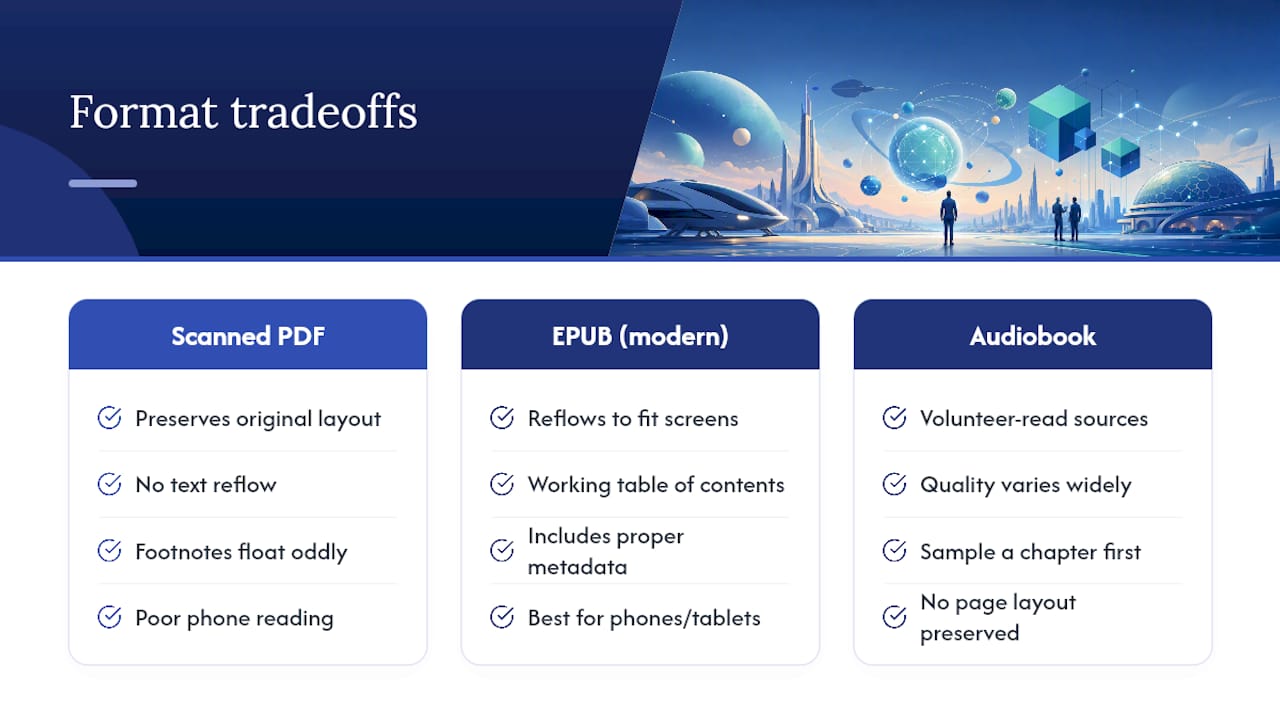
A raw scanned PDF preserves the original page layout, which researchers sometimes want, but it's miserable to read on a phone. Text doesn't reflow, footnotes float in odd places, and there's no real navigation beyond scrolling.
Modern EPUBs from Standard Ebooks or a curated marketplace fix that. They reflow to fit any screen, include working tables of contents, and carry proper metadata so your e-reader actually knows the title and author. If you're reading on a phone or tablet, EPUB wins every time.
Audiobooks in the public domain space come mostly from volunteer-read projects, and quality varies widely, so sample a chapter before committing. For accessibility, most e-readers now support larger fonts, dyslexia-friendly typefaces, and built-in text-to-speech, all of which work better on clean EPUBs than on scanned PDFs.
What You Can and Can't Do With Public Domain Sci-Fi
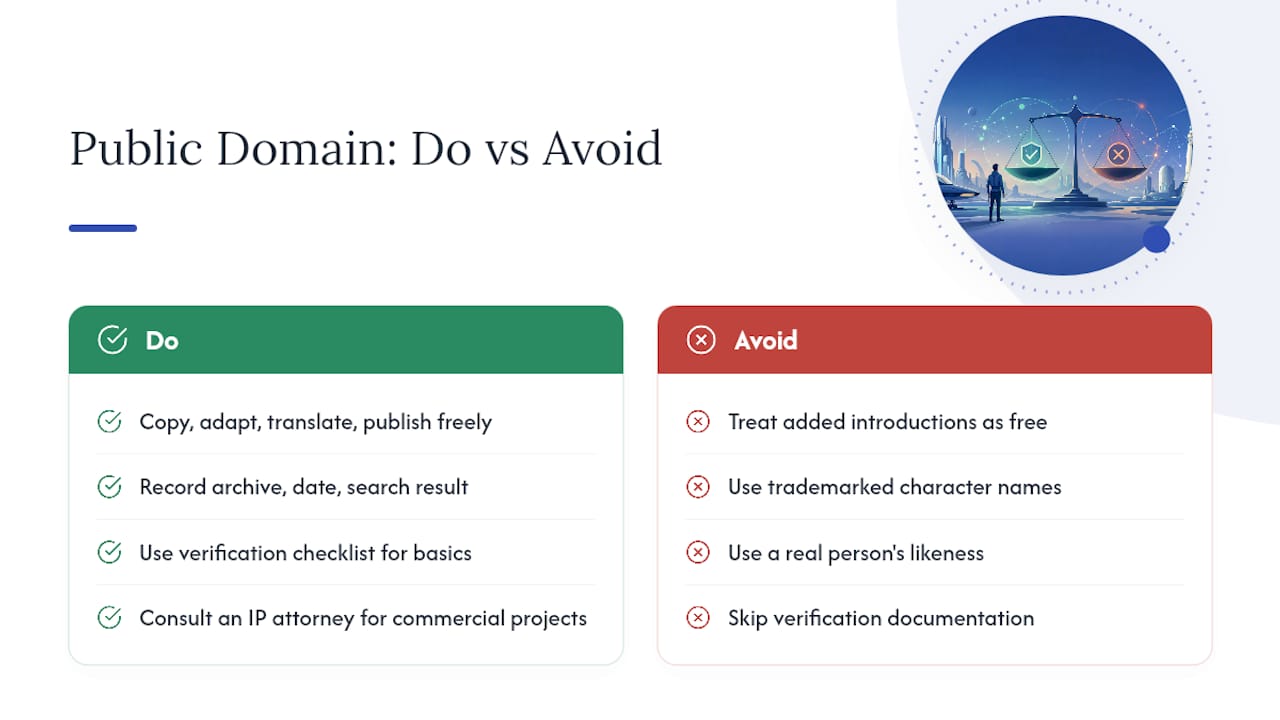
Once a work enters the public domain in your jurisdiction, you can copy it, adapt it, translate it, and publish it, all without asking permission or paying a licensing fee.
The catch is that modern additions don't automatically inherit that freedom. A new introduction, added illustrations, or an edited annotated version can carry its own separate copyright, even when the underlying novel is free to use. Character names or story elements tied to a trademark, or a real person's likeness used in adapted cover art, can also create legal exposure that has nothing to do with copyright status.
Pro Tip: Keep a simple record of every source you verify, including the archive name, the date you checked, and the registration search result. If a status question ever comes up later, you'll have your paper trail ready instead of scrambling to reconstruct it.
If you're planning a commercial adaptation, a screenplay, a paid reprint, a derivative game, talk to an intellectual property attorney before you invest real money. Verification checklists handle the obvious cases; a lawyer handles the ones that aren't.
Why Curation Matters More Than Access
Free access to public domain sci-fi stopped being the hard part years ago. Anyone can search Archive.org. The real friction is sorting through hundreds of scans to find editions that don't read like a fax from 1987, and Thedigitalreads built its catalog with that problem in mind.
Some sites organize readable editions of classic sci-fi literature online alongside a broader collection of titles, including free downloads, so browsing doesn't mean digging through duplicate scans. Curated blog guides point readers toward themed collections, and every title ships in PDF, EPUB, or DOCX depending on how you like to read.
— richard
Download Curated Public Domain Sci-Fi in Minutes
Hunting across four different archives for a decent edition gets old fast, especially when half the files you find are blurry scans missing their first ten pages. Some platforms solve that by putting free and low-cost genre fiction, including classic public domain sci-fi, in one place with instant downloads and no format guesswork.
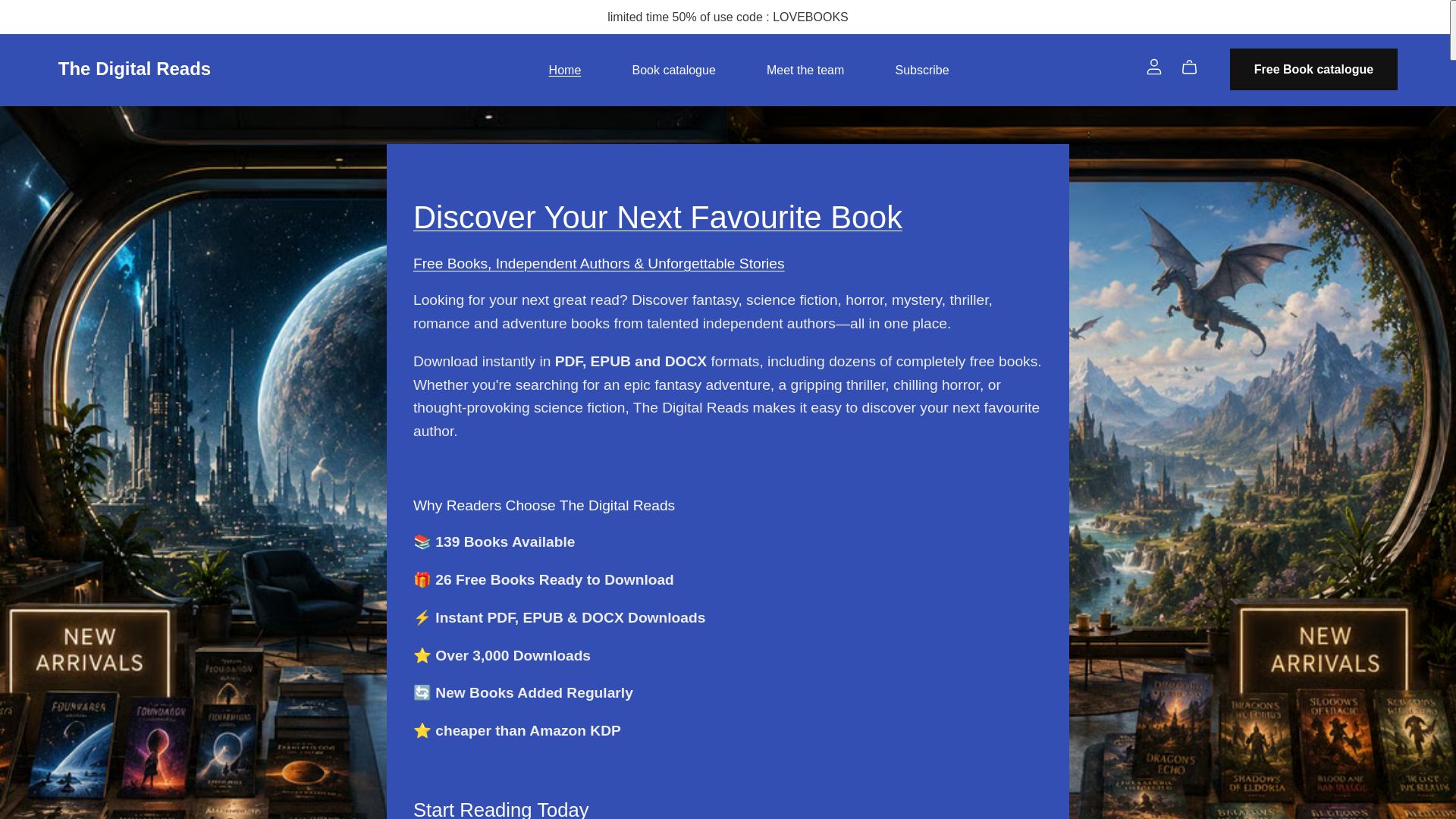
Browsing a well-curated catalog can provide clean EPUB, PDF, and DOCX files, curated lists built around themes and eras, and a mix of free titles alongside indie science fiction releases. If you're researching older editions for a personal project or adaptation, still run your own copyright check first. Some services curate for readability, not legal clearance. When you're ready to start reading, browse the current collection and grab your next title in under a minute.
Sources
- Public Domain flowcharts — UC Berkeley
- Books in Science Fiction - Project Gutenberg
- Stanford Libraries — Public domain overview
- U.S. Copyright Office public records — Fahrenheit 451
FAQ
Is Fahrenheit 451 in the public domain?
No. U.S. Copyright Office records confirm Ray Bradbury's 1953 novel remains under active copyright protection in the United States.
Which books enter the public domain in 2026?
Works published in 1930 cleared U.S. copyright under the 95-year rule, joining titles like The Maltese Falcon and other works highlighted in Public Domain Day 2026 coverage.
Which movies enter the public domain in 2027?
Films first published in 1931 in the United States are expected to clear the 95-year copyright term following the standard rules, though renewal records for that era should always be checked before assuming full clearance.
What are the best public domain sci-fi books to start with?
The War of the Worlds, Frankenstein, The Time Machine, and A Princess of Mars are among the most accessible and widely available classic sci-fi titles, all easy to find as clean EPUB editions.
Where can I find quality free editions instead of messy scans?
Standard Ebooks specializes in proofread, well-formatted public domain EPUBs, while Thedigitalreads curates readable editions of classic and indie sci-fi in one downloadable catalog.