
Progression fantasy is a subgenre where a character's measurable growth in power or skill, not fate or prophecy, drives the entire plot. It appeals to readers who love systems, training arcs, and earned payoff more than sudden plot twists. If you're new to the genre, start with Cradle by Will Wight for a tight, completed epic, or He Who Fights With Monsters by Jason Cheyne for a slower-burn systems story with real humor.
TL;DR:
- Progression fantasy emphasizes a character's measurable growth in power through systematic devices like training arcs, tiers, and institutional ranks, which are essential to the genre.
- The genre demands that power progression is earned through sacrifice, with clear milestones and long-term payoffs that reward patience and consistent effort.
- Series like Cradle and Arcane Ascension exemplify system-focused stories, with the protagonist's strength at least doubling by the end of multiple books, adhering to the core progression principle.
- Ongoing serials such as Mother of Learning and The Wandering Inn offer scale and depth, but web serial status requires patience due to potential delays or incomplete stories.
- The genre favors hard magic systems and worlds where magic and power levels influence societal, political, and economic structures, making growth a tangible, integral part of the setting.
Table of Contents
- What Is Progression Fantasy? A Clear Explanation
- Core Traits Readers Expect in Progression Fantasy
- Progression Fantasy vs. LitRPG, Cultivation, and Power Fantasy
- Progression Fantasy Substyles and Where to Find Them
- How to Choose Your Next Progression Fantasy Read
- How The Digital Reads Helps You Find Progression Fantasy
- The History and Origins of Progression Fantasy as a Genre
- Common Narrative Structures and Pacing Techniques
- Typical Protagonist Archetypes and Development Arcs
- How Progression Fantasy Reflects and Subverts Fantasy Tropes
- Themes of Perseverance, Power, and Self-Improvement
- World-Building and Magic Systems in Progression Fantasy
- Editor's Note: Why Progression Fantasy Is Resonating Now
- Find Your Next Progression Fantasy Read on The Digital Reads
- Sources
- FAQ
What Is Progression Fantasy? A Clear Explanation
Progression fantasy centers on a protagonist getting measurably stronger over the course of a story, and the story treats that growth as the main event rather than a subplot. Author Andrew Rowe first proposed the label in 2019, arguing that these books share a specific structural feature: the character's power at the end of the book should clearly outclass where they started, in a way readers can point to and measure.
That distinction matters because plenty of fantasy involves characters who "grow" emotionally without ever getting stronger in a way the plot tracks. A character who learns to trust their friends has changed. A character who spent six months in a sect's inner courtyard learning a forbidden technique, and can now beat someone who used to crush them, has progressed. The genre cares about the second kind of change. LitRPG Critic describes this as the core engine of the subgenre: structured systems, training arcs, and tangible milestones that readers can watch accumulate.
That growth shows up in the plot through a handful of recurring devices:
- Training arcs: extended sequences where the protagonist studies, drills, or suffers through a discipline before applying it in conflict.
- Institutional ranks: schools, sects, guilds, or militaries that assign visible status (apprentice, core disciple, journeyman) so readers always know where a character stands.
- Tournaments and trials: staged competitions that let the story show off new abilities against a fixed, comparable bar.
- Tier or threshold breakthroughs: named power levels (cultivation stages, mana tiers, class ranks) that mark a before-and-after moment in the narrative.
None of these devices are required in isolation, but you'll rarely find a progression fantasy novel that skips all of them.
Core Traits Readers Expect in Progression Fantasy
Readers who pick up a progression fantasy novel come in with specific expectations, and books that violate them tend to get called out fast in reader communities. Four traits show up again and again.
- Earned progression. Power has to cost something, whether that's time, risk, sacrifice, or failure. A character who wakes up strong for no reason breaks the contract with the reader.
- Visible milestones. You should be able to point to a scene, chapter, or arc and say "that's when they leveled up." Vague, hand-wavy growth frustrates genre fans.
- Institutional frameworks. Sects, academies, and guilds give the story pacing structure. They create natural checkpoints, rivalries, and stakes without the author inventing a new crisis every chapter.
- Long-term payoff. The best entries in the genre plant abilities or lessons early that pay off books later. That delayed gratification is often the entire appeal.
Pro Tip: A healthy progression system rewards patience with a real shift in how fights play out. Padding just repeats the same power level in a new location. If the protagonist's tenth fight looks tactically identical to their third, the story is stalling, not progressing.
Progression Fantasy vs. LitRPG, Cultivation, and Power Fantasy
These four labels overlap so often that readers mix them up constantly, but each one has a distinct center of gravity.
- LitRPG vs. progression fantasy: LitRPG requires visible game mechanics, like stat screens, experience bars, or an in-world system interface the character can literally view. Progression fantasy only requires measurable growth. Many books are both, since an explicit leveling system is one of the cleanest ways to show progress, but plenty of progression fantasy (Cradle, for instance) has no game UI at all.
- Cultivation fantasy books: these lean on Chinese xianxia and wuxia traditions, with named cultivation stages, sects, spiritual energy (often called qi), and a strong cultural backbone borrowed from martial arts fiction. Cultivation fantasy novels are a flavor of progression fantasy, not a separate genre.
- Shonen and battle manga: these share the training arc and tournament structure but usually run on serialized weekly pacing and lean harder into spectacle and friendship themes than on tracked, consistent systems.
- Power fantasy: this is the odd one out. A power fantasy protagonist often starts overwhelmingly strong and stays there. Progression fantasy is defined by the climb, not the plateau.
The cleanest way to sort a borderline book is Rowe's own heuristic: the protagonist in book three should be able to beat the protagonist from book one in a straight fight. If that's true, you're looking at progression fantasy.
Quick, complete entry: Cradle
If you want one answer to "what should I read first," it's Cradle by Will Wight. The series follows Lindon, a talentless outcast in a cultivation society, as he claws his way up through named power tiers over ten complete books. Curated lists consistently point to Cradle as the most accessible on ramp into the genre, mostly because it's finished, moves fast, and never buries its progression system under excessive exposition. Wight also writes short, digestible volumes, so you're never staring down an 800 page commitment just to see if the genre clicks for you.
Systems first: Arcane Ascension and He Who Fights With Monsters
If the appeal of progression fantasy for you is watching a character optimize a system the way you'd min-max a tabletop character sheet, two series do this especially well.
- Arcane Ascension by Andrew Rowe (the same author who coined the subgenre label) builds a detailed spell-crafting and dueling system at a magical university, and the mechanics stay consistent and legible the entire series.
- He Who Fights With Monsters by Jason Cheyne follows Jason Asano, a man pulled into a magic system built on codified abilities and classes. It leans comedic and self-aware, which makes the systems talk go down easier for readers who find hardcore LitRPG mechanics dry.
Both series reward the kind of reader who enjoys tracking exactly how a power works and predicting how a character will use it three fights later.
Long-form epics and web serials: for readers who want scale
Some readers want a series they can live in for years, not weeks. Two titles define this lane.
- Mother of Learning by Domagoj Kurmaic uses a time loop structure, and the protagonist Zorian repeats roughly four months over and over, using each loop to master new magic and unravel a conspiracy. It's often held up as one of the best-executed time loop stories in any genre, progression fantasy included.
- The Wandering Inn by Pirateaba is a sprawling, ongoing web serial following an innkeeper named Erin Solstice in a world with classes, levels, and skills. It's known for its scope: the story has run for years and now spans millions of words, with a huge cast whose individual progression arcs interlock.
Statistic Callout: A 2019 count of the fastest-growing web serial communities noted that Royal Road hosts thousands of ongoing progression and LitRPG titles, and community hubs like r/ProgressionFantasy actively track which serials are updating and which have stalled, a genuinely useful filter before you commit to an unfinished story.
Dungeon crawlers and darker tones
Dungeon Crawler Carl by Matt Dinniman drops a man and his ex-girlfriend's cat into an alien-run dungeon crawl broadcast across the galaxy as reality TV. It mixes progression fantasy's systems obsession with sharp, dark comedy and a genuinely inventive dungeon structure, making it a strong pick if you want your leveling system delivered with more satire than solemnity.
A note on accessibility
Completion status matters more in this genre than most, because ongoing series can stall for years. Cradle, Arcane Ascension (mostly complete), and Mother of Learning are finished or close to it. The Wandering Inn and Dungeon Crawler Carl are ongoing, which is fine if you enjoy the wait between installments but frustrating if you want closure. All six titles are available through mainstream ebook formats, and independent-author marketplaces are often the fastest way to find affordable EPUB or PDF copies, since several of these authors built their fan base through self-publishing before landing traditional deals.
Progression Fantasy Substyles and Where to Find Them
Once you know you like the genre broadly, it helps to know its neighborhoods.
- LitRPG: explicit game mechanics, stat blocks, and system notifications the character can see directly. Heavy presence on Royal Road and in dedicated LitRPG imprints.
- Cultivation fantasy novels: xianxia and wuxia influenced, named cultivation stages, sect politics, spiritual cultivation resources. Often translated from Chinese web novels, with completion and translation quality varying wildly between titles.
- Time-loop progression: a character repeats a fixed period, using each loop to train or gather knowledge (Mother of Learning is the genre's flagship example).
- Tower and dungeon climbers: linear structures where each floor or level raises the stakes and the required power, a subgenre practically built for pacing junkies.
Community-run progression and LitRPG databases catalog thousands of these titles by substyle, update status, and reader rating, and they're often the fastest way to find something a mainstream bookstore never stocked. Translated cultivation fantasy in particular tends to surface first through indie catalogs and community-recommended lists rather than big retail algorithms, so check completion and translation quality before committing to a long-running series.
How to Choose Your Next Progression Fantasy Read
Picking the right series comes down to matching a handful of practical factors to your own reading habits.
- Check completion status. A finished series lets you binge without cliffhanger fatigue; an ongoing one means waiting between volumes, sometimes for years.
- Look at update cadence if you're considering a web serial. A series updating weekly behaves very differently from one that's gone dark for six months.
- Test system clarity early. If you're three chapters in and still can't explain how the magic or leveling system works, that's a real warning sign, not a puzzle to solve.
- Weigh translation quality for cultivation fantasy novels translated from Chinese. Fan translations vary enormously in polish.
- Match the length to your appetite. Some readers want a tight ten-book epic like Cradle; others want The Wandering Inn's multi-million-word sprawl.
Watch for a few red flags too: endless serialization with no meaningful payoff, opaque systems the author never bothers to explain, and repetitive arcs where every "big fight" plays out the same way as the last one. Rowe's own test, whether the protagonist a few books in would crush their earlier self, is a fast way to sanity check whether a series is actually progressing or just spinning its wheels.
Pro Tip: Sample smart. For a traditionally published series, read the first two or three volumes before deciding, since pacing often tightens after the setup. For a web serial, read through the first completed arc rather than a handful of chapters. Arcs are where progression fantasy shows its hand. A practical framework for building a reading list you'll actually finish can help you avoid the common trap of starting five long series at once and finishing none of them.
How The Digital Reads Helps You Find Progression Fantasy
Thedigitalreads is built around exactly the kind of discovery this genre rewards. The catalog includes independent authors alongside established names, with instant downloads in PDF, EPUB, and DOCX so you're never stuck waiting on a format your e-reader won't open. A meaningful share of the collection is free, which makes it low-risk to sample a new series before committing your reading time to it.
Curated lists and blog coverage make it easier to spot completed series, translated cultivation fantasy, and systems-heavy picks without wading through algorithm-driven storefronts that don't know the difference between progression fantasy and generic epic fantasy. Search by substyle, filter for finished works if cliffhangers aren't your thing, and check the free titles first if you want to test the genre before spending anything.
The History and Origins of Progression Fantasy as a Genre
Progression fantasy didn't arrive with a manifesto. It grew out of two separate traditions colliding online. The first is Western web serial fiction, particularly the wave of amateur fantasy writers publishing chapter by chapter on forums and, later, Royal Road, often borrowing structure from tabletop RPGs and video games they'd grown up playing. The second is Chinese web novel culture, where xianxia and wuxia cultivation stories had already built enormous, dedicated fan bases years before Western readers discovered them through fan translation sites.
By the mid-2010s, these two currents were feeding each other. Western authors absorbed cultivation pacing and tier structures; cultivation fiction found new English-language readers hungry for the same systems-driven storytelling. The term itself didn't exist yet, though. Readers and authors argued for years about whether "LitRPG" covered everything with a power curve, even books with no game mechanics at all.
Andrew Rowe's 2019 blog post gave the sprawling, undefined category a name. He wasn't trying to invent a movement, just trying to solve a labeling problem: readers wanted books like Cradle and Mother of Learning, but "LitRPG" didn't fit them and "epic fantasy" was too broad to be useful. "Progression fantasy" stuck because it named the thing readers actually cared about, not the mechanism used to deliver it.
Common Narrative Structures and Pacing Techniques
Progression fantasy runs on a rhythm you can predict once you know to look for it: setup, training, test, breakthrough, repeat at a higher stakes tier. Each cycle typically ends with the protagonist measurably stronger than when it began, and that repeated structure is what makes the genre satisfying rather than repetitive when it's done well.
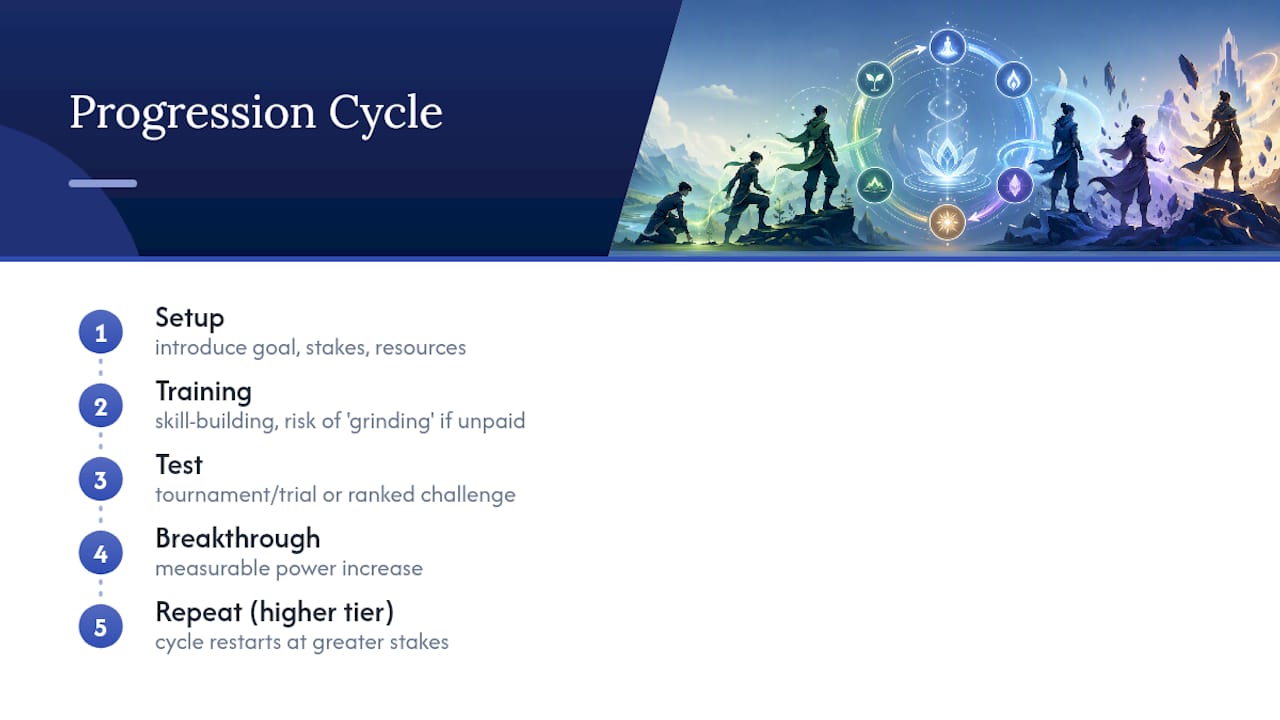
Authors vary the rhythm mainly through pacing between breakthroughs. Cradle compresses training arcs into relatively short spans and lets Lindon break through power tiers frequently, which keeps momentum high across ten books. Mother of Learning inverts the usual pacing entirely: the time loop structure means Zorian's growth happens across dozens of in-story repetitions of the same four months, so progression accumulates through iteration rather than a linear timeline.
Tournament and trial arcs serve a specific structural purpose beyond spectacle. They let an author stage a controlled comparison, showing exactly how much a character has grown by putting them against opponents the reader has already seen them lose to. Institutional ranking systems do similar work on a longer timescale, giving the story natural chapter and book break points without inventing a new external threat every time.
The genre's biggest pacing risk is what readers call "grinding," where training arcs stretch on without a corresponding narrative payoff. The strongest entries treat every training sequence as a setup for a specific future payoff, not filler between fights.
Typical Protagonist Archetypes and Development Arcs
Three protagonist types dominate the genre, and each one sets up a different kind of growth arc.
The underdog outcast, like Cradle's Lindon, starts with almost nothing (no natural talent, low social status, or a body that can't handle standard training methods) and compensates through creativity and persistence. Their arc is about proving that effort and clever adaptation can outperform raw gifts.
The transported or reincarnated protagonist, common across cultivation fantasy novels and LitRPG, arrives in the world with outside knowledge (game mechanics, modern problem-solving, foreknowledge of a plot) that gives them an edge over natives. Their arc usually shifts from exploiting that knowledge advantage early to earning genuine mastery once the story catches up to their head start.
The institutional climber, common in academy-based stories like Arcane Ascension, starts with real but unrefined talent and spends the story navigating a formal hierarchy: ranks, professors, rival students, graduation requirements. Their arc is as much about politics and reputation as raw power.
What unites all three is a resistance to the "chosen one" template. Progression fantasy protagonists are rarely destined for greatness. They build it, which is precisely the appeal for readers who find prophecy-driven plots unsatisfying.
How Progression Fantasy Reflects and Subverts Fantasy Tropes
Traditional epic fantasy often treats power as something discovered: a hidden bloodline, a prophecy, a sword that chooses its wielder. Progression fantasy takes the opposite stance almost as a genre-wide argument. Power here is built through repeatable, describable effort, and that's a direct rebuttal to the "chosen one" convention that dominated fantasy for decades.
The genre keeps some familiar fantasy furniture: magic systems, quests, dark lords, ancient orders. But it recontextualizes them around process instead of destiny. A magic sword in traditional fantasy is often a symbol of fate. In progression fantasy, a powerful weapon is more likely to be something the protagonist earned, crafted, or leveled up alongside.
The genre also inverts the pacing of traditional fantasy, where major power shifts often happen off page or through single dramatic events (a coronation, a magical awakening). Progression fantasy insists on showing the work: the training, the failed attempts, the incremental gains. That's less mystical and more procedural, which is exactly why readers who like systems and clear rules gravitate toward it.
Themes of Perseverance, Power, and Self-Improvement
Underneath the training arcs and tier systems, progression fantasy is doing something fairly direct: dramatizing the idea that sustained effort produces real results. That's a simple theme, but it's rare for a genre to build its entire structure around proving it scene after scene.
Perseverance shows up as the genre's baseline value. Protagonists who quit, or who expect shortcuts, are almost always punished narratively; the ones who put in repetitive, unglamorous work get rewarded with visible milestones. That structure appeals to readers who find something genuinely satisfying, not just escapist, in watching effort compound.
Power in this genre is rarely presented as corrupting by default, which sets it apart from a lot of traditional fantasy. Getting stronger is treated as a legitimate goal, not a moral trap, though the better entries in the genre still explore what a character sacrifices (relationships, time, ethical compromises) to keep climbing.
Self-improvement is the theme that ties the other two together, and it's likely why the genre has found such a devoted readership among people who also enjoy skill-building hobbies, tabletop gaming, and structured goal-setting in their own lives. Watching a character optimize their training regimen scratches an itch that's more personal than most fantasy subgenres attempt to reach.
World-Building and Magic Systems in Progression Fantasy
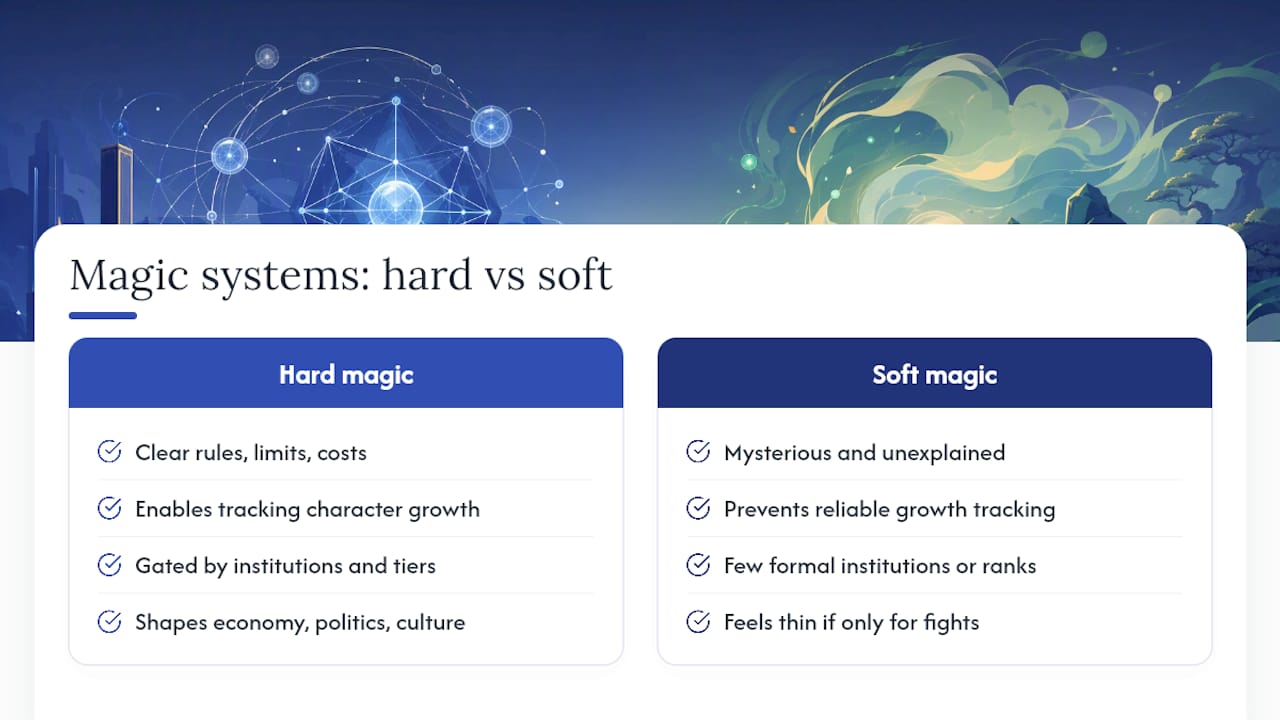
Magic systems in progression fantasy generally lean "hard" rather than "soft," a distinction fantasy readers often borrow from author Brandon Sanderson's writing about magic. A hard magic system has clear rules, limits, and costs that readers can learn and use to predict outcomes. A soft magic system stays mysterious and unexplained. Progression fantasy needs hard systems because the entire genre depends on readers being able to track growth, and you can't track growth against rules you don't understand.
That need shapes the world-building around it. Institutions (sects, academies, guilds) exist largely to formalize and gatekeep the magic system, giving it social structure and stakes beyond raw power. Named tiers and ranks aren't just flavor text; they're the scoreboard the entire plot runs on. Even currency, politics, and social status in these worlds often trace directly back to how magic power is measured and distributed.
The best progression fantasy worlds treat their magic system as an ecosystem with consequences, not just a power-up mechanic. Cradle's cultivation tiers reshape entire nations' politics. The Wandering Inn's class and skill system influences everything from farming to warfare. When the system only exists to justify fight scenes, the world-building around it tends to feel thin. When it's woven into economics, culture, and conflict, the setting starts to feel lived in rather than gamified.
Editor's Note: Why Progression Fantasy Is Resonating Now
Readers are drawn to stories where effort visibly pays off, and that's not a coincidence given how much of daily life feels arbitrary or ungoverned by clear rules. Progression fantasy offers the opposite: a world where training produces results you can point to.
Curating this genre means prioritizing books with a real completion path or a strong, consistent update pattern, since half-finished serials burn out reader goodwill fast. We also weigh whether a system stays legible past the first act, because that's usually what separates a series readers finish from one they quietly abandon.
— richard
Find Your Next Progression Fantasy Read on The Digital Reads
Thedigitalreads gives you a faster path into this genre than hunting through a general bookstore's fantasy shelf, where progression titles get buried between epic fantasy and sword and sorcery with no way to filter by system type or completion status. You get instant downloads in PDF, EPUB, or DOCX, a catalog weighted toward independent authors who are often writing the exact systems-heavy, training-arc-driven stories this genre is known for, and a real batch of free titles to sample before you spend anything.

Start by browsing The Digital Reads' full catalog and searching by substyle, whether that's cultivation, LitRPG-adjacent systems, or long-form epics. If you want to test the genre with zero risk first, check the free ebook selection before committing to a longer series. Either way, your next training arc is a download away on The Digital Reads' main page.
Sources
Picking your first progression fantasy novel is less about finding "the best" book and more about matching the story's pace and system complexity to what you actually want to read this month. Here's a reading path broken into four entry points.
- Progression Fantasy – A New Subgenre Concept – Andrew Rowe
- LitRPG - Wikipedia
- What Is Progression Fantasy? Definition & Best Books - LitRPG Critic
- 9 Best Progression Fantasy Books Classics & Hidden Gems - Immortal Cultivation Hub
- Progression Fantasy & LitRPG Database
FAQ
What Is a Progression Fantasy?
Progression fantasy is a subgenre where a character's measurable growth in power or skill drives the main plot, typically through training arcs, institutional ranks, or tiered systems rather than fate or prophecy.
What Is the Best Progression Fantasy to Start With?
Cradle by Will Wight is the most commonly recommended starting point because it's complete, fast-paced, and keeps its progression system clear from the first book; He Who Fights With Monsters is a strong second option for readers who want more humor.
What Is the Difference Between Progression Fantasy and LitRPG?
LitRPG requires visible game mechanics, like stat screens or an in-world system interface, while progression fantasy only requires measurable growth in power, which means many LitRPG books qualify as progression fantasy but not all progression fantasy uses LitRPG mechanics.
Is Harry Potter Progression Fantasy?
Not really. Harry Potter's power growth is present but incidental to a plot driven by prophecy and external threats; applying Andrew Rowe's own test, a book seven Harry doesn't clearly outclass a book one Harry the way genre-defining protagonists do.