
A portal fantasy book is any story where a character steps out of one world, usually ours, into another through a door, a wardrobe, a book, or some stranger threshold entirely. This guide walks you through what separates portal fantasy from its cousins in the fantasy family, then hands you curated picks across classic, dark adult, and mood-based lists so you can find your next read fast. If you want to skip the browsing and start downloading, curated ebook copies of many titles are available online.
TL;DR:
- Most portal fantasies involve a one-way or round-trip crossing, with the strongest stories exploring the psychological or emotional impact of either scenario.
- Classic portal stories like Narnia or Alice feature immediate, tangible thresholds that emphasize wonder and discovery, while darker titles like Piranesi or Neverwhere introduce themes of isolation and danger.
- Modern adult portal fantasies often focus on trauma, grief, and identity, using the crossing device to delve into complex emotional states and psychological unsettlement.
- The effectiveness of a portal story depends on how well the crossing feels consequential and whether the story earns its portrayal of the other world as a meaningful, dangerous, or transformative place.
- Curated lists and digital marketplaces provide instant access to both classic and contemporary portal fantasy titles across a wide range of tones and themes.
Table of Contents
- What Is Portal Fantasy, Exactly?
- Essential Classic Portal Fantasy Books to Start With
- Modern and Darker Portal Fantasies for Adult Readers
- Which Portal Fantasy Fits Your Mood?
- The Themes That Make Portal Fantasy Resonate
- How Do Portals Work as a Storytelling Device?
- Why Trust This Guide to Portal Fantasy?
- Why Portal Fantasy Still Matters for Grown-Up Readers
- Find and Download Your Next Portal Fantasy Read
- Where to Read More About Portal Fantasy
- Sources
- FAQ
What Is Portal Fantasy, Exactly?
Portal fantasy is defined by one move: a character leaves a familiar world, often our own, and enters a different one, according to Five Books' expert curation of the subgenre. That single act of crossing is what separates it from its neighbors on the fantasy shelf.
High fantasy, by contrast, builds its entire story inside an invented world from page one. There's no earthly starting point and no return trip; Middle Earth doesn't connect to anywhere you've been. Urban fantasy and intrusion fantasy flip the portal fantasy formula: instead of the character traveling to the magic, the magic invades their world, whether that's vampires in a modern city or a monster crawling out from under the bed. Portal fantasy needs the crossing itself, the literal geography of leaving one reality for another.
That crossing point can take several forms:
- Doors and wardrobes: the classic hinge, literalized. Narnia's wardrobe is the template everyone measures against.
- Books and pages: the story itself becomes the threshold, as in Inkheart or The Neverending Story.
- Dreams and sleep states: travel that blurs whether the other world is real or psychological.
- Objects and artifacts: a key, a mirror, a coin, or a strange piece of furniture that opens onto somewhere else.
- Scientific or pseudo-technical devices: machines, wormholes, or experiments standing in for magic doors.
The device matters because of what it does for storytelling. When a character (and by extension, the reader) walks into a new world for the first time, they have to learn its rules alongside us. Five Books' curators point out that this shared discovery lets authors avoid dumping pages of history and magic-system exposition on the reader; we learn as the protagonist learns, one strange rule at a time. That's a structural advantage high fantasy often struggles to replicate, since its readers are dropped into an already-built world with no naive guide walking beside them.
Essential Classic Portal Fantasy Books to Start With
If you're new to the subgenre, these are the touchstones that shaped it, and most readers who love portal fantasy point back to at least one of them.
- The Chronicles of Narnia by C.S. Lewis. The wardrobe crossing is the single most famous portal in fantasy fiction, and The Lion, the Witch and the Wardrobe remains the cleanest entry point for readers of any age.
- The Magician's Nephew by C.S. Lewis. A prequel that shows the creation of Narnia itself and introduces the "Wood Between the Worlds," one of the most inventive multiverse-portal concepts in the genre.
- Alice's Adventures in Wonderland by Lewis Carroll. Alice falls down a rabbit hole into a world with its own dream-logic rules, making it arguably the first widely read portal fantasy in English literature.
- Neverwhere by Neil Gaiman. Richard Mayhew slips beneath London into "London Below," a shadow city that runs on different laws entirely. This one's great for readers who want their portal fantasy laced with real menace.
- Piranesi by Susanna Clarke. A quieter, stranger pick: the protagonist lives inside an endless house full of statues and tides, and the mystery of how he got there (and whether he can, or wants to, leave) drives the entire book. Ideal for readers who like their fantasy meditative rather than fast.
- The Ten Thousand Doors of January by Alix E. Harrow. A young woman discovers doors that lead to other worlds throughout history and starts to understand her own family's connection to them. It's a strong pick for readers who want lush prose alongside their world-hopping.
- Every Heart a Doorway by Seanan McGuire. The first Wayward Children book follows kids who've already been through their portals and returned, then struggle to fit back into ordinary life. It works as a classic-adjacent entry point because it treats the portal premise itself as the subject of the story.
Start with Narnia or Alice if you want the purest, most foundational version of the formula. Reach for Neverwhere or Piranesi if you want the classic structure filtered through adult, literary sensibilities.
Modern and Darker Portal Fantasies for Adult Readers
Portal fantasy isn't confined to children's shelves. Modern writers regularly use the crossing device to explore trauma, identity, and grief, subjects that classic portal stories mostly skirted. Book Riot notes that the tone of portal fantasy runs the full range from cozy to genuinely dark, and the titles below sit toward the adult, literary end of that spectrum.
- A Darker Shade of Magic by V.E. Schwab. Kell travels between four parallel Londons, each with its own relationship to magic, in a series built for readers who want political intrigue and morally gray characters alongside the world-hopping.
- Every Heart a Doorway and the wider Wayward Children series by Seanan McGuire. These novellas ask what happens after the portal adventure ends, when a kid who found a real home in another world gets shoved back into a body and family that no longer fit. It is one of the sharper examples of "portal-back" storytelling in modern fantasy.
- The Ten Thousand Doors of January by Alix E. Harrow. Beyond its fairy-tale surface, this one wrestles with colonialism, ownership, and who gets to control the doors between worlds.
- Piranesi by Susanna Clarke. Its slow reveal deals with isolation, memory loss, and manipulation, making it a fit for readers who want their portal fantasy psychologically unsettling rather than adventurous.
- Neverwhere by Neil Gaiman. Good for readers who want body counts and real stakes attached to their alternate-London wandering.
If you want your first adult portal fantasy to ease you in, start with A Darker Shade of Magic. If you want something that will sit with you for days, go straight to Piranesi or Every Heart a Doorway.
Which Portal Fantasy Fits Your Mood?
Matching a book to how you're feeling beats scrolling a 400-title list. Readers consistently do better with a short list and a reason attached to each pick than with a bare title dump, which is part of why massive Goodreads Listopia rankings work better as a browsing tool than a decision tool.
Cozy and comforting:
- The Chronicles of Narnia — gentle stakes, clear morals, safe for any age.
- The Magician's Nephew — creation-myth wonder without much darkness.
Dark and unsettling:
- Piranesi — quiet dread built from isolation and mystery.
- Neverwhere — real danger and body horror lurking under London.
YA-friendly with emotional weight:
- Every Heart a Doorway — grief and belonging, handled with warmth.
- The Ten Thousand Doors of January — coming-of-age wrapped in mystery.
Experimental and literary:
- Piranesi again, for its structure alone.
- A Darker Shade of Magic — for readers who want genre-bending world design over strict portal mechanics.
When you're unsure which mood fits, ask yourself whether you want the crossing to feel like an adventure or a wound. That single question sorts most of the list above.
The Themes That Make Portal Fantasy Resonate
Portal fantasy keeps returning to the same handful of emotional territories, and recognizing them helps you predict whether a new title will land for you.
- Liminal spaces: the in-between moment of the crossing itself, whether that's Platform 9¾-style thresholds or the "Wood Between the Worlds" in Lewis's books.
- Yearning and transcendence: the portal often functions as a metaphor for wanting your whole life to change overnight, not just a plot mechanism. Five Books' curators describe this yearning as central to why the subgenre appeals to readers of every age.
- Identity: who are you in a world that doesn't know your ordinary self?
- Grief: several modern entries, especially the Wayward Children books, use the portal as a stand-in for loss and the desire to return to a place (or a version of yourself) that no longer exists.
- Found family: groups of portal travelers, whether in Narnia or in McGuire's boarding school for returned children, often form bonds that replace the family left behind.
Pro Tip: If you're not sure a book counts as portal fantasy, check whether the "other world" ever gets treated as a real, consequential place the character can lose. Books that only use magic as set dressing back home are intrusion fantasy, not portal fantasy, even if a door or mirror shows up somewhere in the plot.
Tone and pacing usually follow the theme a book leans into. A story built around yearning tends to move slower and linger on wonder (think Piranesi), while one built around identity or grief often moves faster and hits harder emotionally (think Every Heart a Doorway).
How Do Portals Work as a Storytelling Device?
The mechanism of travel shapes everything about a portal fantasy's stakes, and readers who've spent time with the subgenre judge books partly on how well the author handles this part.
Common portal mechanisms include:
- Doors and wardrobes: instant, physical, and easy for readers to visualize immediately.
- Books: the reading experience itself becomes recursive, since you're reading about someone falling into a story.
- Dreams: introduces ambiguity about whether any of it is "real," which can heighten psychological tension.
- Objects: keys, mirrors, and coins tend to imply rules and limits, since an object can be lost, stolen, or broken.
- Scientific devices: machines and experiments swap magic for pseudo-technical logic, nudging a book toward science fantasy.
The bigger question, though, is whether travel is one-way or round-trip. A one-way portal raises the stakes immediately: there's no home to return to, so every choice in the new world carries permanent weight. Round-trip portals, the Narnia model, let characters go back and forth, but that structure creates its own challenge, sometimes called the "portal-back" problem. What happens to a character's ordinary life while they're gone, and what happens to them psychologically once they return?
Seanan McGuire's Wayward Children series builds its entire premise around that second question, using returned portal travelers to explore reintegration trauma and the grief of losing a world that felt more like home than reality ever did. The most common pitfall in weaker portal fantasy is treating the home world as a throwaway detail, a boring place the character is glad to escape and never think about again. The strongest entries in the subgenre, from Piranesi to the Wayward Children books, treat the return (or the impossibility of it) as just as important as the world on the other side of the door.
Why Trust This Guide to Portal Fantasy?
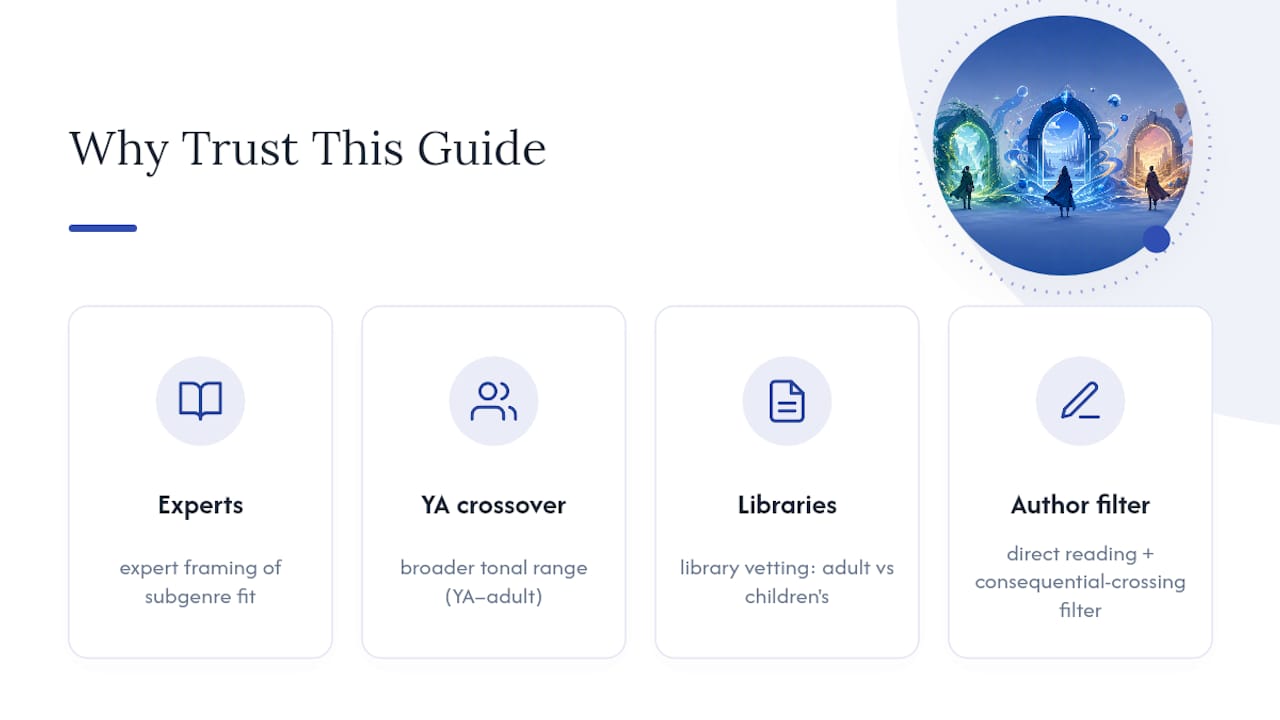
This list leans on expert curation rather than a raw index. Five Books' subgenre roundup, Book Riot's YA-crossover coverage, and staff-built library lists like Lawrence Public Library's adult portal fantasy collection all shaped the picks above, and each source adds something different: expert framing on why a book fits the subgenre, broader tonal range for YA and adult crossover, and library-grade vetting that separates adult titles from children's shelving.
There are fantasy catalogs curated to help readers find the right book fast without scrolling an endless shelf, carrying titles across science fiction, fantasy, horror, thriller, and romance, with instant downloads in common ebook formats, plus a lineup of free and independently published titles.
Richard's approach to building this list combined direct reading experience with genre-matching. Rather than listing every book with a door in it, each title was measured against the same test: does the crossing feel consequential, and does the story earn its "other world"? That filter is what separates a curated shortlist from a 400-item spreadsheet.
Why Portal Fantasy Still Matters for Grown-Up Readers
Portal fantasy gets dismissed sometimes as a children's device, all wardrobes and rabbit holes. That undersells what the subgenre is actually doing. The portal has always been a stand-in for the moment your life changes without warning, and adult readers carry a lot more baggage to project onto that moment than a child does.
What's changed is how directly modern authors use the device. Where Lewis kept Narnia mostly wondrous, writers like Susanna Clarke and Seanan McGuire point the crossing straight at grief, isolation, and the impossibility of ever fully coming home again. That's not a departure from portal fantasy's roots; it's the logical extension of what the yearning at its center was always about.
If you've only read the classics, the modern and dark picks above are worth the detour. Browse the curated lists on The Digital Reads and see which door you want to walk through next.
— richard
Find and Download Your Next Portal Fantasy Read
Some online marketplaces offer a faster route to your next portal fantasy than hunting through a big-box retailer's catalog, with fantasy collections that span classic touchstones and independently published titles side by side, offering instant downloads in popular formats along with free and affordable indie books alongside paid titles.
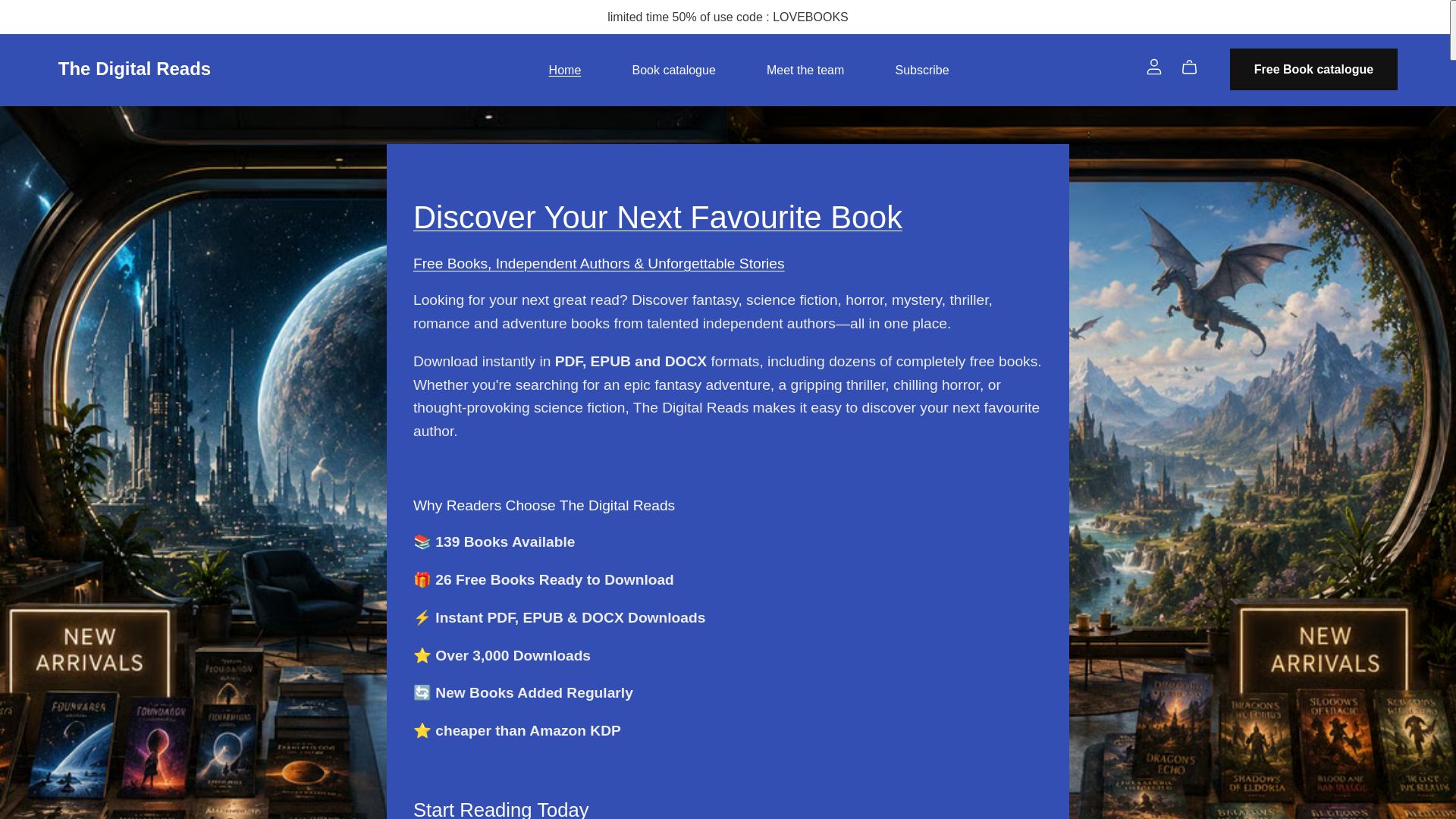
Start by browsing the fantasy subgenre breakdown to see how portal fantasy fits alongside the site's other genre categories, or head straight to the full catalog and search by title if you already know which door you want to open. Every format downloads instantly, so there's no waiting on shipping or device compatibility checks. If you loved the darker picks above, the site's list of unsettling reads for readers who want something different is worth a look next. Pick a title, check out, and start reading in minutes.
Where to Read More About Portal Fantasy
A few sources go deeper than any single article can, and they're worth bookmarking if this subgenre becomes a habit.
- Five Books' expert portal fantasy recommendations offer curator-level reasoning for why specific titles define the subgenre.
- Book Riot's roundup of portal fantasies for YA readers covers the crossover space between YA and adult tone.
- Lawrence Public Library's staff-built adult portal fantasy list shows how librarians separate adult titles from children's shelving.
- The Wikipedia category page for portal fantasy works well for readers who want an exhaustive index to dig through on their own.
For readers curious how portal fantasy overlaps with invented worlds more broadly, The Digital Reads' guide to books for fans of complex worlds is a natural next stop, and the fantasy archetype guide from Remerlinds offers a fun look at recurring character types across the genre.
Sources
- The Best Portal Fantasy Books - Five Books Expert Recommendations
- Adult Portal Fantasy — a staff-created list from Lawrence Public Library | Lawrence Public Library | BiblioCommons
- 8 great portal fantasies for YA readers — Book Riot
- Category:Portal fantasy — Wikipedia
FAQ
What Is a Portal Fantasy Book?
A portal fantasy book is a story in which a character leaves one world, typically the reader's own reality, and enters a different one through a door, object, book, or similar threshold, according to Five Books.
What Are Some Famous Portal Fantasy Stories?
The Chronicles of Narnia, Alice's Adventures in Wonderland, Neverwhere, and The Ten Thousand Doors of January are among the genre's most recognized examples, alongside modern entries like Every Heart a Doorway and A Darker Shade of Magic.
Is Harry Potter Considered a Portal Fantasy?
Not typically. Library classification tends to place the Harry Potter series under contemporary or urban fantasy, since magic exists hidden within our world rather than requiring the character to cross into a fully separate one, per Lawrence Public Library's staff curation.
What Are Some Famous Fictional Portals?
The wardrobe in Narnia, the rabbit hole in Alice in Wonderland, the doors throughout The Ten Thousand Doors of January, and the mysterious house in Piranesi all count among the genre's most recognizable crossing points.
Where Can I Find Portal Fantasy Ebooks to Download?
There are curated fantasy catalogs available with instant PDF, EPUB, and DOCX downloads, featuring free and independently published titles alongside paid picks from established authors.