
An indie author is a writer who publishes independently of the Big Five publishing conglomerates and keeps creative and business control over their own work. The label carries an attitude with it: an indie author treats writing as a business, not a side hobby. That single distinction shapes everything from how a book gets edited to who keeps the royalty check, and it's the thread running through every section below.
TL;DR:
- Indie authors retain ownership of all rights and maintain control over creative decisions, production, and distribution, unlike traditional publishers who license rights and handle most processes.
- Successful indie publishing typically involves continuous effort across multiple projects, building a catalog, and working with freelancers for editing and design, rather than publishing a single book.
- Indie authors usually sell directly through their websites or multiple outlets at lower prices, with higher royalty percentages, but face challenges in discoverability and operational tasks like metadata management.
- The upfront costs for editing, cover design, and formatting are significant, but they significantly impact professionalism and reader perception, making quality investments crucial.
- Indicators of an indie author include self-created imprint names, direct sales channels, lower consistent pricing, and acknowledgment of freelance professionals in the book.
Table of Contents
- Indie Author Meaning: The Definition Behind the Term
- Indie Author vs. Self-Published, Hybrid, and Traditional Authors
- The Indie Publishing Process, Step by Step
- The Business Side: Rights, Royalties, and Paperwork
- What Indie Authors Gain, and What It Actually Costs
- How to Spot an Indie Author's Book
- Starting Your Own Indie Author Path
- What Being Indie Actually Feels Like
- Sources
- FAQ
Indie Author Meaning: The Definition Behind the Term
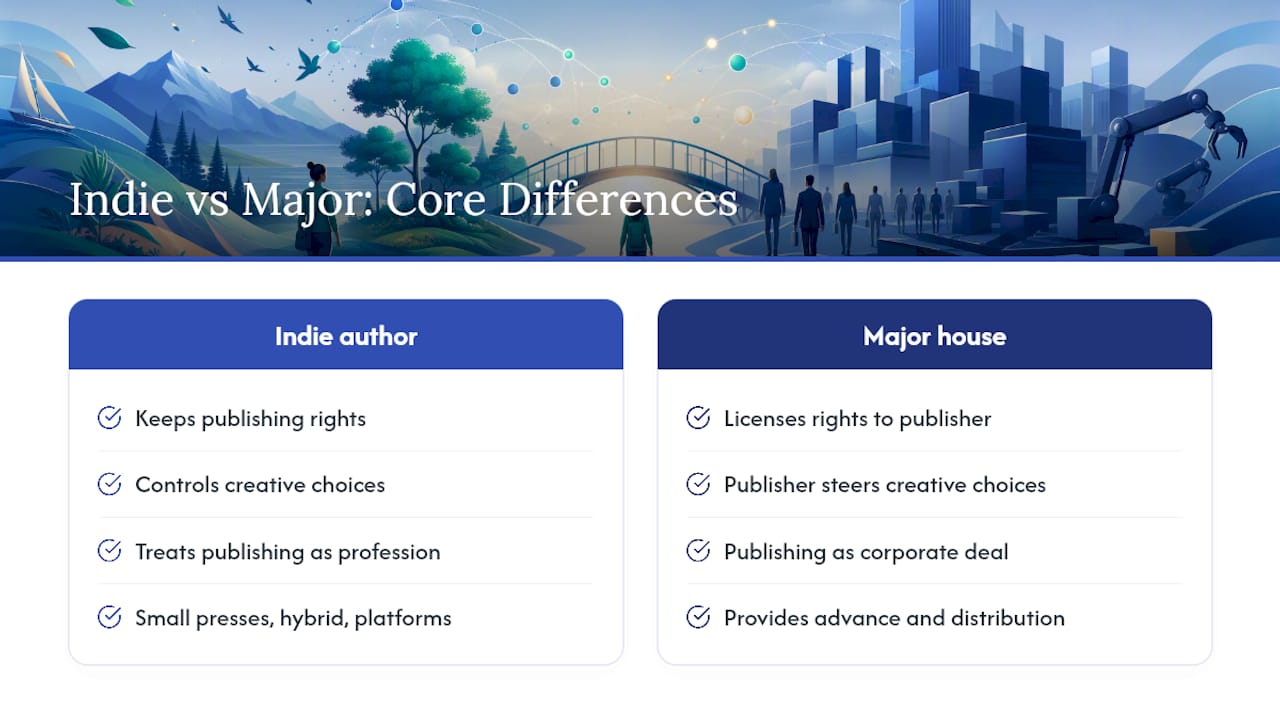
The Alliance of Independent Authors defines an indie author as someone who self-publishes at least one book, sees themselves as the creative director of their own books, and treats publishing as a profession rather than a pastime. Reedsy frames it similarly: an indie author retains creative and business control over their publishing rights and operates independently of the handful of corporate publishing houses that dominate bookstore shelves.
Those two definitions agree on the core point. "Indie" isn't really about how a book gets printed. It's about who's steering the ship.
That said, the term covers more ground than most readers assume. Indie publishing spans small independent presses, hybrid publishers, and self-publishing platforms that all share one trait: the author keeps autonomy that a Big Five deal typically doesn't offer. An author who signs with a boutique press but negotiates to keep subsidiary rights can reasonably call themselves indie. So can someone uploading a novel to a self-publishing platform from their kitchen table. The common denominator is control, not the size of the operation.
Rights ownership sits at the center of this. When you publish through a major house, you're usually licensing rights to your book for a set term, often the life of copyright, in exchange for an advance and the publisher's distribution muscle. An indie author typically holds onto those rights: translation, audio, film option, foreign editions, all of it. That means every deal an indie author signs later, whether it's an audiobook license or a foreign rights sale, is a choice they make rather than one made for them.
There's also a difference between publishing one book independently and building an indie author career. Plenty of people self-publish a single memoir for family and never touch the process again. That's self-publishing in the literal sense, but it's not really what the industry means by "indie." The label implies an ongoing practice: multiple titles, a growing catalog, and a business mindset that treats each release as part of something larger.
Indie Author vs. Self-Published, Hybrid, and Traditional Authors
These terms get tangled up constantly, so here's how they actually sort out.
Self-published describes the mechanism: the author uploads the files, sets the price, and skips a traditional publisher entirely. Every indie author is technically self-published, but not every self-published author is indie. Someone who publishes a single poetry collection as a keepsake for grandchildren is self-published. They're probably not running an author-business, and that's fine. It's just a different activity than what "indie" usually describes.
Hybrid authors work both sides. They might have a traditional deal for one series and self-publish a companion novella or backlist title on their own. Plenty of career indie authors eventually work with agents or small presses for specific projects while keeping direct control over others. Being indie doesn't mean swearing off publishers forever. It means the author decides project by project, rather than defaulting to whatever a single publisher offers.
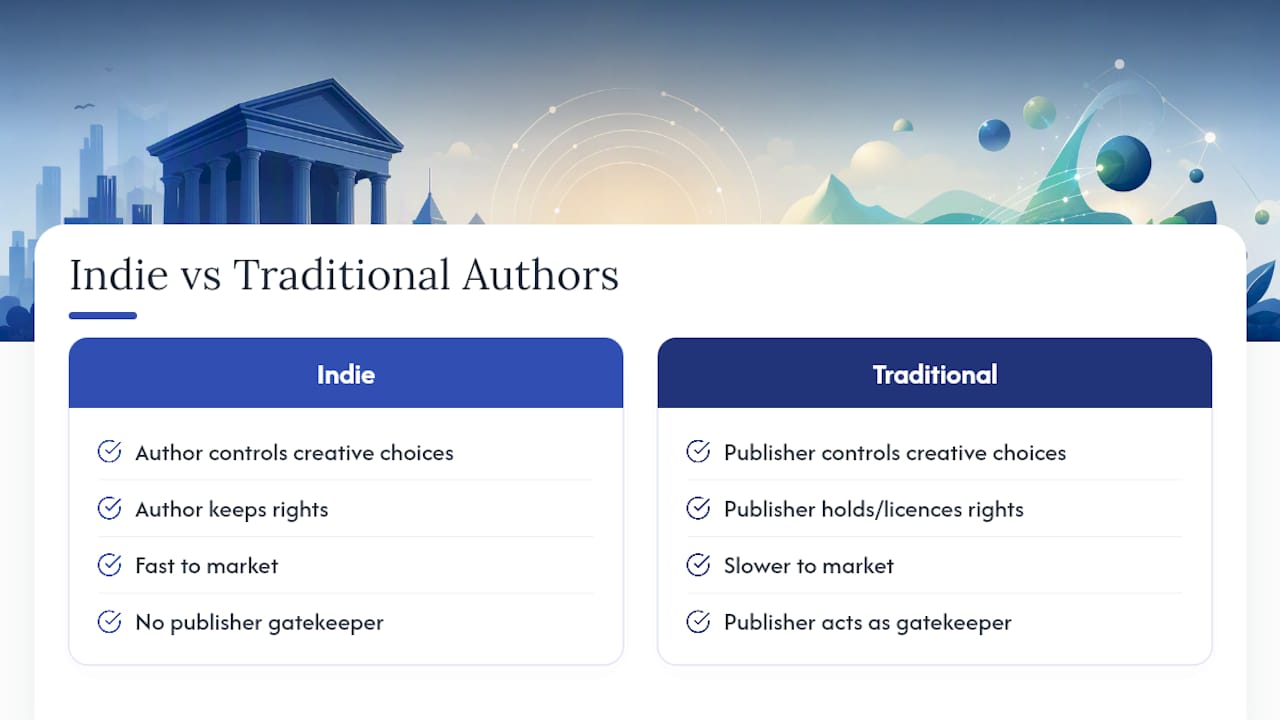
Traditionally published authors license their rights to a publisher who handles editing, design, distribution, and marketing, usually in exchange for an advance instead of a larger royalty percentage per copy. Independent publishing offers speed to market and greater creative control compared with that traditional route, while traditional publishing still holds an edge in established distribution networks and upfront money.
The dividing line, in practice, comes down to four things: who controls creative decisions, who owns the rights, how fast the book reaches readers, and who acts as gatekeeper before publication. Indie authors take the wheel on all four. Traditionally published authors hand most of that off in exchange for institutional support.
The Indie Publishing Process, Step by Step
Every indie author eventually runs the same production line, even if the order shifts a little. Here's the typical sequence:
- Finish and refine the manuscript. This usually means a developmental edit for structure and pacing, followed by feedback from beta readers who catch plot holes the author can't see anymore.
- Copyedit and proofread. These are separate skills. A copyeditor fixes grammar, consistency, and clarity. A proofreader catches what's left after everything else is "final."
- Design the cover and format the files. Genre fiction lives or dies on cover design because readers judge a book in about two seconds while scrolling. Formatting has to work across ebook, print, and increasingly audiobook.
- Choose a distribution path. Options range from direct sales on an author's own site to wide aggregator distribution across multiple retailers. Each has trade-offs in royalty split, reporting speed, and reader reach. A closer look at IngramSpark alternatives is worth a read before locking in a platform.
- Build a launch plan. Metadata, categories, and keywords determine whether a book surfaces in search or gets buried. Discoverability is arguably harder than writing the book.
- Cultivate reader relationships. A newsletter, an early-review team, and the occasional giveaway do more for long-term sales than a single launch-day push.
Most indie authors don't do every step alone. Reedsy's guide to indie publishing notes that successful authors typically work with a small team of freelancers, hiring an editor here, a cover designer there, rather than attempting the whole pipeline solo. Finding early readers matters enough that it's worth its own research; a resource like finding beta readers can shortcut a step that otherwise eats weeks.
The Business Side: Rights, Royalties, and Paperwork
Retaining your rights sounds abstract until you realize what it actually permits: you can license an audiobook version to one company, sell translation rights to a foreign publisher, and option film rights, all as separate deals, all on your own timeline. A traditionally published author usually can't do any of that without their publisher's involvement, because the publisher holds those rights.
Royalty structures differ sharply by channel. Direct sales and major ebook platforms often pay indie authors a much larger percentage per copy than a traditional contract would, though the trade-off is that the author absorbs production costs upfront instead of receiving an advance. Pricing strategy becomes part of the job: a $2.99 ebook and a $14.99 paperback aren't just different price points, they're different marketing decisions.
Metadata is the unglamorous half of the business. ISBNs, category selection, and keyword choices determine whether a book shows up where readers are actually looking. New indie authors consistently underestimate these operational tasks, and it costs them sales they never see happen.
Then there's the paperwork nobody warns you about: bookkeeping, tracking royalty statements across platforms, filing taxes as self-employment income, and reviewing every contract you sign with a freelancer or a distributor. That last one carries real risk. A common pitfall is signing with a fee-based service that markets itself like a publisher but quietly takes rights or locks the author into restrictive terms. Read every contract for rights reversion and distribution clauses before you sign anything.
Pro Tip: Don't cut corners on editing or cover design to save money early. A weak cover or a manuscript full of typos is the single fastest way to convince a reader you're an amateur, no matter how good the story actually is.
What Indie Authors Gain, and What It Actually Costs
The upside is real, and it's bigger than most newcomers expect. The downside is real too, and it's not the one people usually worry about.
The benefits:
- Full creative control over covers, titles, series direction, and release timing.
- Higher royalty percentages per copy sold on most direct and digital channels.
- Speed. An indie author can go from finished manuscript to published book in weeks, not the twelve to eighteen months typical of a traditional deal.
- Long-term backlist value. Guides on indie strategy consistently recommend building a series or catalog rather than betting everything on one release, since older titles keep generating income while newer ones launch.
The trade-offs:
- Every task without a hired freelancer falls on the author, including tasks they may not be good at.
- Upfront costs for editing, design, and formatting come out of pocket before a single copy sells.
- Discoverability is genuinely difficult without an existing platform or built-in distribution.
A few myths deserve to be retired outright. DIY doesn't mean amateur; some of the most polished books on the market are indie, produced by authors who hired the right professionals. Indie authors do win awards and earn reviews, including from major trade publications. And nobody gets rich overnight. Income tends to build gradually as a catalog grows, not from a single lucky release.
How to Spot an Indie Author's Book
Sometimes it's obvious. Sometimes it takes a little detective work. Here's what to look for:
- Check the imprint and copyright page. Traditional houses list recognizable imprint names. An indie title often lists the author's own name or a self-created imprint instead.
- Look at where the book is sold. Direct sales pages, author websites, and newsletter-driven promotions are strong indie signals. Traditionally published books rarely need the author to hand-sell copies from their own site.
- Notice pricing patterns. Indie ebooks are often priced consistently lower across every platform, since the author sets the price directly rather than a publisher setting a standardized retail price.
- Read the acknowledgments. Indie authors frequently credit specific freelance editors and cover designers by name, since they hired them individually rather than through an in-house publishing team.
When it's genuinely ambiguous, the safest move is to check the author's own website or ask directly. Hybrid cases exist, and an author who's indie for one series and traditionally published for another isn't hiding anything by looking mixed on paper.
Starting Your Own Indie Author Path
If you're ready to move from understanding the term to actually doing it, here's a realistic sequence:
- Finish the draft, then get outside eyes on it. Beta readers catch what you can't see after months inside your own manuscript. Paid developmental editing comes next, followed by a copyedit and proofread pass. Skipping straight to publishing without this step is the single most common regret among first-time indie authors.
- Decide your distribution approach before you format anything. Direct sales give you the biggest royalty cut but require you to build your own traffic. Aggregators simplify wide distribution across multiple retailers but take a cut for the convenience. Going wide through a single platform's exclusive program trades reach for simplicity. Compare the actual platforms available for self-publishers before committing, since switching later means re-uploading everything.
- Set your pricing and metadata strategy together, not separately. Categories and keywords determine who sees your book; price affects how many of them buy it. Treat this as one decision, not two afterthoughts.
- Build a simple three-pillar launch plan: a small early-review team, a newsletter signup that starts before launch day, and a modest paid or organic promotion push once the book is live. You don't need all three perfected. You need all three present.
- Budget for a small team instead of trying to do it all yourself. Even a modest budget for an editor and a cover designer changes the ceiling on what your book can achieve. A useful primer comparing self-publishing against traditional routes can help you weigh which trade-offs actually matter for your specific project.
For readers and researching authors alike, marketplaces built specifically around independent work are worth exploring early. The Digital Reads exists as a home for exactly this kind of discovery, connecting readers directly with independently published titles across genre fiction in instant-download PDF, EPUB, and DOCX formats. If you're an aspiring author trying to understand how readers actually find indie books, spending time browsing a platform built around that connection tells you more than any checklist can.
What Being Indie Actually Feels Like
Being indie means wearing every hat until you can afford to hand one off, and even then, you're still the one deciding which hat goes first. Some weeks you're a writer. Other weeks you're a project manager chasing a cover designer's proof, or a marketer figuring out why a new release isn't moving. That constant hat-switching is the actual job, far more than the glamorous parts anyone pictures.
Certain platforms exist in part because that entrepreneurial grind deserves a direct line to readers, not just a crowded shelf competing with everything else. Catalogs built around independent voices, with instant downloads and a genuine focus on discovery rather than algorithmic noise, can change how that daily trade-off pays off.
— richard
Sources
- Reedsy: What is an indie author?
- Alliance of Independent Authors: What is an indie author?
- Indie Pen Press: What Is Indie Publishing?
- Forbes: What independent publishing offers
FAQ
How can you tell if an author is indie?
Look at the copyright page for a self-created imprint, check whether the book sells directly from the author's own site or newsletter, and notice whether pricing stays consistent across every retailer rather than following a publisher's standardized rate.
Do indie authors make money?
Yes, and often at a higher royalty percentage per copy than traditional contracts pay, though income typically builds gradually as an author grows a catalog rather than arriving from a single release.
Who are some indie authors?
Indie authors span every genre and range from authors self-publishing their first title to writers running multi-book series entirely on their own; the category is defined by publishing independence, not by name recognition.
What's the difference between indie publishing and self-publishing?
Self-publishing describes the mechanism of putting a book out without a traditional publisher, while indie publishing implies an ongoing author-business built around retained rights, professional production standards, and a career mindset rather than a single release.