
Historical fantasy blends a real historical setting with magic, myth, or the supernatural — think medieval Russia haunted by folklore spirits or the Napoleonic Wars fought with dragon squadrons. Katherine Arden's Winternight Trilogy and Naomi Novik's Temeraire series both show exactly how it works. The rest of this guide covers the subgenre map, curated reading lists for every mood, and practical notes for writers who want to try it themselves.
TL;DR:
- Most historical fantasy hinges on secret history, alternate history, or numbers-filed-off worlds, each creating different ways magic integrates with real settings.
- At least eight subgenres, such as steampunk, gaslamp fantasy, and fantasy of manners, provide distinct flavors that influence tone, style, and historical inspiration.
- The genre's key themes include power dynamics, cultural clashes, and the use of folklore and mythology to deepen the portrayal of historical societies.
- Stronger representation from global cultures and non-European settings has broadened the genre's scope, offering more diverse and authentic experiences.
- Popular books like the Winternight Trilogy and Temeraire set foundational standards, while new titles like Babel and The Monsters We Defy push the genre in fresh directions.
Table of Contents
- What Is Historical Fantasy, Exactly?
- How Many Subgenres Does Historical Fantasy Actually Have?
- Which Historical Fantasy Books Should You Read First?
- Is Historical Fantasy the Same as Alternate History?
- How Do You Write Historical Fantasy That Feels Real?
- Quick Picks by Mood
- What Themes Show Up Again and Again?
- How Has Historical Fantasy Shaped Movies, TV, and Games?
- What Makes Historical Fantasy Ethically Tricky?
- Who Reads Historical Fantasy, and Why?
- A Publisher's Note on Curating This List
- Where to Find Historical Fantasy on Thedigitalreads
- Sources
- FAQ
What Is Historical Fantasy, Exactly?
Historical fantasy takes a real, usually pre-20th-century time period and layers fantastic elements onto it, magic, monsters, gods, or altered physics, without pretending the setting is invented. Wikipedia's overview of the category breaks this down into three common approaches, and understanding them will save you a lot of frustration when you're trying to figure out why one "historical fantasy" novel feels nothing like another.
The first approach is secret history: magic exists quietly alongside real events, hidden from the official record. Nobody in the history books notices, because the spellcasters made sure of it. The second is work that leans into alternate history, where a fantastical element changes the outcome of real events. Novik's Temeraire books are the textbook case. Napoleon's wars unfold differently because both sides now field aerial combat dragons, and the entire geopolitical chessboard shifts as a result.
The third approach is the secondary world modeled closely on a real period, sometimes called "numbers filed off." The author invents a fictional country, city, or empire but builds it so precisely on a real historical culture that readers recognize the bones underneath. R. F. Kuang's Babel: An Arcane History sits closer to this space; Oxford is real, but the magic system built on translation and silver is entirely invented.
Most historical fantasy draws its timeframe from before the 20th century, since folklore, empire, and pre-industrial technology give fantasy the most room to breathe. Writers frequently pull directly from regional mythology, Slavic house spirits, West African cosmology, Chinese wuxia traditions, rather than inventing a fantasy pantheon from scratch. That's part of why the genre rewards readers who like their magic tied to something that feels lived-in and specific, not generic.
A few things to keep straight as you browse:
- Secret history hides magic from the historical record entirely.
- Alternate history lets a fantastical cause visibly rewrite a real outcome.
- Numbers-filed-off worlds borrow a real culture's shape without naming it directly.
How Many Subgenres Does Historical Fantasy Actually Have?
At least eight labels show up often enough that you'll want to recognize them on sight. They overlap constantly, but each one signals a distinct flavor, and knowing the difference will make your book search a lot more precise than just typing "historical fantasy" into a search bar.
- Steampunk imagines an alternate Victorian or industrial era powered by fantastical steam and clockwork technology, often with airships and brass gadgetry standing in for modern machines.
- Gaslamp fantasy is steampunk's quieter cousin, using gaslit Victorian or Edwardian settings for magic and mystery without the heavy machinery focus.
- Gunpowder fantasy places magic in a world with muskets, cannons, and early modern warfare, splitting the difference between medieval sword fantasy and full industrial steampunk.
- Fantasy of manners borrows the drawing rooms, courtship rituals, and social maneuvering of works like Jane Austen's, then adds magic as another tool of status and scandal.
- Wuxia-influenced historical fantasy draws on Chinese martial arts traditions and imperial-era settings, blending swordplay, honor codes, and often qi-based magic.
- Afro-diasporic historical fantasy roots its magic and mythology in West African, Caribbean, or African American history and folklore, a space Lesley Penelope's The Monsters We Defy works directly in.
- Secret history hides its magic inside real documented events, as described above.
- Numbers-filed-off works build an invented setting so closely mirrored on a real place that the resemblance is the whole point.
These labels aren't just trivia. If you loved the airships in one book and hated the courtroom drama in another, knowing the difference between steampunk and fantasy of manners means your next pick actually matches what you're craving.
Which Historical Fantasy Books Should You Read First?
Some titles function as reference points for the entire genre. Others are the newer books actively reshaping what historical fantasy can do. Here's how they break down.
Benchmarks and genre-defining reads:
- The Winternight Trilogy by Katherine Arden — Medieval Russia, house spirits, and a heroine who refuses to choose between the old gods and the new church. This is secret history done with folklore precision.
- Temeraire by Naomi Novik — Napoleonic Wars fought with an intelligent dragon corps. The alternate-history approach at its most fully realized, spanning nine books.
- Babel: An Arcane History by R. F. Kuang — Oxford's translation institute runs on silver magic built from linguistic loss, and the empire that funds it has a body count. FiveBooks' genre roundup, curated with author P. Djèlí Clark, places this among the sharpest recent examples of the genre interrogating power directly.
Contemporary standouts:
- The Monsters We Defy by Leslye Penelope — 1920s Washington, D.C., a heist crew, and spirit-summoning magic rooted in Black folklore traditions. It's historical fantasy that treats the Harlem Renaissance era as more than backdrop.
- The Pomegranate Gate — A Kensington-published title set during the Inquisition, blending Jewish folklore and a mirror-realm magic system into a period rarely explored in fantasy. Kensington's own description of the book frames it as historical fantasy that treats a specific cultural tradition, rather than a generalized "old world" aesthetic, as its foundation.
Diverse and global voices worth seeking out:
Historical fantasy has expanded well past its early Anglo-European center of gravity. Penguin Random House's own curated historical fantasy list notes this shift explicitly, pointing to a wider geographic and tonal range as one of the genre's biggest recent changes. Readers who started with medieval Europe are now just as likely to land in Song dynasty China, colonial West Africa, or Ottoman court intrigue, and the genre is better for it.
If you're building a shelf, start with one benchmark, one contemporary standout, and one book from a tradition you haven't read before. That's the fastest way to see the genre's actual range instead of one narrow slice of it.
Is Historical Fantasy the Same as Alternate History?
Not quite, and the distinction matters more than it first appears. Wikipedia's breakdown of the category draws the line clearly: alternate history usually centers on a single divergent event and traces how it reshapes the timeline going forward. Historical fantasy, by contrast, often keeps history's major outcomes intact and simply adds magic or myth underneath or alongside it.
- Alternate history: a single change (a war won differently, a leader who never died) drives the entire plot forward from that fork.
- Secret history: magic is present throughout, but it's hidden, so the official historical record stays untouched.
- Historical fiction with fantasy elements: reads and feels grounded in real events, but adds folklore, ghosts, or magic as texture rather than as the engine of the plot.
Here's the practical takeaway: if you pick up a book expecting Napoleon to lose because of dragons, that's alternate history. If you expect Napoleon's wars to unfold roughly as they did, with a witch quietly working in the background nobody in the textbooks ever mentioned, that's secret history. Knowing which one you're holding sets your expectations correctly before chapter one.
How Do You Write Historical Fantasy That Feels Real?
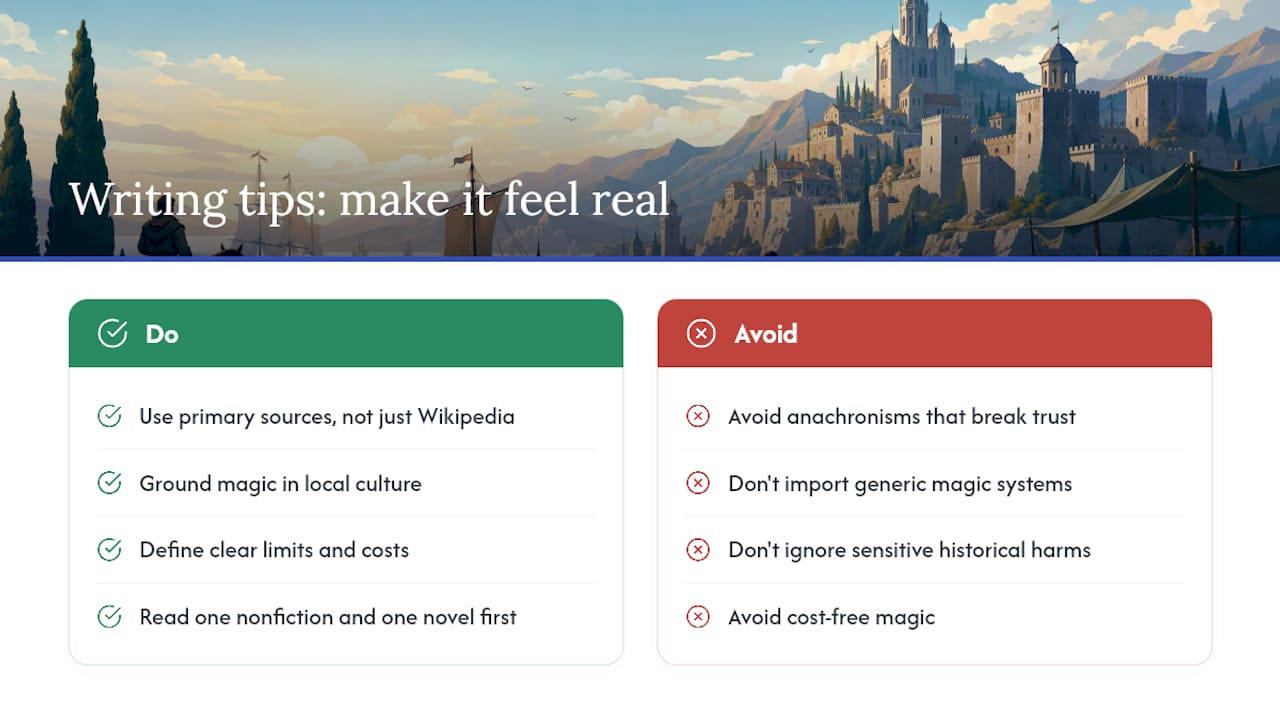
Good historical fantasy starts with research that goes past a Wikipedia skim. Primary sources, letters, court records, period newspapers, oral histories, give you the texture that secondary sources (textbooks, documentaries, other novels) tend to smooth over. If you're writing a Song dynasty court intrigue, a modern historian's analysis will tell you what happened; a translated primary account will tell you how people actually talked about it.
Your magic system needs its own internal logic, and that logic should grow out of the culture you're writing, not get imported from a generic fantasy toolkit. Ask who controls the magic in this society. Is it institutional, like a court-sanctioned order of translators, the way Kuang builds it in Babel? Or is it folk-level and hidden, passed between women in a household the way Arden handles it in Winternight? Limits matter too. Magic with no cost or consequence flattens tension fast.
Anachronism is the fastest way to break reader trust, and sensitive history deserves real care, especially when your magic system amplifies real historical harm like empire, slavery, or religious persecution. Historical fantasy at its best uses magic as a lens on those forces rather than a way to dodge them.
Pro Tip: Read one nonfiction source and one novel set in your target period before you write a single scene. The novel shows you what other authors chose to fictionalize; the nonfiction shows you what they left out. Once you've got a draft, browsing Thedigitalreads' genre collections and blog roundups is a fast way to see how other indie authors are handling similar settings and tones.
Quick Picks by Mood
If you want a classic starter: The Winternight Trilogy for folklore-soaked secret history, or Temeraire if you'd rather have dragons in your war rooms.
If you want pure atmosphere: The Pomegranate Gate for Inquisition-era dread laced with Jewish folklore, or anything from the Viking-flavored historical fiction space if you want cold, myth-heavy settings.
If you want something short: Look for novellas and shorter standalone entries in indie hidden-gem roundups, where length constraints often push authors toward tighter, sharper worldbuilding.
If you're studying craft: Babel for how a magic system can carry an entire political argument, and The Monsters We Defy for how folklore-rooted magic can anchor an ensemble heist plot in a specific time and place.
Readers who also like their historical fantasy with a strong romantic thread should check romantasy recommendations for crossover picks.
What Themes Show Up Again and Again?
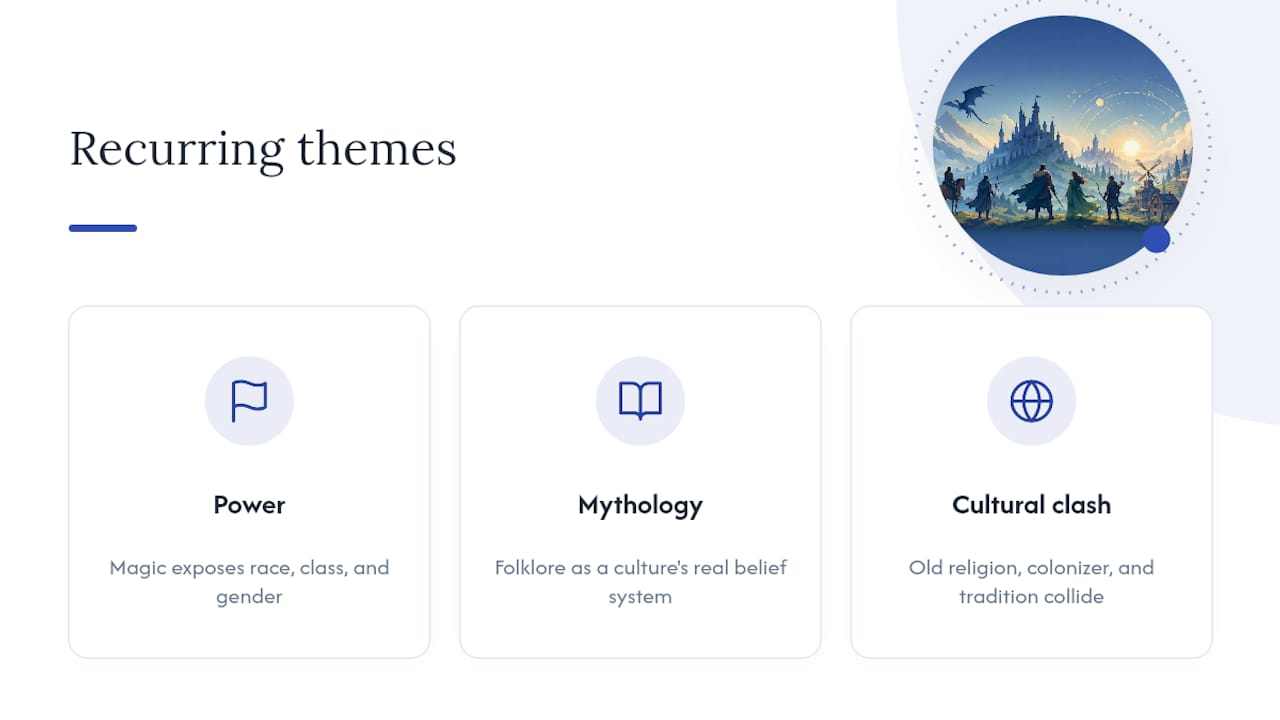
Power is the genre's most persistent obsession. Empires, courts, and institutions recur constantly because historical settings hand authors a ready-made power structure to interrogate, and magic makes the mechanics of that power visible in ways realistic fiction can't. P. Djèlí Clark and other authors working in this space treat magic as a way to expose how race, class, and gender actually function inside a historical hierarchy, rather than softening it.
Mythology and folklore show up almost as often, not as decoration but as the actual belief system a culture organized its life around. Arden's house spirits in Winternight aren't cute set dressing; they represent a real pre-Christian Slavic worldview colliding with an encroaching church.
Cultural clash is the third recurring engine: old religion versus new, colonizer versus colonized, tradition versus empire. Historical fantasy tends to dramatize these collisions through the lens of a single protagonist caught between worlds, which is part of why the genre so often produces coming-of-age arcs even when the setting is centuries removed from a modern reader's experience.
How Has Historical Fantasy Shaped Movies, TV, and Games?
The genre's fingerprints are all over prestige television and prestige-adjacent streaming slates. Court intrigue plus folklore magic has become a reliable formula for adaptation, and video games have leaned even harder into the space, letting players walk through reconstructed historical cities with a supernatural layer laid over the top. Tabletop and video game worldbuilders borrow constantly from wuxia, gaslamp, and steampunk conventions because those aesthetics translate well visually, brass gears and lantern light read instantly on screen in a way that abstract fantasy sometimes doesn't.
Adaptation also drives new readers back to the source material. A well-received show or game frequently sends viewers looking for the book or the historical period behind it, which is part of why publisher reading lists and roundups keep expanding. The traffic runs both ways: screen adaptations popularize the genre's aesthetic, and that popularity sends people back to novels for the depth a two-hour runtime can't hold.
What Makes Historical Fantasy Ethically Tricky?
Blending real history with invented magic raises a genuine question every author in this space has to answer: how much can you change before you're distorting a real culture's story? Writing a fictional empire "inspired by" a real one, without naming it, can let an author dodge the responsibility of getting the details right. The numbers-filed-off approach carries a specific risk here: authors have to balance recognizable cultural detail against invented names carefully enough that they don't flatten a real tradition into an aesthetic borrowed for atmosphere.
Magic that amplifies real historical harm, colonialism, slavery, religious persecution, needs deliberate handling. Done well, it exposes how those systems actually functioned. Done carelessly, it can turn real suffering into set dressing. There's no universal fix here; it comes down to whether the author treats the culture and history as a subject worth taking seriously or as raw material for spectacle.
Who Reads Historical Fantasy, and Why?
Historical fantasy tends to draw readers who want two things at once: the escapism of magic and the grounding of a setting that feels real enough to research further afterward. That combination pulls in history buffs who wouldn't normally pick up straight fantasy, and fantasy readers who find pure invented worlds a little too weightless.
The genre's expansion into wuxia traditions, Afro-diasporic folklore, and non-European courts has also widened who sees themselves reflected in it. A reader with roots in a culture historical fantasy rarely touched a decade ago now has real options, not just a European medieval default. That shift shows up clearly in how publisher lists like Penguin Random House's have broadened their geographic range in recent curated roundups, a sign the audience itself has diversified right alongside the catalog.
A Publisher's Note on Curating This List
I built this list the way I'd want a friend to hand me one: benchmarks first, then the newer books actually pushing the genre somewhere interesting. Thedigitalreads carries over 139 titles across genres, including 26 free downloads, and historical fantasy readers get the same deal everyone else does, instant PDF, EPUB, or DOCX access, with a real emphasis on independent authors who don't always get shelf space at a traditional bookstore. If you've read something in this space that deserves a spot on this list, tell us. We update the collection regularly, and reader requests genuinely shape what we add next.
— richard
Where to Find Historical Fantasy on Thedigitalreads
Thedigitalreads is built for exactly the kind of reading this list points you toward: instant access, no waiting on a library hold, no guessing whether a format will work on your device. Every title downloads in PDF, EPUB, or DOCX, so whether you're on an e-reader, a tablet, or reading straight off a laptop, the file just works.
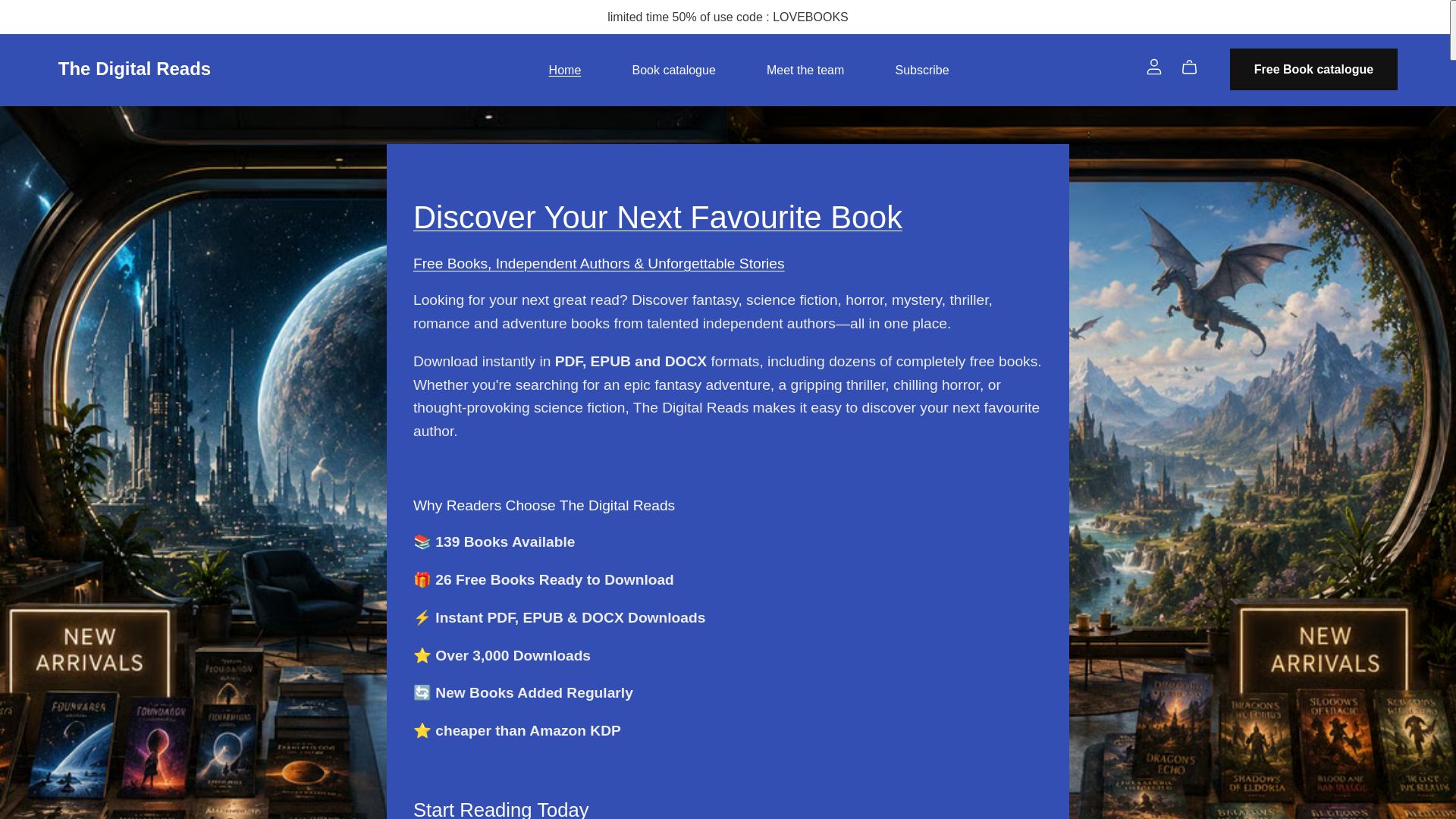
Browse the full collection to search historical fantasy alongside fantasy, romance, and thriller titles from independent authors you won't find on a typical bookstore shelf. If romantic subplots are part of what you're after, the romance collection has plenty of crossover picks worth a look, and readers hunting for free entry points into the genre should check the free fantasy ebooks roundup before spending a dime. Pick a title, download it, and you're reading in under a minute.
Sources
For deeper background on the titles and definitions covered here: FiveBooks' expert-curated historical fantasy list for author-recommended picks, Penguin Random House's reading list for editorial annotations, Wikipedia's genre overview for the standard taxonomy, and Kensington's page for The Pomegranate Gate for a detailed look at a modern example.
- The Best Historical Fantasy Books - Five Books Expert Recommendations
- Historical fantasy — Wikipedia
- Historical Fantasy Books To Escape Reality | Penguin Random House
- The Pomegranate Gate - Kensington Publishing
FAQ
What Counts as Historical Fantasy?
A book counts as historical fantasy when it sets a story in a real historical period, generally pre-20th century, and adds fantastic elements like magic, myth, or supernatural beings, whether hidden as secret history or woven visibly into the plot.
What Are Some Popular Historical Fantasy Series?
The Winternight Trilogy by Katherine Arden and the Temeraire series by Naomi Novik are two of the genre's most widely recommended multi-book series, both cited repeatedly in expert roundups like FiveBooks' list.
What Are Some Historical Fantasy Books Worth Reading Now?
Babel: An Arcane History by R. F. Kuang, The Monsters We Defy by Leslye Penelope, and The Pomegranate Gate all represent strong, distinct entry points into the genre's contemporary wave.
How Is Historical Fantasy Different From Straight Historical Fiction?
Historical fiction stays within the bounds of documented reality, while historical fantasy adds magic, myth, or the supernatural on top of a real setting, sometimes hidden from history, sometimes reshaping it outright.
Where Can I Find Free or Affordable Historical Fantasy Ebooks?
Thedigitalreads offers free and low-cost historical fantasy titles from independent authors, downloadable instantly in PDF, EPUB, or DOCX through its full collection.