
If you want to jump straight in, here are the ten grimdark fantasy books worth your time right now:
- The Blade Itself by Joe Abercrombie — sharp prose, gallows humor, high brutality; Book 1 of The First Law trilogy; available in EPUB/PDF
- The First Law trilogy by Joe Abercrombie — the complete arc; essential for anyone serious about the genre; series commitment
- Prince of Thorns by Mark Lawrence — antihero at his most ruthless; Book 1 of the Broken Empire trilogy; EPUB available
- The Poppy War by R.F. Kuang — war, trauma, and genocide through a Chinese-inspired lens; Book 1 of a trilogy; high intensity, significant payoff
- The Court of Broken Knives by Anna Smith Spark — lyrical and brutal in equal measure; Book 1 of the Empires of Dust series; standalone (single book)-friendly start
- Remote Control by Nnedi Okorafor — slim, speculative, and quietly devastating; standalone (single book); EPUB/PDF friendly
- Best Served Cold by Joe Abercrombie — standalone (single book) revenge thriller set in the First Law world; great entry point if you want one book, no series
- The Lies of Locke Lamora by Scott Lynch — heist-driven, witty, and vicious; Book 1 of the Gentleman Bastard sequence
- Blood Song by Anthony Ryan — character-driven grit with earned brutality; Book 1 of Raven's Shadow; strong series starter
- The Way of Shadows by Brent Weeks — fast-paced assassin story; Book 1 of the Night Angel trilogy; great for readers new to dark fantasy
New to the genre? Start with The Blade Itself or Best Served Cold. Returning readers ready to go deeper? The Poppy War or The Court of Broken Knives will push you further.
Key Takeaways
The single most important thing to know about grimdark fantasy books: the best titles in the genre use moral ambiguity and brutal consequences to say something true about power, human nature, and the cost of survival.
| Point | Details |
|---|---|
| Start with Abercrombie | The Blade Itself is the clearest entry point for new grimdark readers: dark humor, high brutality, and a payoff that earns every page. |
| Match tone to your tolerance | Kuang's The Poppy War hits hardest; Okorafor's Remote Control is the gentlest entry; Abercrombie sits in the middle. |
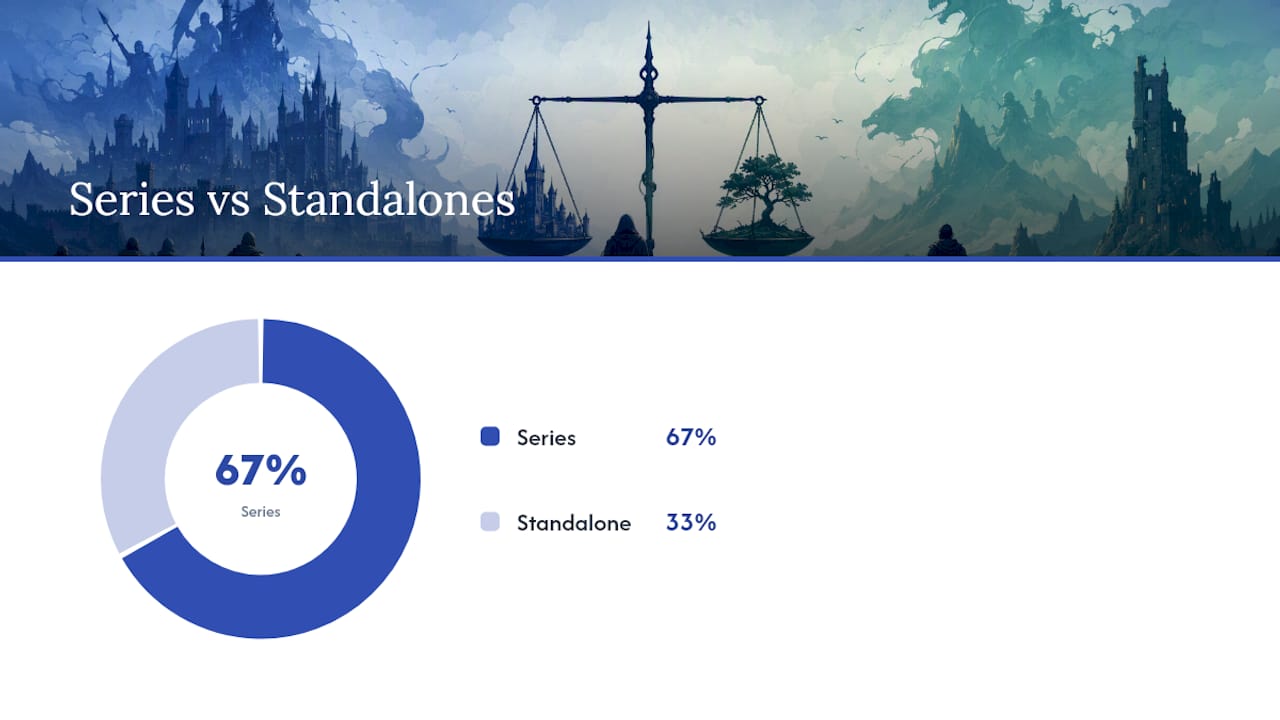
| Series vs. standalone (single book) matters | Best Served Cold and Remote Control deliver full grimdark payoff in one book; the First Law trilogy requires three. |
| Check content warnings first | Graphic violence, sexual violence, and pervasive despair are common across the genre; sample a chapter before committing. |
| Thedigitalreads for instant access | The platform offers PDF, EPUB, and DOCX downloads with no subscription, including indie titles not found on major retailers. |
Table of Contents
- What grimdark fantasy actually is (and how it differs from dark fantasy)
- Curated grimdark picks by category: starters, classics, and contemporary voices
- How to pick your next grimdark book
- Content warnings: what to expect before you start
- Reading order for major grimdark series
- How modern grimdark has grown beyond its early roots
- Where to find these grimdark books in digital formats
- How grimdark fantasy changed the genre and popular culture
- An editor's honest take on reading grimdark
- Thedigitalreads has the grimdark ebooks you're looking for
- Sources
- FAQ
What grimdark fantasy actually is (and how it differs from dark fantasy)
Grimdark fantasy is a subgenre defined by moral ambiguity, systemic cruelty, and realistic consequences rather than supernatural horror or clear-cut heroism. The term itself is borrowed from the Warhammer 40,000 tagline "In the grim darkness of the far future, there is only war," and it stuck because it captures the tone perfectly: worlds where good intentions fail, power corrupts, and survival often requires compromising everything you believe in.
The key distinction from dark fantasy is tonal and thematic, not just about violence level. Dark fantasy leans on supernatural dread, gothic atmosphere, and horror elements. Grimdark, by contrast, centers on moral failure and human cost. The monsters are often the people in charge. The heroes, when they exist at all, are deeply flawed and pay real prices for their choices.
Four traits that define the subgenre:
- Moral ambiguity: protagonists make choices you'd condemn in real life, and the story doesn't let them off the hook
- Systemic cruelty: institutions, governments, and armies are corrupt by design, not by accident
- Consequential violence: injuries, deaths, and trauma carry weight and alter the story's direction
- Cynical tone: idealism is tested hard, and often broken
Critics and editors at Grimdark Magazine stress that what separates genuine grimdark from gratuitous suffering is consequence. Violence and cruelty must mean something to the story and the characters. When it doesn't, it's shock value. When it does, it's grimdark.
Curated grimdark picks by category: starters, classics, and contemporary voices
The books below are organized by reader type, not just quality. Every title here has earned its place through community consensus, critical recognition, or a distinctive voice that expands what the genre can do.
Starter picks (lower barrier, high reward)
The Blade Itself by Joe Abercrombie is the modern grimdark benchmark. Its cynical protagonist Logen Ninefingers, the scheming Inquisitor Glokta, and the vain nobleman Jezal dan Luthar form one of fantasy's most memorable trios. The prose is fast, the humor is dark, and the violence lands with real weight. It's the book that showed the genre what it could be.
Best Served Cold (Abercrombie) works as a standalone (single book) revenge thriller set in the same world. No prior reading needed. If you want to test your tolerance for grimdark without committing to a trilogy, this is the cleanest entry point.
Classic grimdark essentials
Prince of Thorns by Mark Lawrence introduces Jorg Ancrath, a thirteen-year-old who leads a band of killers and has done things that would make most protagonists flinch. It's deliberately iconoclastic, designed to unsettle readers who expect a heroic arc. The Broken Empire trilogy that follows is one of the genre's most debated and most admired.
The Lies of Locke Lamora by Scott Lynch blends heist fiction with brutal consequences. The city of Camorr is vivid and dangerous, and Lynch's characters are clever enough to make you root for them even when they're doing terrible things.
Contemporary and diverse voices
The Poppy War by R.F. Kuang draws on the Second Sino-Japanese War and the Nanjing Massacre to build a fantasy world where war crimes are not metaphorical. Kuang's protagonist Rin goes from scholarship student to weapon of mass destruction across three books. The brutality is purposeful and historically grounded. This is grimdark with something urgent to say.
The Court of Broken Knives by Anna Smith Spark is the most literary entry on this list. Her prose is fragmented and poetic, her soldiers are exhausted and morally hollow, and her world feels genuinely ancient and indifferent. It's a harder read than Abercrombie, but the payoff is a distinctive voice unlike anything else in the genre.
Remote Control by Nnedi Okorafor is shorter and stranger than most grimdark titles. Set in near-future Ghana, it follows a girl called Sankofa who carries death with her wherever she goes. It's speculative, quietly devastating, and proof that grimdark doesn't require a medieval European setting.
Comparison at a glance
| Book | Best for | Tone / brutality | Standalone vs series | Approx. commitment | Content warnings |
|---|---|---|---|---|---|
| The Blade Itself | New grimdark readers | Dark humor, high brutality | Series (Book 1 of 3) | substantial length per book | Graphic violence, torture |
| Prince of Thorns | Readers who want a ruthless antihero | Bleak, high brutality | Series (Book 1 of 3) | moderate length per book | Violence, sexual violence |
| The Poppy War | Readers ready for historical weight | Harrowing, very high brutality | Series (Book 1 of 3) | substantial length per book | War crimes, genocide, drug use |
| The Court of Broken Knives | Literary readers, experienced grimdark fans | Lyrical and brutal | Series (Book 1 of 3) | moderate length per book | Graphic violence, despair |
| Remote Control | Readers wanting a short, standalone (single book) | Quiet, unsettling | Standalone | short length | Death, isolation, grief |
| Best Served Cold | Readers wanting one book, no commitment | Revenge-driven, high brutality | Standalone | substantial length | Graphic violence, sexual content |
Pro Tip: If you're unsure about your brutality tolerance, read the first chapter of The Blade Itself as a sample. Abercrombie's opening pages tell you exactly what kind of story you're in for.
For readers who love complex worlds with dense lore, the First Law trilogy and The Poppy War both reward the investment. If you're drawn to morally corrupt characters who operate in shades of grey rather than black and white, every title on this list delivers.
How to pick your next grimdark book
Four questions decide which grimdark title fits you right now:
- How much brutality can you handle? Some readers want grit without graphic detail; others want the full weight of consequence. Know your threshold before you start.
- Do you want a series or a standalone (single book)? A trilogy is a relationship. A standalone (single book) is a one-night read. Both are valid, but they're different commitments.
- What tone draws you in? Abercrombie's dark humor is very different from Kuang's historical fury or Smith Spark's lyrical despair. Tone matters as much as plot.
- Do you want character-driven or plot-driven? Grimdark skews character-heavy, but some titles (like The Lies of Locke Lamora) lean harder on plot mechanics.
A quick decision path:
- Want character-driven grit with dark humor? Start with The Blade Itself.
- Want a single-volume payoff with no series commitment? Pick Best Served Cold or Remote Control.
- Want historical weight and something that feels urgent? Go to The Poppy War.
- Want literary prose and a genuinely different voice? Try The Court of Broken Knives.
- Want fast-paced action with a morally complex antihero? Prince of Thorns or The Way of Shadows.
One thing to watch: if a book is labeled as progression fantasy rather than grimdark, the tonal expectations are very different. Progression fantasy (and cultivation fantasy books in a similar vein) focuses on earned power growth and measurable advancement. Grimdark focuses on moral decay and human cost. The two occasionally overlap, but readers who cross between them without knowing the difference often feel blindsided.
Pro Tip: Before committing to a full series, read the author's acknowledgments or a few reader reviews that mention tone specifically. Authors like Abercrombie are transparent about what they're doing; that transparency is a good sign.
Content warnings: what to expect before you start
Grimdark fantasy earns its reputation. The most common triggers across the genre:
- Graphic violence: detailed combat injuries, torture, and death are standard. In titles like The Poppy War, this extends to depictions of war crimes.
- Sexual violence: present in varying degrees across many grimdark titles, including Prince of Thorns and Best Served Cold. Some authors handle it with care; others less so.
- Cruelty to children: grimdark doesn't always protect younger characters. The Poppy War and Prince of Thorns both include harm to minors.
- Pervasive despair: unlike dark fantasy, which often resolves toward hope or horror catharsis, grimdark can end in ambiguity or outright bleakness. Readers prone to depression should pace themselves.
- Substance use and addiction: appears in The Poppy War as a plot-significant element.
- Moral complicity: readers are often positioned to root for characters doing genuinely terrible things. That discomfort is intentional.
The best way to check before you buy: look at reader reviews on Goodreads that specifically mention triggers, check the publisher's content advisory if one exists, and read the first chapter as a tone test. Author and publisher pages for modern grimdark releases often call out tone and content explicitly. Joe Abercrombie's publicity for The Devils, for example, emphasizes gore, dark humor, and an ensemble of monstrous heroes so readers know exactly what they're walking into.
Pro Tip: The StoryGraph lets you filter books by content warnings and mood, which is genuinely useful for grimdark readers who want to manage their reading experience.
Reading order for major grimdark series
Follow publication order unless an author explicitly recommends otherwise. Prequels written after the fact often assume familiarity with the world; reading them first can flatten the emotional payoff.
Major series and recommended starting points:
- The First Law trilogy (Abercrombie): The Blade Itself → Before They Are Hanged → Last Argument of Kings. Then standalone (single book) novels (Best Served Cold, The Heroes, Red Country) in any order. The Age of Madness trilogy follows after.
- Broken Empire (Mark Lawrence): Prince of Thorns → King of Thorns → Emperor of Thorns. The Red Queen's War trilogy is set in the same world and can be read independently.
- The Poppy War (R.F. Kuang): The Poppy War → The Dragon Republic → The Burning God. Read in order; the trilogy builds on itself.
- Empires of Dust (Anna Smith Spark): The Court of Broken Knives → The Tower of Living and Dying → The House of Sacrifice. Start at Book 1.
- Raven's Shadow (Anthony Ryan): Blood Song → Tower Lord → Queen of Fire. Blood Song works as a near-standalone (single book) if you want to test the series.
How modern grimdark has grown beyond its early roots
The genre's early canon was built largely by male British authors in the late 1990s and 2000s. Joe Abercrombie, Mark Lawrence, and Steven Erikson defined the template: sprawling worlds, morally compromised protagonists, and a willingness to kill or maim anyone. That template was genuinely exciting, but it also had blind spots in whose stories got told and whose suffering got centered.
Grimdark Magazine's community lists now include a much wider range of authors alongside those early staples, and the shift is meaningful. R.F. Kuang brings a Chinese-American perspective and a historian's precision to atrocity. Nnedi Okorafor writes from a West African tradition that makes the genre's usual European medieval setting feel like the narrow choice it always was. Kameron Hurley's work (particularly the Bel Dame Apocrypha series) centers women in brutal military worlds without softening the brutality for them.
What these newer voices bring isn't just demographic diversity. They bring different kinds of moral complexity. Kuang's grimdark is about what colonialism and nationalism do to individuals who believe in a cause. Okorafor's is about what it means to carry power you didn't ask for. The suffering in their books is purposeful in ways that feel different from the "war is hell" template, and that difference has made the genre more interesting.
For readers who want to explore the overlap between grimdark and gothic horror traditions, E.L. Ravenheart's dark fantasy and gothic horror titles show how adjacent genre conventions handle similar themes of moral corruption and dread.
Where to find these grimdark books in digital formats
Most of the titles on this list are available across major US ebook retailers in EPUB and MOBI formats. Thedigitalreads offers curated genre collections with instant downloads in PDF, EPUB, and DOCX, which is particularly useful for readers who want format flexibility or who are looking for indie and independent-author titles that don't always surface on larger platforms.
A few practical tips for digital readers:
- Format matters: EPUB is the most flexible format for most e-readers. PDF works best on tablets or larger screens. DOCX is useful if you annotate heavily.
- DRM considerations: some major retailer editions are DRM-locked to specific apps. Thedigitalreads titles are available for instant download without the platform lock-in.
- Price-saving strategies: library apps like Libby and Hoopla carry many grimdark titles for free with a library card. For indie or hard-to-find titles, Thedigitalreads is worth checking first.
- Sales timing: major ebook retailers run genre sales regularly. Abercrombie's backlist in particular goes on sale frequently.
Pro Tip: Download a sample chapter before buying any grimdark title. Most platforms offer this, and a single chapter tells you more about whether a book's voice suits you than any review can.
For readers who enjoy dark fiction broadly, Thedigitalreads also curates dark romance picks and regularly updates its most popular fantasy titles so you can see what's trending right now.
How grimdark fantasy changed the genre and popular culture
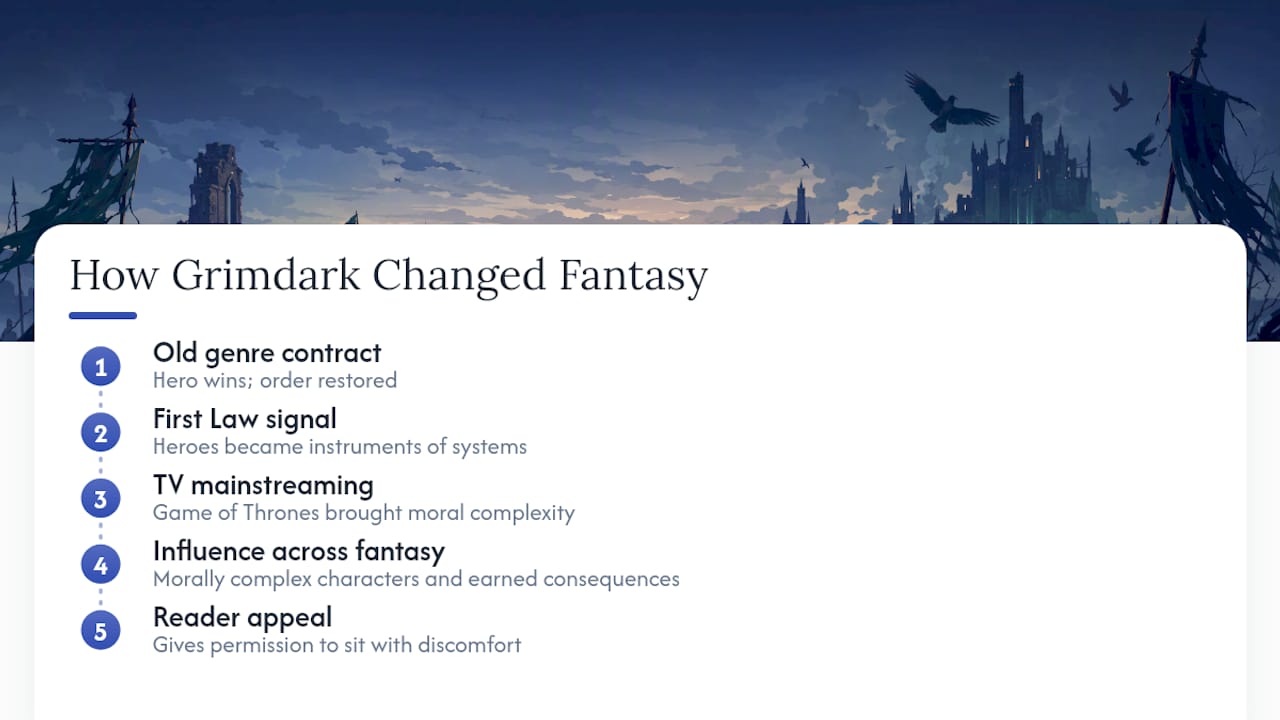
Grimdark didn't just add darkness to fantasy. It fundamentally changed what fantasy was allowed to be. Before the genre solidified in the early 2000s, mainstream epic fantasy operated under an implicit contract: the hero would struggle, but good would ultimately win, and the world would be restored to something recognizable. Grimdark broke that contract deliberately.
Joe Abercrombie's First Law trilogy, published between 2006 and 2008, was the clearest signal that the rules had changed. Characters who looked like heroes turned out to be instruments of systems they couldn't escape. Victories came at costs that negated them. That cynicism resonated with readers who had grown up watching real-world institutions fail in ways that epic fantasy's optimism couldn't address.
The cultural ripple was significant. Television adapted the tone before it adapted the books: Game of Thrones (based on George R.R. Martin's A Song of Ice and Fire, a direct predecessor to the grimdark wave) brought the genre's moral complexity to a mainstream audience that had never read Abercrombie or Lawrence. That exposure created a new generation of readers who came to the books wanting the darkness rather than tolerating it.
The genre also pushed back against the idea that fantasy was escapism in a simple sense. Grimdark argues that fiction can hold difficult truths about power, violence, and human nature without flinching. That argument has been absorbed into the broader fantasy conversation, and you can see its influence in titles that wouldn't call themselves grimdark at all: morally complex characters, earned consequences, and a refusal to let protagonists off the hook are now standard tools across the genre.
For readers interested in why dark fiction holds such a powerful pull, that question has a real answer: grimdark gives readers permission to sit with discomfort and find meaning in it.
An editor's honest take on reading grimdark
What I look for in a grimdark book comes down to three things: consequences that actually land, tonal control, and at least one character whose choices I can follow even when I can't excuse them. When a book has all three, the brutality earns its place. When it's missing even one, the darkness starts to feel like decoration.
The Blade Itself works as an entry point because Abercrombie never lets the violence feel cheap. Every injury, every betrayal, every moral compromise accumulates. By the end of the trilogy, you understand why the world is the way it is, and that understanding is genuinely uncomfortable. That's the genre doing its job.
The Poppy War is the deeper dive I'd recommend for anyone who wants grimdark that has something specific to say. Kuang isn't just writing a dark fantasy; she's writing about how ideologies consume people and how historical atrocities get rationalized. It's a harder read, but it stays with you in a way that most fantasy doesn't.
If you're new to dark fiction and wondering whether grimdark is for you, the piece on why readers are drawn to dark fiction is worth a few minutes of your time before you commit to a 500-page trilogy.
Thedigitalreads has the grimdark ebooks you're looking for
Thedigitalreads is the fastest route from "I want to read grimdark" to actually reading it. The platform carries curated genre fiction in PDF, EPUB, and DOCX formats with instant downloads, no waiting, and no subscription required. That means you can grab a title from the shortlist above and be reading within minutes.

The collection includes indie and independent-author titles that don't always surface on larger retail platforms, which matters for grimdark readers who want to go beyond the bestseller lists. Free titles are available alongside paid ones, so you can sample the genre without spending anything upfront. Browse the full fantasy and horror collection to find your next read, or check the main catalog for the latest additions.
Sources
- Grimdark Fantasy: Where to start reading - Grimdark Magazine
- The Devils - Joe Abercrombie
- Grimdark Fantasy: Your Guide to Literary Devastation - Dabble
- The Blade Itself by Joe Abercrombie | Hachette UK
FAQ
What is a grimdark fantasy book?
A grimdark fantasy book is a subgenre of fantasy defined by moral ambiguity, systemic cruelty, and realistic consequences rather than heroic triumph or supernatural horror. The term comes from the Warhammer 40,000 tagline and describes stories where protagonists are deeply flawed, institutions are corrupt, and violence carries real narrative weight.
What are the best grimdark fantasy books to start with?
The Blade Itself by Joe Abercrombie is the most widely recommended starting point, followed by Best Served Cold (standalone (single book), same world) for readers who want a single-volume commitment. The Poppy War by R.F. Kuang is the strongest contemporary pick for readers ready for higher intensity.
What are the darkest grimdark fantasy books?
The Poppy War by R.F. Kuang is among the most harrowing, drawing on historical war crimes for its source material. The Court of Broken Knives by Anna Smith Spark and Prince of Thorns by Mark Lawrence are also consistently cited for their unflinching brutality and bleak outcomes.
What is the difference between grimdark and dark fantasy?
Grimdark centers on moral failure, human cost, and systemic cruelty; dark fantasy leans on supernatural dread, gothic atmosphere, and horror conventions. The distinction is tonal: grimdark asks what people do to each other, while dark fantasy asks what darkness does to people.