Start with the curated shortlist below: a mix of modern standouts and genre touchstones, chosen because each one nails a specific corner of folk horror rather than a watered-down version of all of them. You'll find capsule reviews, the themes that define the subgenre, and reading paths matched to your taste, so you walk away with your next book already picked.
TL;DR:
- Most folk horror books feature isolation, ancient rituals, and landscapes that act as active, almost sentient characters driving the story.
- Settings like remote villages, forests, coastal towns, and industrial sites are essential, each imparting different atmospheres of community secrets or natural menace.
- Contemporary folk horror often explores modern anxieties such as gentrification, ecological collapse, and social fragmentation alongside traditional motifs.
- Slower-paced novels like The Loney and Harvest Home reward patience with gradual buildup of dread, while faster entries like The Ritual deliver more immediate tension.
- Recognizing motifs like community secrecy and landscape as character helps identify folk horror even in books that do not explicitly label themselves as belonging to the subgenre.
Table of Contents
- The Best Folk Horror Books, Ranked by What They Do Best
- Authors Who Shaped Folk Horror Fiction
- What Actually Makes a Book Folk Horror?
- How to Pick Your Next Folk Horror Read
- Why Trust This List of Folk Horror Recommendations
- Where Folk Horror Came From
- How Folklore and Mythology Shape the Genre
- Folk Horror Books vs. Folk Horror Films
- Settings That Define Folk Horror's Atmosphere
- How Folk Horror Reshaped Contemporary Fiction
- A Curator's Personal Picks
- Find and Download These Folk Horror Picks on Thedigitalreads
- Sources
- FAQ
The Best Folk Horror Books, Ranked by What They Do Best
Folk horror earns its name from what haunts it: not ghosts in the traditional sense, but belief systems, buried history, and the land itself turning against outsiders. The picks below cover that range, from slow-burn village dread to coastal industrial horror, and each one tells you exactly who it's for before you commit your reading time.
-
Something in the Walls by Daisy Pearce. A child psychologist travels to a remote English village to treat a girl convinced a witch lives in the walls of her home, and the town's decades-old superstitions turn out to be less quaint than they first appear. Reviewers and Pearce's publisher frame it as folklore braided with psychological suspense, which makes it a strong pick if you want dread that builds through character rather than jump scares. Best for: readers who like their horror grounded in a protagonist's unraveling perspective.
-
The Dark Between the Trees by Fiona Barnett. Two timelines collide: a doomed 1643 platoon fleeing an ambush into Moresby Wood, and a present-day expedition retracing their route. The publisher's synopsis leans hard into landscape as antagonist, with the wood itself holding memory and menace across centuries. Best for: readers who want the forest to feel like a character with its own grudges.
-
Withered Hill by David Barnett. An isolated Lancashire village clings to pagan rites that outsiders mistake for quaint tradition until the rituals start demanding more than dancing around a maypole. Penguin Random House's description positions it alongside classic village-horror touchstones, and the sense of entrapment is the point: nobody who visits Withered Hill leaves quite the same. Best for: fans of claustrophobic, community-complicity horror.
-
Scratch Moss by David Barnett. This one swaps the pastoral village for a former mining community, where the folklore is tied to what got dug out of the ground rather than what grows on top of it. The publisher's blurb frames industrial history as the horror engine, a variation on folk horror that rewards readers tired of the same moorland setting. Best for: readers who want folk horror with a working-class, post-industrial edge.
-
Scuttler's Cove by David Barnett. Barnett's coastal entry trades mine shafts for tide pools and harbor towns, where community complicity and old maritime superstition drive the dread. Best for: readers drawn to isolation of a different kind, the kind you get when the sea cuts a town off rather than the woods.
-
The Wicker Man novelization by Robin Hardy and Anthony Shaffer. The book that gave the subgenre its most famous ending still reads as a masterclass in how a rational outsider gets dismantled by a community that never doubted itself for a second. Best for: anyone starting from zero who wants the foundational text before branching out.
-
Harvest Home by Thomas Tryon. An American family relocates to a New England village that still practices agricultural rites nobody bothered to mention during the house tour. It's slower than most modern picks, but the payoff justifies the patience. Best for: readers who like their dread to arrive in inches, not jump scares.
-
The Loney by Andrew Michael Hurley. A family's Easter pilgrimage to a bleak stretch of English coastline turns into something closer to a reckoning with what the land has absorbed over generations. Best for: readers who want prose-forward, literary folk horror over plot-forward thrillers.
-
Starve Acre by Andrew Michael Hurley. A grieving couple digs into the history of their rural property and finds that the land keeps a longer memory of loss than either of them can manage. Best for: readers who want folk horror filtered through grief rather than outright menace.
-
A Cosmology of Monsters by Shaun Hamill. Less classically "folk" than the others here, but its family mythology and small-town dread make it a smart bridge for readers who came from cosmic horror and want something with more community texture. Best for: crossover readers testing the subgenre for the first time.
-
The Ritual by Adam Nevill. Four friends take a shortcut through Scandinavian wilderness and discover the forest has its own worshippers. It moves faster than most entries on this list, which makes it a solid pick if you want folk horror without the slow burn.
Pro Tip: If a blurb uses the words "isolated," "ancient," or "traditions," that's usually the publisher signaling folk horror even when the marketing copy avoids the term outright.
Authors Who Shaped Folk Horror Fiction
Some names come up again and again once you start reading folk horror seriously, and knowing them helps you build a reading list beyond any single roundup.
- David Barnett. With three entries on this list alone (Withered Hill, Scratch Moss, Scuttler's Cove), Barnett has built a body of work exploring how different British landscapes, from village to mine to coast, generate their own flavor of dread. Starter title: Withered Hill.
- Andrew Michael Hurley. His prose style, dense and unhurried, defined a wave of "quiet" British folk horror in the 2010s that prized atmosphere over plot mechanics. Starter title: The Loney.
- Thomas Tryon. A former actor turned novelist, Tryon proved American soil could grow the same dread as an English moor. Starter title: Harvest Home.
- Shirley Jackson. Not always shelved under folk horror, but her fixation on communities that police outsiders through unspoken ritual (see The Lottery) laid groundwork the subgenre still leans on. Starter title: The Lottery and Other Stories.
- Fiona Barnett. A newer voice using dual timelines to make historical trauma and modern folk horror speak to each other in the same narrative. Starter title: The Dark Between the Trees.
- Daisy Pearce. Works at the intersection of folklore and psychological suspense, often through a female protagonist whose grip on reality gets tested by a community's belief system. Starter title: Something in the Walls.
Cross-genre writers like Shaun Hamill, whose A Cosmology of Monsters leans partly cosmic, show how porous the border is between folk horror and its neighboring subgenres. If you want to map that border more precisely, a rundown of horror subgenres is worth a look before you commit to a reading path.
What Actually Makes a Book Folk Horror?
Folk horror runs on a specific set of motifs, and knowing them turns you from a passive reader into someone who can spot the subgenre from a book jacket alone.
- Ritual. Communities perform ceremonies that outsiders read as harmless custom until the stakes reveal themselves. Withered Hill's pagan traditions are the clearest example on this list.
- Landscape as character. The setting isn't backdrop, it's an active force with memory and intent. The Dark Between the Trees makes Moresby Wood feel like it's been waiting centuries for the right visitors.
- Communal belief and complicity. The horror often comes from an entire town agreeing on something the protagonist can't accept, a dynamic that goes back to genre-defining explainers on the subgenre's core motifs.
- Isolation. Geographic remoteness cuts characters off from help, whether it's a Lancashire village or a coastal town like the one in Scuttler's Cove.
- Survivals of paganism. Old belief systems that never fully died out, resurfacing under a thin coat of modern respectability.
Modern folk horror has started bending these motifs toward newer anxieties. Recent releases increasingly fold in gentrification, climate anxiety, and social fragmentation as updates on the same old fear: a community protecting something at the expense of an outsider.
How to Pick Your Next Folk Horror Read
Match your mood to a reading path instead of grabbing whatever's trending. It saves you from the specific disappointment of expecting a slow burn and getting a sprint, or vice versa.
- New to the subgenre? Start with The Wicker Man or A Cosmology of Monsters for a gentler entry point before you hit denser prose stylists.
- Want a slow burn? The Loney and Harvest Home reward patience over pacing.
- Craving psychological unease over supernatural threat? Something in the Walls keeps you guessing whether the horror is real or a mind unraveling.
- Want ritual front and center? Withered Hill delivers it without much throat-clearing.
- Prefer landscape-driven dread? The Dark Between the Trees and Scratch Moss both make setting the true antagonist.
A quick warning on pacing: several of these books, particularly Hurley's and Tryon's, take their time. If you need constant momentum, start with The Ritual instead, then work backward into slower entries once you've calibrated to the subgenre's rhythm.
Pro Tip: Read folk horror at dusk, ideally somewhere with a window facing trees or open field. The genre's dread depends on ordinary landscapes turning uncanny, and reading in daylight under fluorescent lights undercuts that effect more than any weak chapter could.
Why Trust This List of Folk Horror Recommendations
This shortlist is built around books with strong publisher and reviewer backing, not algorithmic guesswork. The curated list includes a mix of independent authors alongside established names, focusing on books that earn the folk-horror label through actual motif and atmosphere, not marketing convenience. This piece was curated by richard, whose related coverage of atmospheric and unsettling fiction on a dedicated book blog informs the reading paths above. Curation here means cross-referencing publisher descriptions, reviewer consensus, and reader discovery patterns like the ones on Goodreads' folk horror shelf, then trimming the list down to titles that actually deliver on the label.
Where Folk Horror Came From
Folk horror as a labeled subgenre traces back to a loose trio of British films from the late 1960s and early 1970s, most famously The Wicker Man, though the term itself wasn't widely used until decades later when critics retroactively grouped these works together. The literary roots run deeper and older: 19th-century ghost story writers like M.R. James were already mining rural England's half-remembered customs for dread long before anyone called it folk horror.
What changed in the 1970s was a specific cultural anxiety: rapid urbanization and the decline of rural tradition made writers and filmmakers newly interested in what got left behind when villages modernized. That anxiety, a rational modern person confronting a community that never let go of its older beliefs, became the subgenre's engine. It resurfaced hard in British fiction during the 2010s, driven by writers like Andrew Michael Hurley, and again in the 2020s as a new wave of novelists applied the same structure to fresh settings, from mining towns to coastal villages.
The throughline across sixty years of folk horror is remarkably stable: modernity arrives somewhere it doesn't belong, and the place pushes back.
How Folklore and Mythology Shape the Genre
Folk horror doesn't invent its terror from nothing. It borrows directly from real folklore, half-remembered agricultural rites, harvest festivals, well worship, and pre-Christian survivals that lingered in rural pockets long after formal religion took over. Writers mine this material because it already carries cultural weight; readers sense, correctly, that these rituals echo something real even when the specific plot is fiction.
Harvest Home's agricultural ceremonies draw on genuine corn-god mythology found across European farming cultures. Withered Hill's pagan traditions pull from the same well of British folklore that inspired The Wicker Man. This isn't coincidence: authors researching the subgenre tend to circle back to the same wells of pre-Christian belief because those traditions were built around exactly the anxieties folk horror wants to dramatize: fertility, death, and a community's survival against nature's indifference.
Mythology also supplies structure. Many folk horror plots quietly follow the shape of a sacrificial myth, an outsider or chosen figure whose death or transformation restores balance to the land or community. You don't need to know the specific folklore a novel is drawing from to feel its pull, but recognizing the pattern helps explain why these stories feel inevitable rather than random. Once you notice a book building toward a harvest, a chosen victim, or a communal rite timed to the calendar, you're watching mythology's oldest engine at work.
Folk Horror Books vs. Folk Horror Films
The films got there first in cultural memory, largely because The Wicker Man, Blood on Satan's Claw, and later Midsommar gave the subgenre its visual shorthand: sun-drenched fields, ceremonial costumes, communities smiling a little too readily at strangers. But books and films deliver folk horror's dread through different mechanisms, and knowing the difference helps you pick the right medium for what you want.
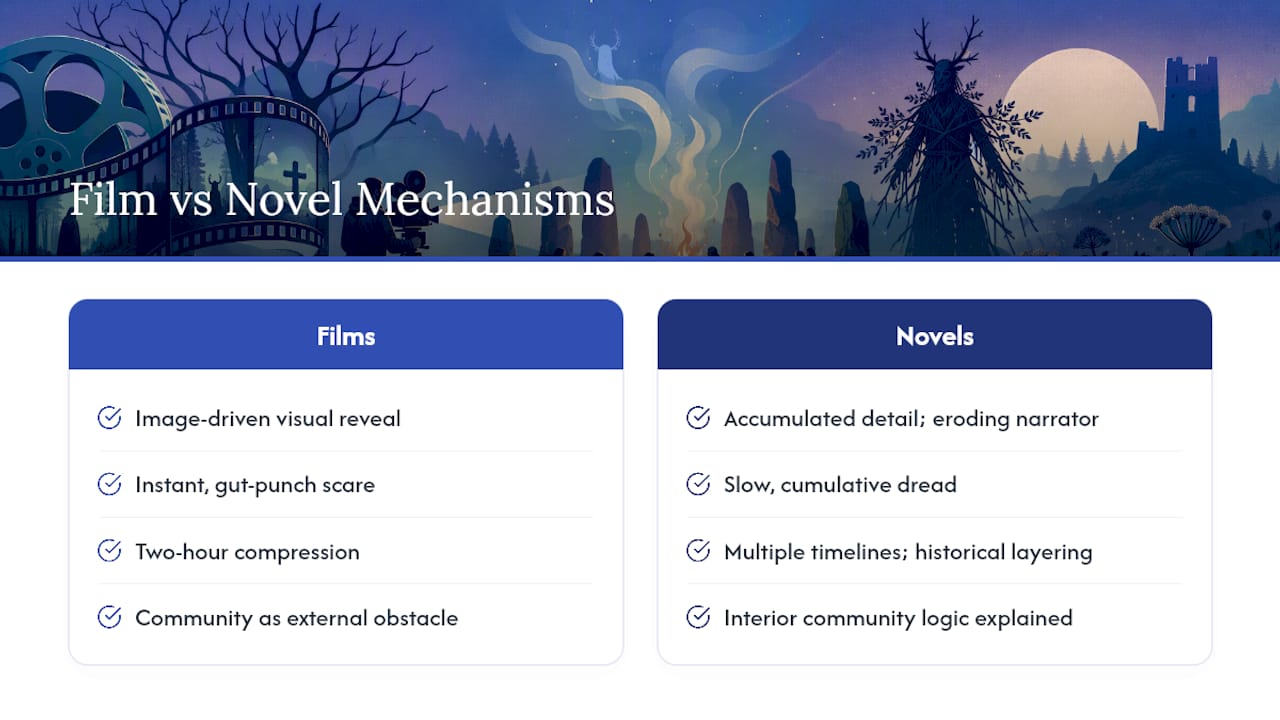
Film relies on visual reveal, a ritual mask, a hidden structure, a crowd turning to face the camera in unison. That's an instant, image-driven scare. Books, by contrast, build dread through accumulated detail and a narrator's slowly eroding certainty. Something in the Walls works because you're trapped inside a psychologist's rationalizations as they crack, page by page, something film's faster pacing rarely allows.
Books also have more room for historical layering. The Dark Between the Trees juggles two full timelines, 1643 and the present day, giving the woodland mythology centuries of texture that a two-hour film would need to compress or cut. Novels can also linger on a community's interior logic, letting you understand why villagers believe what they believe, rather than presenting them purely as an obstacle for outsiders to escape.
Neither format wins outright. Film delivers the immediate visual gut punch; novels deliver the slow, cumulative dread of watching a worldview collapse. Most serious folk horror fans end up consuming both.
Settings That Define Folk Horror's Atmosphere
Folk horror is unusually dependent on where it happens, more than most horror subgenres. The setting isn't scenery, it's load-bearing.
Isolated villages remain the classic backdrop, close-knit enough that everyone shares the same secret, remote enough that outside help never arrives in time. Withered Hill uses this to full effect. Forests and woodland carry their own weight, a location where paths disappear and old growth implies old memory, as The Dark Between the Trees demonstrates across both its timelines. Coastal towns bring a different flavor of isolation: cut off by tide and weather rather than distance, with maritime folklore standing in for pagan agricultural rites, the terrain Scuttler's Cove works.
Industrial and post-industrial settings are the subgenre's newer frontier. Scratch Moss trades green fields for mine shafts, proving folk horror doesn't need rolling hills to work, just a community bound tightly enough by shared history and shared ground. What unites all of these settings is the same underlying rule: the location has to be closed enough that the community's belief system goes unchallenged for generations, and remote enough that when something goes wrong, nobody outside notices in time.
How Folk Horror Reshaped Contemporary Fiction
Folk horror's fingerprints show up well outside horror shelves now. Literary fiction has borrowed its slow-dread pacing and landscape-as-character technique, visible in the way novels marketed as upmarket fiction increasingly foreground rural isolation and buried community history as engines of tension rather than pure backdrop.
Crime and mystery fiction have absorbed folk horror's central trick, too: a tight-knit community's collective silence functioning as the real antagonist, more than any single culprit. That structure now shows up regularly in rural mystery novels that owe more to folk horror's DNA than to traditional detective fiction.
The subgenre's biggest recent shift is thematic rather than structural. Writers are increasingly using folk horror's old bones, ritual, isolation, communal belief, to dramatize modern anxieties like gentrification and ecological collapse rather than sticking purely to historical pagan revival plots. A village protecting its land from developers now carries the same narrative weight a village protecting a pagan rite once did. That flexibility is likely why the subgenre keeps finding new readers instead of calcifying into a nostalgia act: the framework bends toward whatever a given decade is actually afraid of, whether that reader also happens to enjoy historical fiction rooted in similar isolation.
A Curator's Personal Picks
If forced to pick three favorites from this list, I'd go with Something in the Walls for how completely it commits to its protagonist's unraveling, The Dark Between the Trees for making two timelines feel like one continuous nightmare, and Withered Hill for the way it makes a maypole dance feel like a countdown.
What folk horror delivers that other subgenres don't is a specific kind of dread: the sense that you, the outsider, are the only one who hasn't been let in on the joke, and by the time you understand it, it's too late to leave. That's a harder emotional trick to pull off than a jump scare, and it's why the best entries stick with readers for weeks.
What would you add to this list? The subgenre keeps expanding, and the best folk horror recommendations tend to come from readers trading titles, not top-down rankings.
— richard
Find and Download These Folk Horror Picks on Thedigitalreads
Thedigitalreads gives you a faster route to these titles than hunting across multiple retailers: one catalog, instant downloads, and a heavy focus on independent authors you won't find lined up on a chain bookstore shelf.

Thedigitalreads' full catalog mixes free and affordably priced ebooks across horror, fantasy, thriller, and romance, with an emphasis on indie voices who don't always get shelf space elsewhere. To get started, search the title you want from this list, check the sample pages if one's available, and download in EPUB, PDF, or DOCX depending on your reading setup. Availability and format options vary by title, since independent authors control their own uploads, so it's worth confirming a specific format is listed before you commit to a purchase. If you've already burned through this list, browse the broader catalog for adjacent indie horror while you wait for your next folk horror recommendation to surface.
Sources
- Something in the Walls by Daisy Pearce | Hachette UK
- The Dark Between The Trees | Simon & Schuster
- Withered Hill by David Barnett | Penguin Random House
- Fiction 101: Folk Horror
FAQ
What is the best folk horror book to start with?
The Wicker Man novelization remains the most accessible entry point, but if you want a contemporary pick, Something in the Walls by Daisy Pearce delivers folklore and psychological suspense without demanding prior genre knowledge.
What is considered the scariest book ever written?
There's no single agreed-upon answer since fear is subjective, but within folk horror specifically, Harvest Home and The Loney are frequently cited by readers for dread that lingers well past the final page.
What is considered folk horror?
Folk horror centers on rituals, isolated landscapes, and communities holding onto pre-Christian or pagan traditions that outsiders discover too late, a definition reflected in genre explainers and consistent across both classic and modern titles.
Who are some famous folk horror authors?
David Barnett, Andrew Michael Hurley, Thomas Tryon, and Daisy Pearce are among the names most associated with the subgenre, each bringing a distinct setting, whether village, coast, mine, or moor, to the same core themes.