
Fantasy subgenres are labels built from four axes: how far the setting sits from our reality, the story's tone, its scope, and what other genres it blends with. This guide names the major subgenres, from epic fantasy to romantasy to progression fantasy, explains what makes each one tick, and shows you how to pick or write in the right one, including where things overlap and where the genre is heading in 2026.
TL;DR:
- Romantic fantasy and cozy fantasy are currently experiencing the strongest growth in reader interest, driven by social media trends and gaming culture.
- Many popular books blend multiple subgenres, such as dark romantasy or cozy mystery fantasy, reflecting the overlapping and flexible nature of genre labels.
- Choosing a subgenre depends on the story's climax and tone, emphasizing promise-keeping and accurate labeling to meet reader expectations.
- Subgenres like high, epic, and grimdark fantasy remain steady, but newer categories such as progression fantasy and LitRPG are gaining popularity due to familiarity with gaming mechanics.
- The proliferation of labels indicates a healthy genre that increasingly reflects specific reader desires, not a sign of clutter or confusion.
Table of Contents
- What Fantasy Subgenres Actually Mean (And Why the Lines Blur)
- The Complete List of Fantasy Subgenres, Grouped by What They Promise
- How to Choose the Right Fantasy Subgenre, Whether You're Reading or Writing
- Which Fantasy Subgenres Are Growing in 2026
- Where Fantasy Subgenres Came From
- Who Reads What: Demographics and Expectations by Subgenre
- Representation and Diversity Across the Genre
- Finding Fantasy Subgenres You've Never Tried
- Why Thedigitalreads Exists for This Exact Discovery Problem
- Editorial Take: The Genre Doesn't Need Fewer Labels, It Needs Better Ones
- Sources
- FAQ
What Fantasy Subgenres Actually Mean (And Why the Lines Blur)
Every fantasy label answers four questions, and once you know them, no subgenre feels mysterious again. The first is world distance: is the story set in a fully invented secondary world, or does magic sneak into our real one? Wikipedia's overview of the fantasy genre treats this as the backbone of how subgenres get sorted, and it holds up across nearly every list you'll find.
The second axis is tone, running from grim and violent to warm and low stakes. The third is scope, personal quest versus continent-spanning war. The fourth is blend: how much romance, horror, or science fiction the book borrows from a neighboring genre, which often decides the age category a book gets shelved under too.
Here's the part that trips up new readers: a single book usually sits on all four axes at once, and that's normal, not messy.
- World distance: Secondary world (Middle-earth style) or real-world intrusion (a wizard living in Chicago).
- Tone: Cozy and hopeful, gritty and morally gray, or somewhere between.
- Scope: One character's arc, or the fate of a kingdom.
- Blend: Romance-forward, horror-adjacent, science-fiction hybrid, or straightforward adventure.
A book like Fourth Wing is secondary-world, high stakes, and heavily romance-blended, which is exactly why "romantasy" exists as its own shelf tag instead of just "fantasy." Squibler's framework for classifying fantasy recommends picking one primary label based on what the story's climax actually delivers, then using secondary tags only when they change what a reader expects going in.
Pro Tip: If you're stuck deciding what to call your own manuscript or which shelf to browse, ask what the last chapter pays off. A war won by an army is epic fantasy. A war won by a kiss is romantasy.
The Complete List of Fantasy Subgenres, Grouped by What They Promise
This is the reference list. Each entry gives you a one-line definition, the tone and stakes to expect, a well-known example, and who tends to love it.
High and epic fantasy
High fantasy takes place entirely in an invented secondary world, often with its own geography, history, and magic system. Epic fantasy usually overlaps with it but emphasizes massive scope, long series, and civilization-level stakes. Chapter's guide to the fantasy genre defines this pairing as the genre's backbone, and The Lord of the Rings remains the reference point nearly every list circles back to. Readers who want sprawling maps, multi-book arcs, and armies clashing over the fate of nations belong here. Writers choosing this label should be ready to commit to at least a trilogy's worth of worldbuilding, because readers expect the invented world to feel load-bearing, not decorative.
Low fantasy and urban fantasy
Low fantasy keeps the real world mostly intact but lets magic intrude into it, often in small, unsettling doses. Urban fantasy narrows that further to contemporary city settings, usually with a detective or noir energy layered on top. Editorial convention treats this as a structural distinction rather than a quality judgment: high versus low fantasy is about setting, not craft. Jim Butcher's The Dresden Files is the genre's go-to example, a wizard-for-hire working modern-day Chicago. Readers drawn to urban fantasy tend to want fast pacing, a strong single protagonist voice, and magic that feels like a secret layered under a city they'd recognize.
Dark fantasy and grimdark
Dark fantasy leans into horror atmosphere, dread, and morally compromised choices. Grimdark pushes further, often stripping out the idea that good wins at all. Joe Abercrombie's The First Law trilogy is the genre's benchmark for grimdark: brutal, cynical, and light on easy heroism. If you want a curated starting point, Thedigitalreads keeps a running list of the best grimdark fantasy books for readers who want the tone without guessing which titles actually deliver it. This subgenre skews toward adult readers who want moral complexity over comfort, and writers working in it should signal the tone early. Opening with a betrayal or a battlefield tells a reader far more than a back-cover blurb.
Romantasy
Romantasy fuses fantasy plotting with romance structure, meaning the love story carries as much narrative weight as the magic or war around it. Sarah J. Maas's A Court of Thorns and Roses and Rebecca Yarros's Fourth Wing both anchor this category, and both built massive audiences through reader-driven word of mouth rather than traditional marketing. Thedigitalreads has a curated shelf of romantasy picks worth binging if this is the entry point you're chasing, and readers who loved dragons-plus-romance can find more in books like Fourth Wing. The tone runs from steamy to sweet, but the through line is that the romance's outcome matters as much as the magical plot's.
Cozy fantasy
Cozy fantasy trades high stakes for low-conflict comfort. Nobody's saving the world; somebody's running a tea shop that happens to be staffed by a reformed monster. Travis Baldree's Legends & Lattes kicked off a wave of this style, and it's found a devoted readership among people who want fantasy without dread. There's crossover here with coming-of-age fantasy too, and this cozy, coming-of-age fantasy blog post covers that softer, character-driven edge of the category well. If you're a writer choosing this label, understand that readers here explicitly want lower tension. Killing off a beloved side character will feel like a betrayal of the label itself.
Sword and sorcery / adventure fantasy
Sword and sorcery focuses on a single adventurer or small band, episodic quests, and personal stakes rather than world-ending threats. Robert E. Howard's Conan stories originated the label, and it remains the template: fast, physical, and lower on political intrigue than epic fantasy. This is a good entry point for readers who find sprawling multi-POV epics exhausting but still want swords, monsters, and momentum.
Portal fantasy, progression fantasy, and LitRPG
Portal fantasy sends a real-world character into a magical one, C.S. Lewis's Narnia books being the classic case. Progression fantasy centers on a character's steady power growth, often with visible stat systems borrowed from role-playing games. Is LitRPG a subgenre in its own right? Yes: LitRPG is the more specific tag for stories that render those game mechanics directly on the page, experience points, level-ups, inventory screens, and all. Reedsy's survey of fantasy subgenres notes this cluster as one of the fastest-growing corners of the genre, driven heavily by readers who came from gaming culture rather than traditional fantasy fandom.
Historical, mythic, and fairy-tale fantasy
Historical fantasy layers magic onto a real historical period. Mythic fantasy draws directly from existing mythology, and fairy-tale fantasy retells or riffs on classic tales. These three often overlap, and a single book, say a Norse-inspired retelling set during the Viking Age, can reasonably wear all three tags at once. Readers here tend to enjoy research-backed detail and recognizable cultural touchpoints reimagined with a fantastical twist.
Science fantasy, steampunk, and wuxia
Science fantasy blends magic with technology or space-opera elements, blurring the fantasy and science fiction line. Steampunk imagines an alternate industrial-era world running on steam-powered invention rather than electricity. Wuxia, rooted in Chinese literary tradition, centers on martial artists governed by codes of honor, often with magic-adjacent physical feats. If science fantasy's hybrid appeal interests you, Thedigitalreads' roundup of space opera and cosmic adventure reads shows how porous that border with science fiction really is.
| Subgenre | Typical tone | Scope | Canonical example |
|---|---|---|---|
| High/epic fantasy | Serious, heroic | Kingdom to world-scale | The Lord of the Rings |
| Urban/low fantasy | Fast-paced, noir-tinged | Personal, city-scale | The Dresden Files |
| Dark/grimdark | Bleak, morally gray | Personal to national | The First Law |
| Romantasy | Emotional, high stakes | Personal, relationship-driven | A Court of Thorns and Roses |
| Cozy fantasy | Warm, low conflict | Personal, small-scale | Legends & Lattes |
| Sword and sorcery | Physical, episodic | Personal | Conan stories |
| Portal/progression/LitRPG | Adventurous, growth-focused | Personal to expansive | The Chronicles of Narnia |
Overlaps aren't a flaw in the system, they're the system working as intended. "Dark romantasy" pairs grimdark's moral weight with romantasy's relationship stakes. "Cozy mystery fantasy" borrows whodunit structure without raising the violence. Publishers and retailers use combined tags like these constantly, because a single label rarely captures what a modern fantasy novel is actually doing.
How to Choose the Right Fantasy Subgenre, Whether You're Reading or Writing
Picking a subgenre isn't about boxing a story in. It's about making a promise you intend to keep.
If you're a reader, run through this short checklist before picking up a new title:
- Decide how dark you want the tone; grimdark and cozy sit at opposite ends of the same genre.
- Choose your preferred world distance; secondary-world epics read very differently from urban fantasy set in a city you know.
- Pick your scope tolerance; some readers want a single hero's arc, others want a five-book war.
- Identify your blend interest; romance-heavy, horror-adjacent, or game-mechanic-driven.
- Check the age category; YA fantasy and adult epic fantasy handle violence and romance very differently.
If you're a writer, the checklist flips toward promise-keeping:
- Name your primary subgenre based on what your climax actually delivers, not what sounds impressive on a query letter.
- Tag no more than one or two secondary labels, only if they meaningfully shift reader expectations.
- Match your blurb and cover art to the label; a moody cover on a cozy fantasy novel will draw the wrong readers and lose them fast.
- Use shelf and keyword tags consistently across retailers so discovery algorithms can actually place your book correctly.
Pro Tip: Mismatched labeling is the single most common reason readers leave one-star reviews that have nothing to do with your prose. A grimdark reader who buys a cozy fantasy by accident will blame the book, not the metadata.
Which Fantasy Subgenres Are Growing in 2026
Romantasy, cozy fantasy, and progression fantasy are the three subgenres showing the clearest reader momentum right now, while epic and urban fantasy continue selling at a steady, reliable pace rather than declining.
Signal to watch: Market observers tracking reader behavior across fantasy subgenres point to social platforms like BookTok, along with gaming culture feeding directly into LitRPG's audience, as the two biggest drivers behind this shift.
Cozy fantasy's rise tracks with a broader appetite for comfort reading, low-stakes stories that still deliver a satisfying arc without dread. Progression fantasy and LitRPG owe their growth to readers crossing over from gaming rather than traditional fantasy fandom, drawn to visible stat systems and clear power curves. For a live snapshot of what's actually trending title by title, Thedigitalreads tracks the most popular fantasy books each month, which tends to mirror these subgenre shifts in real time.
For discovery purposes, this matters: search terms like "romantasy" and "cozy fantasy" now function as their own shelf categories on retailer sites, not just descriptive add-ons to "fantasy."
Where Fantasy Subgenres Came From
Fantasy subgenres didn't arrive as a tidy taxonomy. They emerged the way most genre labels do, as booksellers, critics, and readers needed shorthand for stories that kept clustering around similar patterns.
High fantasy crystallized as a label largely in response to J.R.R. Tolkien's influence, once publishers realized readers wanted more invented-world epics and needed a way to signal that scale on a shelf. Sword and sorcery predates it, rooted in pulp magazines of the 1930s where Robert E. Howard's Conan stories ran alongside adventure and horror fiction, before "fantasy" was even a firm bookstore category.
Urban fantasy took shape later, gaining real traction in the 1980s and 1990s as writers started asking what magic would look like colliding with modern cities rather than medieval ones. Grimdark is newer still, a term that only stabilized as a label in the 2000s once readers wanted a way to distinguish morally bleak fantasy from the more traditionally heroic epic tradition it grew out of.
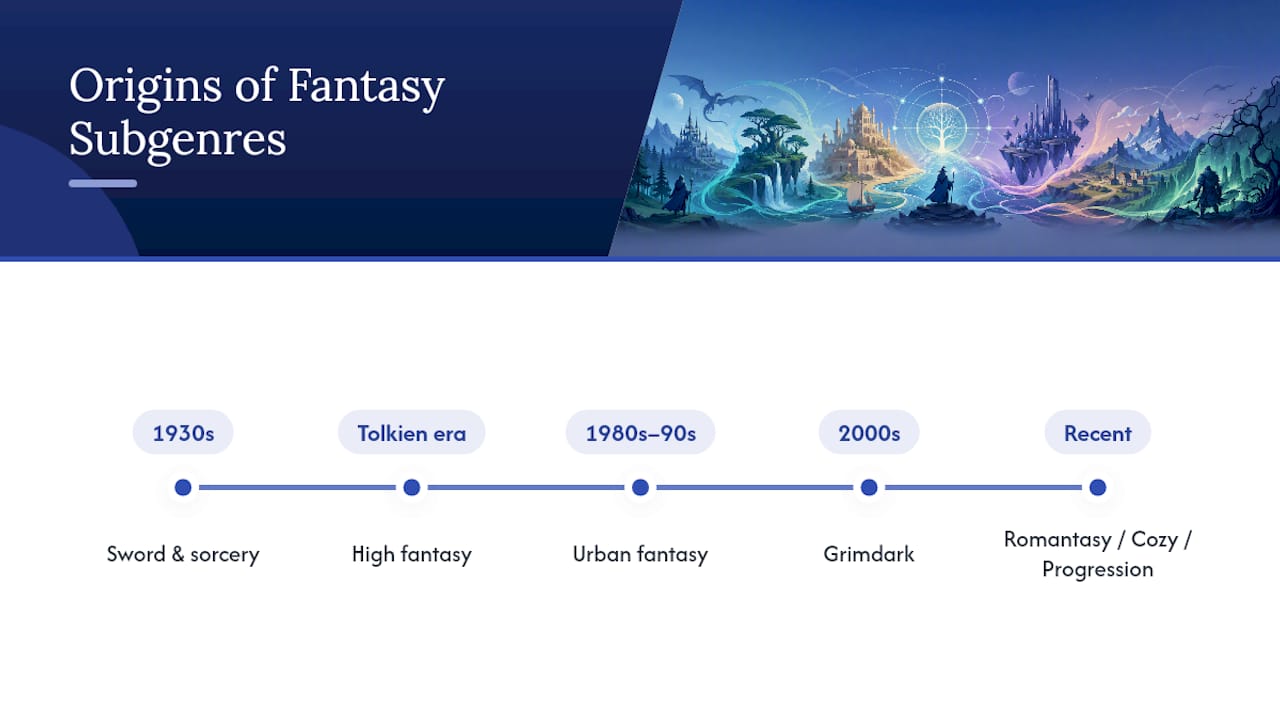
Romantasy, cozy fantasy, and progression fantasy are the newest additions, and their timing isn't a coincidence. Each responded to a specific reader hunger, romance-forward stakes, low-conflict comfort, and game-informed power fantasies, that older labels simply didn't capture. The genre keeps splitting into finer categories because readers keep wanting more precise ways to signal exactly what kind of story they're in the mood for.
Who Reads What: Demographics and Expectations by Subgenre
Different fantasy subgenres pull genuinely different audiences, and mismatched expectations are usually the real reason a book gets a poor reception rather than any flaw in the writing itself.
Epic and high fantasy have historically skewed toward readers who want long-term investment: multi-book series, dense worldbuilding, and a willingness to track dozens of characters across hundreds of pages. Grimdark draws an adult readership specifically seeking moral complexity, often readers who find traditional heroic fantasy too tidy or predictable for their taste.
Romantasy has pulled in a wave of readers, many discovering fantasy through romance first rather than the reverse, who expect the relationship arc to resolve with the same care as the plot. This audience often has different tolerance thresholds around pacing; slow-burn tension matters as much as magical stakes. Cozy fantasy attracts readers explicitly seeking lower emotional intensity, frequently as a deliberate counterbalance to darker media consumption elsewhere in their lives.
Progression fantasy and LitRPG skew toward readers with gaming backgrounds, and they bring genre-specific expectations: clear power systems, visible stat growth, and payoff tied to earned strength rather than luck or fate. Urban fantasy readers often want faster pacing and a strong single-narrator voice, closer to detective fiction than to sprawling ensemble epics.
None of these audiences are fixed categories. Plenty of readers move fluidly between grimdark and cozy fantasy depending on mood, which is exactly why shelf labels matter as a signal rather than a permanent identity.
Representation and Diversity Across the Genre
Fantasy's relationship with cultural representation has shifted substantially, and it shows up differently depending on the subgenre in question.
Epic and high fantasy, long dominated by pseudo-European medieval settings, have expanded to include worldbuilding drawn from West African, East Asian, Middle Eastern, and Indigenous traditions, moving well past a single default template for what an invented world looks like. Wuxia, rooted directly in Chinese literary and cinematic tradition, has brought its own martial and philosophical conventions into wider fantasy readership rather than being treated as a niche import.
Mythic and fairy-tale fantasy naturally invite this expansion since they draw directly from specific cultural source material, letting writers pull from Yoruba, Hindu, Slavic, or Polynesian mythology instead of defaulting to Greek or Norse pantheons that dominated earlier decades of the genre.
Romantasy and cozy fantasy have also broadened their protagonist rosters, with more LGBTQ+ leads and a wider range of body types, ages, and cultural backgrounds appearing in lead roles rather than supporting ones. This shift tracks with reader demand as much as author intent. Genre readers increasingly seek out protagonists and settings that reflect a wider range of lived experience, and subgenres with lower gatekeeping around "canon" traditions, cozy and romantasy especially, have moved fastest to reflect that.
Finding Fantasy Subgenres You've Never Tried
The major categories only cover so much ground. Plenty of rewarding fantasy sits in smaller, less-marketed corners of the genre.
Start by following the axes rather than a genre name. If you loved a book's tone but want a different setting, search for that tone plus a new world type, "cozy" plus "urban," for instance, rather than assuming cozy only means rural fantasy. Retailer and library tag clouds are underused tools here; clicking through secondary tags on a book you already loved often surfaces adjacent niches you didn't know existed, like fantasy of manners or gaslamp fantasy.
Reader communities built around specific tropes, rather than broad genre labels, tend to surface niche subgenres faster than mainstream bestseller lists do. Searching a trope directly, "found family," "slow-burn enemies to lovers," "monster romance", often leads to subgenres you'd never find by browsing a general fantasy shelf.
Free and low-cost sampling matters more here than in most genres, since niche subgenres rarely get marketing budgets that put them in front of you organically. Thedigitalreads keeps a running guide to free fantasy ebooks and daily deals specifically because trying a niche subgenre without financial commitment is the fastest way to figure out whether it's actually for you.
Pro Tip: Don't judge a niche subgenre by one book. A single slow cozy mystery fantasy title might feel like a fluke; three from different authors tells you it's a real pattern you might genuinely enjoy.
Why Thedigitalreads Exists for This Exact Discovery Problem
Fantasy's subgenre sprawl is exactly the problem Thedigitalreads was built to solve. With more than 139 titles across fantasy and adjacent genres, including 26 free downloads available instantly in PDF, EPUB, or DOCX, readers get to sample a niche subgenre without committing money or a trip to a store that may not stock it at all.
What sets the catalog apart is who fills it. Thedigitalreads leans on independent authors rather than only major publishing imprints, which means the niche corners of fantasy, cozy mysteries, wuxia-inflected adventure, quieter portal fantasy, show up here in numbers you won't find on a typical bookstore shelf. Indie authors are often the first to write into an emerging subgenre years before traditional publishing catches up, and this platform gives them direct access to readers hunting for exactly that.
If you're trying to figure out where you land on the axes covered in this guide, browsing by genre tag and blurb tone on Thedigitalreads' catalog is a faster path than guessing from a bestseller list. Start with a free title in a subgenre you've never tried. Worst case, it costs you an afternoon.
Editorial Take: The Genre Doesn't Need Fewer Labels, It Needs Better Ones
Most advice about fantasy subgenres treats the growing list of labels as a problem to solve, as if the genre would be healthier with ten clean categories instead of fifty overlapping ones. That's backwards. A genre that keeps splitting into finer labels is a genre with a readership specific enough to demand precision, and that's a sign of health, not clutter.
The real issue isn't too many subgenres. It's that most marketing copy still treats "fantasy" as one flavor, then wonders why a grimdark reader bounces off a cozy recommendation, or why a progression fantasy fan can't find anything through a bookstore's generic fantasy table. The label isn't decoration. It's a contract with the reader about what the last page will deliver.
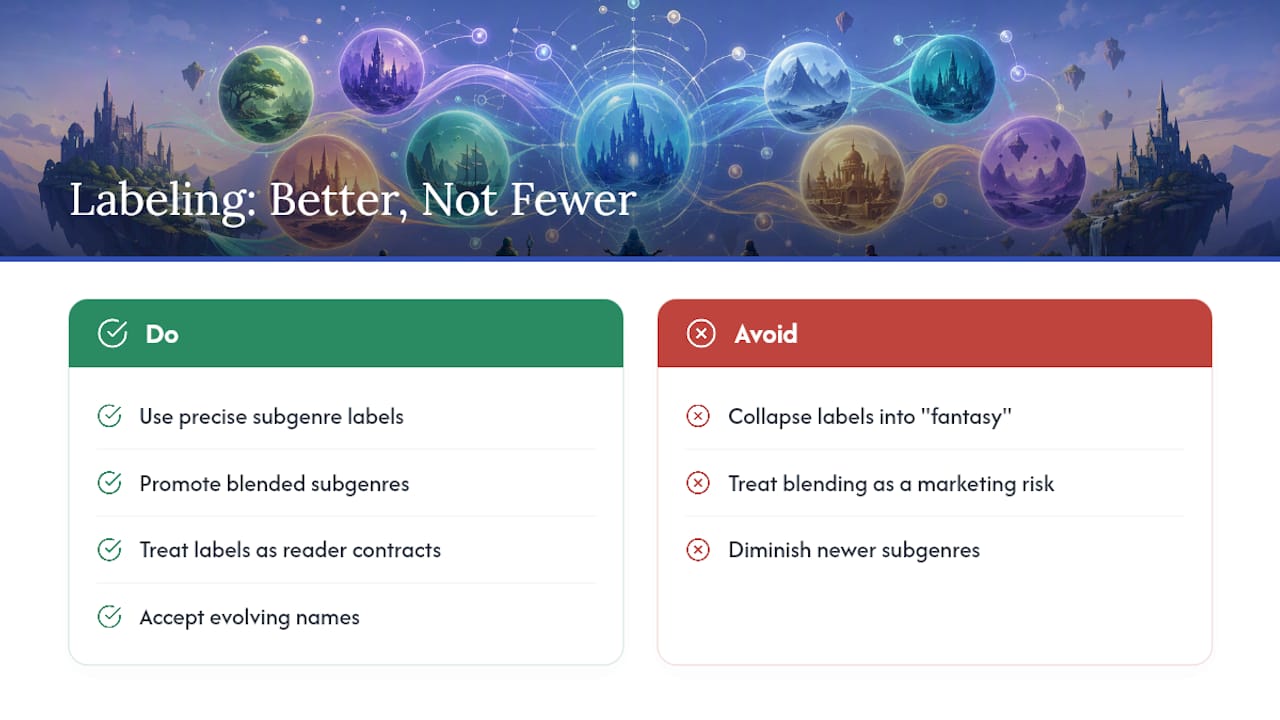
Where the industry gets it wrong, in my read, is treating subgenre blending as a marketing risk instead of the genre's actual growth engine. Dark romantasy, cozy mystery fantasy, science-fantasy hybrids, these combined labels aren't dilution. They're readers telling publishers exactly what they want next, faster than any market research department could. The subgenres that will matter most by the end of this decade probably don't have stable names yet, and that's fine. Naming always lags behind what readers are already devouring.
If there's one thing worth pushing back on, it's the instinct to treat cozy fantasy or romantasy as lesser categories because they're newer or commercially driven. Sword and sorcery started in pulp magazines nobody took seriously either, and it outlasted plenty of genres that critics considered more respectable at the time. Commercial success and staying power tend to travel together more often than genre gatekeepers want to admit.
— richard
Sources
- Fantasy - Wikipedia
- Fantasy Genre: Complete Guide for Writers (2026) 🐉 | Chapter Blog
- Types of Fantasy: A Complete Guide to the Subgenres - Squibler Learning Center
- 50 Fantasy Subgenres and Their Must-Reads | Reedsy Discovery
FAQ
What Is the Difference Between High Fantasy and Low Fantasy?
High fantasy takes place entirely in an invented secondary world, while low fantasy keeps the real world intact and lets magic intrude into it, a structural distinction about setting rather than a measure of quality.
Is LitRPG a Subgenre of Its Own?
Yes. LitRPG is a specific tag within progression fantasy for stories that render game mechanics, like experience points and level-ups, directly on the page rather than just implying a character's growth.
What Is Romantasy, and How Is It Different From Regular Fantasy With Romance?
Romantasy structures its plot so the romance's outcome carries as much weight as the magical or political stakes, rather than treating the relationship as a subplot to the main fantasy arc.
Which Fantasy Subgenres Are Most Popular Right Now?
Romantasy, cozy fantasy, and progression fantasy are showing the strongest reader momentum currently, driven largely by social platforms and gaming culture, while epic and urban fantasy remain steady sellers.
Can a Book Belong to More Than One Fantasy Subgenre?
Yes, and it's common. Combined labels like "dark romantasy" or "cozy mystery fantasy" reflect how most modern fantasy blends tone, stakes, and cross-genre elements rather than fitting neatly into a single category.