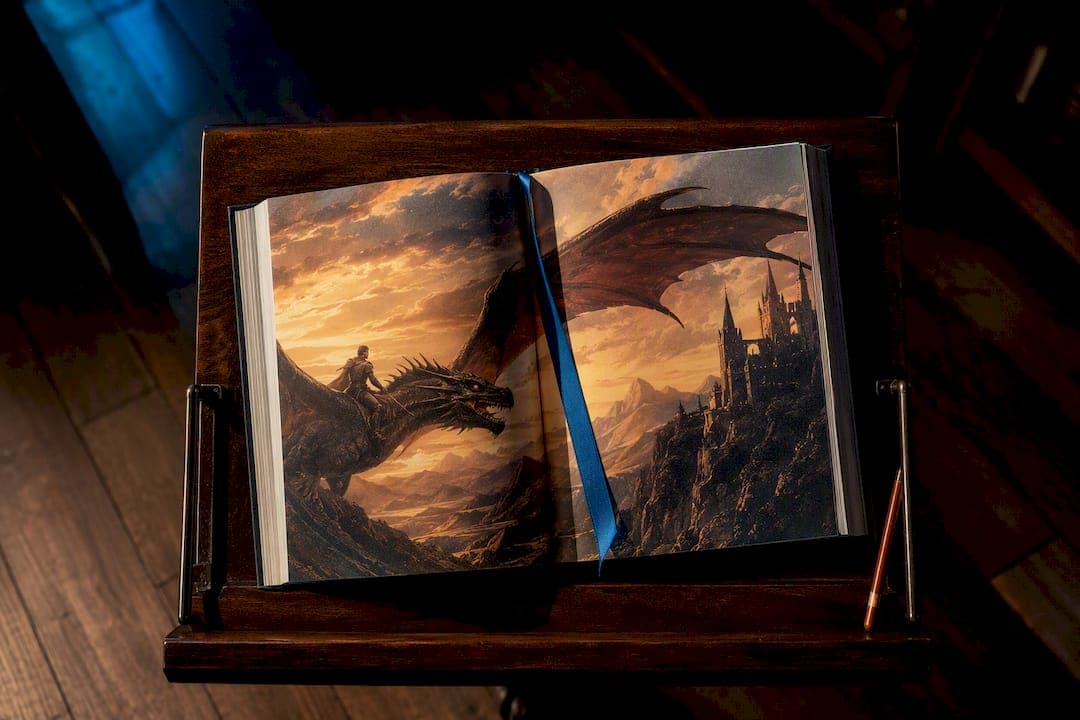
If you want classic dragonrider epic fantasy, start with Anne McCaffrey's Pern. If you want a modern YA hit with romance and teeth, grab Rebecca Yarros's Fourth Wing. For a middle grade reader (or an adult who wants a shorter, gentler flight), Cornelia Funke's Dragon Rider is the one to hand over. Below, you'll find these picks broken out by age group, series length, and where to start, so you can skip the guesswork and get straight to reading.
TL;DR:
- The original Dragonriders of Pern series by Anne McCaffrey is the foundational influence, featuring telepathically bonded dragons and a slower pace that rewards patience.
- Modern YA dragon rider series like Fourth Wing focus on fast-paced, emotionally intense stories with dragons that exercise clear agency and often involve romance elements.
- Cornelia Funke's Dragon Rider is ideal for younger readers, emphasizing gentle adventure, friendship, and environmental themes in a story suitable for children around age 8.
- Standalone or short series, such as Funke's Dragon Rider or Paolini's four-book Inheritance Cycle, offer quicker resolutions and less worldbuilding commitment than open-ended sagas.
- Content and tone vary widely: Pern suits adult readers with complex politics, YA series feature coming-of-age themes with moral grey areas, and Funke's work appeals to middle-grade audiences seeking gentle wonder.
Table of Contents
- Dragon Rider Books Worth Your Time, Grouped by Reader
- Where to Start and How Many Books You're Signing Up For
- How to Choose the Right Dragon Rider Book for You
- What Age Group Is Each Dragon Rider Book Really For?
- How The Digital Reads Helps You Find Your Next Dragon Rider Book
- How the Dragon Rider Genre Actually Evolved
- Why Dragon Riders Look So Different Depending on the Author
- The Authors Who Shaped Dragon Rider Fiction
- From Page to Screen: How Adaptations Changed the Genre's Reach
- Why These Stories Still Grab Readers Decades Later
- Find These Dragon Rider Books on The Digital Reads
- Sources
- FAQ
Dragon Rider Books Worth Your Time, Grouped by Reader
Not every dragon rider book wants the same thing from you. Some ask for a ten-book commitment and a notebook to track bloodlines. Others want an afternoon and give you a complete, satisfying story by dinner. Knowing which category you're browsing saves you from starting a saga when you wanted a weekend read.
Here's how the standout titles break down by audience and appetite.
1. The Classic That Built the Genre
Anne McCaffrey's Dragonriders of Pern is where most serious dragon rider fantasy either starts or eventually leads back to. First published in the 1960s and expanded across decades, the series imagines dragons and their riders telepathically bonded for life, defending the planet Pern from a deadly airborne threat called Thread. Penguin Random House still describes the series as a foundational influence on the entire dragonrider subgenre, and it's easy to see why. McCaffrey treated dragons less like weapons and more like partners with personalities, moods, and loyalty that had to be earned. If you've ever wondered where the "bonding ceremony" trope came from in later fantasy, this is the answer. Expect a slower burn than modern YA fantasy, more anthropological worldbuilding, and a payoff that rewards patience.
2. Adult Epic Picks for Readers Who Want Scope
If Pern hooked you and you want more sprawling, mature dragon worlds, look for series built around political intrigue, war strategy, and multi-generational casts. These books tend to treat dragons as forces of geopolitics as much as companions. Expect longer chapters, denser prose, and plots that unfold across multiple kingdoms rather than a single school or army camp. Readers who loved the scale of Pern's Threadfall wars but want fresher prose styles or different magic systems should browse recent adult fantasy releases that build entire economies and belief systems around dragon flight.
3. The YA Wave: Fourth Wing and Its Kin
Rebecca Yarros's Fourth Wing reignited dragon rider fiction for a new generation of readers, blending a brutal military academy setting with a slow-burn romance and dragons that choose their riders (and sometimes reject them violently). It's fast, emotionally intense, and unapologetically romantic, which is exactly why it's dominating bestseller lists. If you're new to the wave, our roundup of books like Fourth Wing is a good next stop once you finish the main series. The genre distinction worth knowing: these books usually center a single protagonist's first-person voice, weave romance tightly into the plot instead of treating it as a subplot, and give dragons real agency, meaning they can refuse a rider, hold grudges, or die in ways that gut the emotional pacing of the whole book.
Christopher Paolini's Inheritance Cycle, starting with Eragon, sits at the crossroads of YA and epic fantasy. It follows a farm boy who bonds with a dragon and gets pulled into a rebellion against a tyrant king. Paolini wrote much of it as a teenager himself, which shows in its earnest, coming-of-age energy. It reads younger than Fourth Wing but carries more worldbuilding weight than most middle grade dragon stories, making it a solid bridge title for readers aging out of MG fantasy but not quite ready for adult-length political epics.
A few other traits to watch for in the current YA wave:
- Dragons with distinct personalities that clash with their riders, not just obedient mounts.
- Academy or training settings that mirror the "chosen but untested" structure popularized by Paolini and refined by Yarros.
- Romance subplots that carry as much narrative weight as the dragon-bonding plot itself.
4. Middle Grade Charm: Cornelia Funke's Dragon Rider
For younger readers, or adults who want something warm and low-stakes, Cornelia Funke's Dragon Rider is the clear pick. It follows a young silver dragon named Firedrake on a quest to find a legendary mountain range where dragons can live safely, alongside a boy named Ben and a rock troll named Sorrel. Funke's official site lists the book as first published in 2004 with a reading age around 8, and it reads with a gentleness that Pern and Fourth Wing simply don't attempt. There's danger, but it's the kind a nine-year-old can handle without nightmares. Funke has said the book grew out of her own childhood wish to fly on a dragon's back, and that sense of wonder over menace defines the whole trilogy.
5. Standalones and Short Series for Commitment-Averse Readers
Not every reader wants a ten-book saga. If you'd rather get a full dragon rider story arc in one or two books, look for titles explicitly marketed as standalones or duologies rather than open-ended series. These tend to compress the "bond, train, fly, fight" structure into a tighter timeline, which means less worldbuilding sprawl but a faster emotional payoff. They're also a smart way to test whether you actually like dragon rider fantasy before committing to something on the scale of Pern's multi-decade publication history.
Where to Start and How Many Books You're Signing Up For
Picking the right entry point matters more in this genre than most, because dragon rider series range from tidy trilogies to open-ended sagas that span decades of publication.
- Dragonriders of Pern: Start with Dragonflight, the first volume in McCaffrey's saga. The series eventually grew to more than twenty books across multiple sub-series, so new readers should treat the original trilogy (Dragonflight, Dragonquest, The White Dragon) as a complete arc before deciding whether to continue.
- The Inheritance Cycle: Start with Eragon. It's a four-book series (Eragon, Eldest, Brisingr, Inheritance), a manageable commitment compared to Pern, with a clear beginning, middle, and end.
- Fourth Wing / The Empyrean: Start with Fourth Wing. The series is still being released, so expect the total book count to grow, and pace yourself for cliffhangers rather than a tidy finish.
- Dragon Rider: Start with the original Dragon Rider. This is where the reading-order guidance gets specific, and it matters. Funke published the first book in 2004, but didn't release a sequel, The Griffin's Feather, until 2017, followed by The Aurelia Curse in 2020. That's a thirteen-year gap between the first two books, so don't expect a fast-paced trilogy read; treat each volume as a satisfying standalone with connective threads rather than a serialized cliffhanger machine.
Pro Tip: If a series has more than five volumes, check whether it's split into sub-trilogies or arcs before buying the whole set. Pern, for example, works better read as smaller trilogies than as one giant block.
How to Choose the Right Dragon Rider Book for You
Matching a book to your actual reading habits, not just your love of dragons, saves you from abandoning a series halfway through. Here's a simple checklist to run through before you commit.
- Decide your tone tolerance. Do you want cozy and wondrous (Funke), earnest and adventurous (Paolini), or brutal and romantic (Yarros)? Tone shifts more between these authors than the shared "dragon" label suggests.
- Gauge your romance appetite. Fourth Wing leans hard into slow-burn tension and stakes-driven romance. Pern has romantic elements but treats them as secondary to survival and politics. Funke's Dragon Rider has essentially none, by design, given its age range.
- Check your patience for complexity. Pern asks you to track dragon colors, Weyrs, and generational politics. Eragon is more linear. Fourth Wing sits in between, with academy politics layered on top of a central romance.
- Weigh the series length against your schedule. A four-book cycle like Paolini's is a different commitment than an open-ended series still being written, like Yarros's.
- Match the book to the intended age of the reader. This sounds obvious, but a lot of adult readers hand Fourth Wing to a twelve-year-old without checking the content first, or assume Funke's book is "too simple" for a grown-up night of reading, when it's often exactly what a tired adult wants.
When you're scanning blurbs and reviews, watch for specific signal words. First-person narration usually means a tighter emotional focus on one rider's journey. Phrases like "the dragon chooses its rider" or "dragons can refuse a bond" signal that the dragon has real narrative agency, not just decorative firepower. And any mention of a "bonding ceremony" or "impression" is a nod straight back to Pern's influence on the genre.
What Age Group Is Each Dragon Rider Book Really For?
Age labels on dragon rider books aren't just marketing. They tell you how much violence, romance, and moral complexity you're signing up for.
- Middle grade (roughly ages 8 to 12): Expect adventure without graphic violence, friendship-driven plots, and dragons portrayed as wise or gentle rather than terrifying. Funke's Dragon Rider sits squarely here, with Cornelia Funke's own site listing a reading age around 8.
- YA (roughly ages 13 to 18, though adult crossover is huge): Expect coming-of-age arcs, moral gray areas, and increasingly explicit romance depending on the title. Eragon reads on the younger end of YA; Fourth Wing is written and marketed for an adult audience despite its academy setting, and it includes violence and sexual content that make it a poor fit for actual teenagers.
- Adult: Expect political complexity, mature themes, and pacing that assumes readers can hold a large cast and timeline in their heads. Pern fits here, alongside most of the adult epic dragon fantasy that followed it.
One quick note on content warnings: dragon rider stories act as an accessible entry point into epic fantasy for younger readers precisely because they simplify the moral stakes compared to adult war fantasy. If you're buying for a kid, don't assume "dragon book" means "kid book." Check the specific title.
How The Digital Reads Helps You Find Your Next Dragon Rider Book
There are many titles across science fiction, fantasy, horror, thriller, and romance, including free downloads, making it a practical place to browse dragon rider fantasy without committing money upfront to a series you're not sure about. Many books download instantly in popular digital formats, so you can read on various devices instead of hunting for a format-compatible copy.
What makes the catalog useful for genre readers specifically:
- There is a focus on independent fantasy authors, so you may find dragon rider stories not typically featured in major bookstores.
- Curated blog roundups, like the running list of popular fantasy titles updated monthly, that track which dragon and epic fantasy books are trending right now.
- There is a mix of free and affordable titles, allowing readers to explore unfamiliar authors with lower financial risk.
- Some listings include reader reviews to help gauge pacing and tone before starting a new series.
If you gravitate toward the denser, adult end of the genre, the site's list of books for readers who love complex worlds is worth a look for titles that scratch the same itch as Pern's political scope.
How the Dragon Rider Genre Actually Evolved
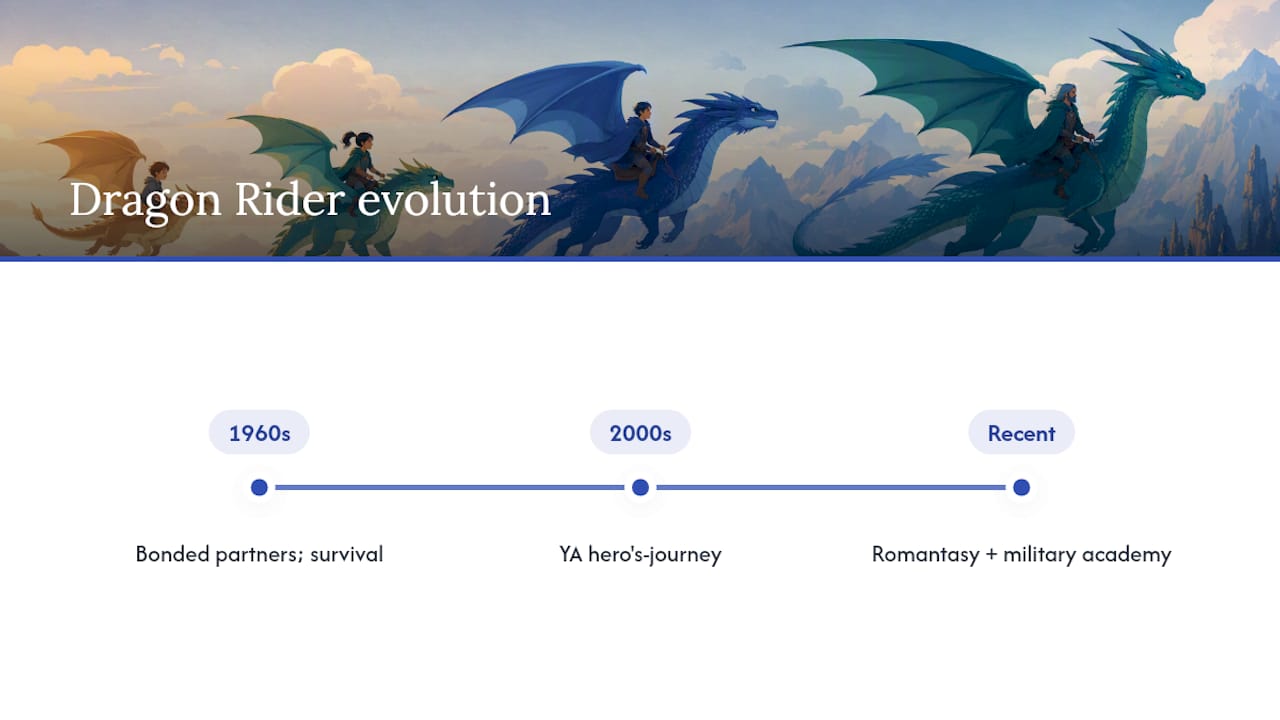
Dragon rider fiction didn't start as its own genre. It grew out of older myth traditions where dragons were either monsters to slay or divine forces to fear, with almost no middle ground where a human and dragon cooperated as equals. McCaffrey's Pern books shifted that relationship dramatically starting in the 1960s, reframing dragons as sentient partners bonded through empathy rather than conquest. That single move, dragon as companion instead of adversary, is arguably the genre's founding idea.
The 2000s brought a second wave aimed at younger readers, with Paolini's Eragon and Funke's Dragon Rider both landing in the same general era and pulling dragon fantasy into mainstream children's and YA shelves. Paolini leaned into classic hero's-journey structure; Funke leaned into gentler, myth-inflected wonder.
The most recent shift, led by Fourth Wing, folds dragon rider fantasy into the romantasy boom, merging military academy tropes with steamy romance arcs and social-media-driven fandom. Each wave reflects its era's appetite: McCaffrey's Cold War-adjacent survival themes, the early 2000s hero's-journey optimism, and today's romance-forward, fast-consumption reading habits.
Why Dragon Riders Look So Different Depending on the Author
Ask five authors what a "dragon rider" is, and you'll get five different relationships. McCaffrey's dragons are telepathic partners bonded for life through a ceremony called Impression, closer to a marriage than a mount. Paolini's dragon, Saphira, functions more like a moral conscience and battle companion to Eragon, echoing classic fantasy mentor dynamics but inside a single bonded creature.
Funke takes the gentlest approach of the group. Her dragon, Firedrake, isn't bonded to a human rider at all in the traditional sense; he travels alongside a human boy as a friend and equal, not a mount to be commanded. That distinction matters if you're choosing a book based on how much you want the "rider controls dragon" power fantasy versus a "companions on equal footing" story.
Yarros pushes the opposite direction: her dragons are dangerous, opinionated, and capable of killing a rider who doesn't measure up, which raises the emotional stakes considerably and turns the bonding process itself into a source of tension rather than comfort. Across cultures and authors, the throughline is choice: who chooses whom, and what happens when the dragon says no. That single variable shapes nearly everything else about tone, stakes, and pacing in a dragon rider book.
The Authors Who Shaped Dragon Rider Fiction
Four names do most of the heavy lifting in this genre, and each contributed something the others didn't.
Anne McCaffrey essentially invented modern dragon rider fantasy as a distinct subgenre, building an entire ecology, caste system, and telepathic bonding mechanic that later authors would borrow from, consciously or not. Her Pern books remain the reference point Penguin Random House still highlights when introducing new readers to the genre's roots.
Christopher Paolini proved a teenager's earnest hero's journey could compete commercially with adult fantasy, and his success helped open publishing doors for more YA dragon fantasy that followed.
Cornelia Funke brought a distinctly European, folklore-inflected sensibility to dragon fiction, treating dragons as endangered creatures worth protecting rather than weapons or war animals, a framing that gives Dragon Rider its gentler, more conservation-minded heart.
Rebecca Yarros modernized the genre for a romance-hungry audience, proving that dragon bonding could carry as much narrative tension as any battle scene, and reintroducing dragon rider fiction to millions of readers who'd never picked up Pern.
From Page to Screen: How Adaptations Changed the Genre's Reach
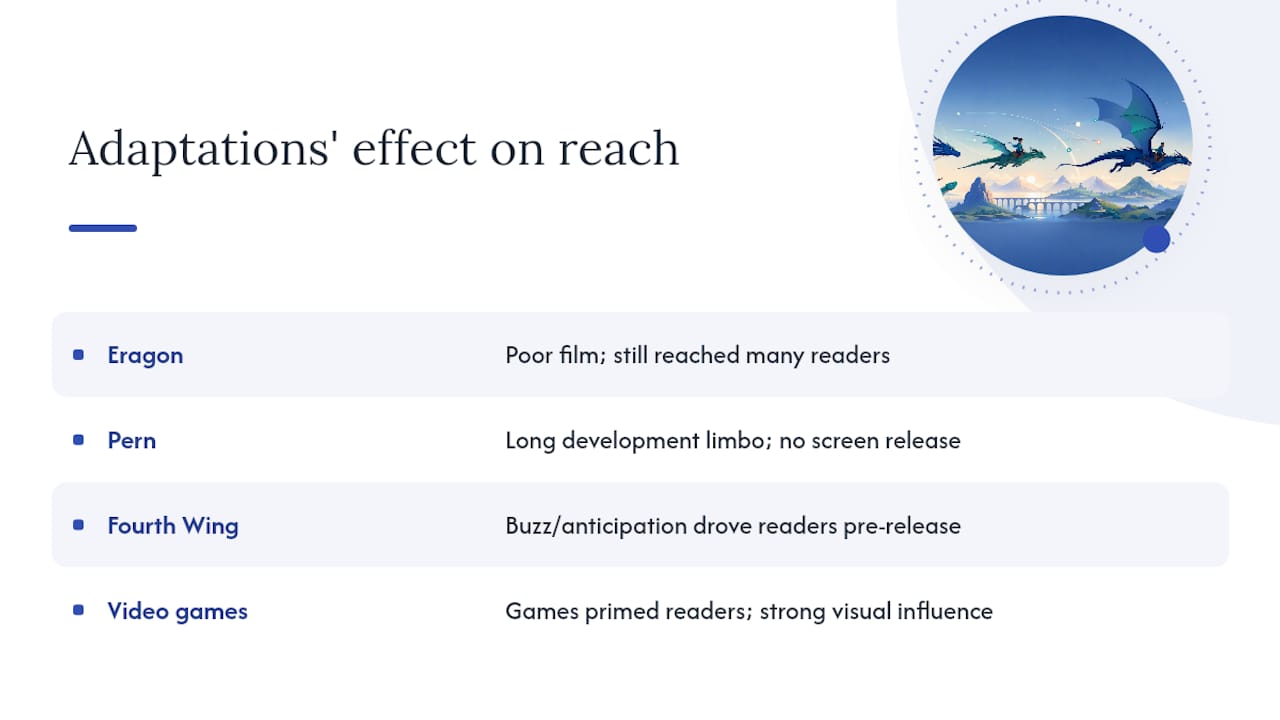
Dragon rider books have had a mixed but influential run outside print. The Eragon film adaptation arrived with high expectations and delivered a critically panned result, but it still introduced a huge number of casual moviegoers to the concept of a bonded dragon rider, some of whom went on to read the books or discover Pern and other dragon fantasy afterward.
Pern itself has spent years in development limbo across various studio attempts, never quite reaching screens despite its status as the genre's foundational text, a reminder that publishing influence doesn't always translate to adaptation success.
Fourth Wing has generated intense demand for a screen adaptation, driven largely by its social-media fandom, though as of now no series or film has been released. The anticipation alone has driven new readers to the books, creating a feedback loop where adaptation buzz sells books even before a single frame exists.
Video games have arguably done more for dragon rider fantasy's visual imagination than film, with dragon-mount mechanics becoming a staple of fantasy gaming. That gaming familiarity has, if anything, made new readers more receptive to dragon rider prose, since they already understand the appeal of the human-dragon bond before they open a book.
Why These Stories Still Grab Readers Decades Later
I keep coming back to the same explanation for why dragon rider books endure: they offer a fantasy of being chosen without demanding you already be special. A dragon picking you, flaws and all, is a more democratic power fantasy than a prophecy or a magic bloodline. That's part of why I favor Funke's Dragon Rider alongside the bigger names here. It gets overshadowed by louder YA hits, but its quieter insistence that dragons deserve protection, not domination, is a genuinely different take worth a reader's time.
I'd also nudge readers toward giving Pern a real chance before assuming it's dated. The prose style is older, but the ideas it introduced are still being reworked by every author on this list. If you've got a favorite dragon rider book that didn't make this roundup, tell us. Thedigitalreads takes reader requests seriously, and hidden gems are exactly what a catalog like this is built to surface.
— richard
Find These Dragon Rider Books on The Digital Reads
It can be convenient to search a digital catalog directly for dragon and fantasy titles, finding instant downloads in common formats and a mix of free and affordable independent titles.
Availability varies by title and author rights, so not every book mentioned here will be in the catalog today, but the collection updates regularly, and you can always submit a request if a specific dragon rider title is missing. Head to Thedigitalreads now, search "dragon," and see what independent authors have written in this space that the bestseller lists never surfaced.
Sources
For readers who want to verify publication details or dig deeper into these series, these sources are worth bookmarking:
FAQ
What grade level is the book Dragon Rider?
Cornelia Funke's Dragon Rider is listed with a reading age around 8, which typically corresponds to a third or fourth grade reading level, making it a solid middle grade pick.
How many books are in the Dragon Rider series by Cornelia Funke?
The series has three volumes: Dragon Rider (2004), The Griffin's Feather (2017), and The Aurelia Curse (2020), with a notable thirteen-year gap between the first two books.
What age group is the Dragon Rider book appropriate for?
It's generally appropriate for readers around age 8 and up, given its gentle tone, low violence, and friendship-driven plot compared to YA dragon fantasy.
Where should I start if I want a shorter dragon rider read?
Start with a standalone or short series rather than an open-ended saga like Pern; Cornelia Funke's Dragon Rider or Christopher Paolini's four-book Inheritance Cycle both offer a defined ending without decades of ongoing volumes.
Is Fourth Wing appropriate for teen readers?
Fourth Wing is written and marketed for adult readers, and its violence and romantic content make it a poor match for younger teens despite its academy setting.