If you only read some cosmic horror books this year, consider The Fisherman by John Langan, Annihilation by Jeff VanderMeer, and Songs of a Dead Dreamer and Grimscribe by Thomas Ligotti. Langan delivers slow-burn dread with genuine emotional weight, VanderMeer is accessible as a modern entry point, and Ligotti's stories offer dense philosophical horror. All are available in EPUB and PDF formats through major US ebook retailers.
Quick content warnings before you dive in:
- Body horror, grief, and descriptions of bodily transformation (The Fisherman, Annihilation)
- Extreme existential despair and nihilistic philosophy (Songs of a Dead Dreamer and Grimscribe)
- Racial slurs and dated language in Lovecraft's original texts (At the Mountains of Madness)
- Violence, occult imagery, and disturbing creature descriptions across most titles below
- The Ballad of Black Tom contains period-accurate racism as a deliberate narrative element
Table of Contents
- The best cosmic horror books you need to read
- Where should you start if you're new to cosmic horror?
- Modern cosmic horror novels that push the genre forward
- Short-story collections are where cosmic horror lives
- The classic works that built this genre
- How to get the most out of reading cosmic horror
- Why readers keep coming back to cosmic horror
- Key Takeaways
- A curator's note on where to begin
- Thedigitalreads has your next cosmic horror read ready to download
- Useful sources
- FAQ
The best cosmic horror books you need to read
These ten titles represent the clearest path through the subgenre, from foundational classics to contemporary must-reads. Each entry below includes a reader-level tag, a content note, and a suggested next read so you always know where to go after you finish.
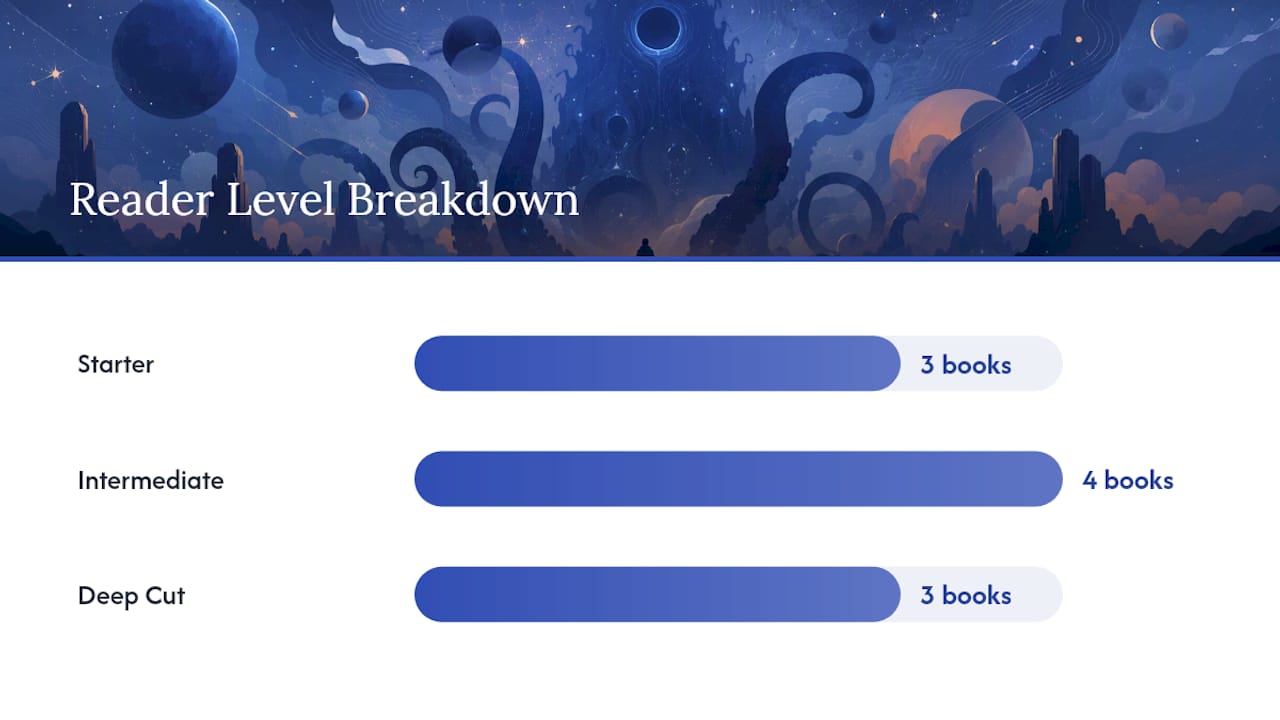
| Title | Author | Reader Level | Tone | Best Mood to Read |
|---|---|---|---|---|
| Annihilation | Jeff VanderMeer | Starter | Eerie, atmospheric | Quiet evening, alone |
| The Ballad of Black Tom | Victor LaValle | Starter | Tense, lyrical | Focused single sitting |
| The King in Yellow | Robert W. Chambers | Starter | Unsettling, literary | Rainy afternoon |
| The Fisherman | John Langan | Intermediate | Slow-burn, emotional | Long weekend read |
| The Croning | Laird Barron | Intermediate | Visceral, dread-heavy | Late nights |
| At the Mountains of Madness | H. P. Lovecraft | Intermediate | Dense, archaic | Patient, curious reader |
| The Willows | Algernon Blackwood | Intermediate | Quiet, creeping | Solitary, contemplative |
| Songs of a Dead Dreamer and Grimscribe | Thomas Ligotti | Deep Cut | Philosophical, bleak | Slow, deliberate reading |
| Dark Gods | T. E. D. Klein | Deep Cut | Subtle, literary | Unhurried, attentive |
| Furnace | Livia Llewellyn | Deep Cut | Intense, visceral | Experienced horror readers |
1. Annihilation by Jeff VanderMeer
A biologist enters Area X, a quarantined wilderness where the rules of nature no longer apply, and what she finds there refuses any rational explanation. VanderMeer keeps the horror at the level of wrongness rather than spectacle, which makes it far more unsettling than a monster-driven plot would be. This is the easiest entry point in the list: the prose is clean, the novel is short, and the dread accumulates without requiring any familiarity with Lovecraft or weird fiction history.
Reader level: Starter | Content notes: Body horror, psychological disorientation | Next read: The Fisherman
2. The Ballad of Black Tom by Victor LaValle
LaValle retells Lovecraft's "The Horror at Red Hook" from the perspective of Tommy Tester, a Black musician in 1920s Harlem, and in doing so exposes exactly what Lovecraft's original story got wrong. The cosmic horror here is doubled: the indifferent universe is terrifying, but so is the very human cruelty Tommy faces before the monsters arrive. It's one of the best cosmic horror novels of the 21st century and a genuinely essential read for anyone who wants to understand where the genre is going.
Reader level: Starter | Content notes: Period-accurate racism, violence, occult horror | Next read: Annihilation
3. The King in Yellow by Robert W. Chambers
Published in 1895, this linked short-story collection centers on a fictional play whose second act drives readers to madness. Chambers never explains the play's contents, and that restraint is the whole trick: the horror lives entirely in what you don't see. The first four stories are the ones that matter, and they're short enough to read in a single sitting. This is the collection that influenced Lovecraft most directly, and it holds up better than most of his work.
Reader level: Starter | Content notes: Madness, suicide, occult themes | Next read: At the Mountains of Madness
4. The Fisherman by John Langan
A widower and his grieving friend travel to a remote Catskill stream rumored to hold supernatural fish, and what they find there reaches back through centuries of cosmic mythology. Langan structures the novel as a story-within-a-story, which slows the pace deliberately, but the payoff is one of the most emotionally resonant endings in modern horror fiction. Expert recommendations from FiveBooks single this out as a standard-bearer for 21st-century cosmic horror, and it earns that reputation.
Reader level: Intermediate | Content notes: Grief, body horror, disturbing creature imagery | Next read: The Croning
5. The Croning by Laird Barron
Barron follows an elderly geologist whose wife has been entangled with ancient, malevolent forces for their entire marriage. The horror builds slowly and then hits with physical force. Barron's prose is dense and sensory, closer to literary fiction than pulp, and his creatures feel genuinely alien rather than borrowed from any existing mythology. Practitioners of the genre point to Barron as one of the writers who internalized cosmic dread most completely, moving past creature spectacle into something more existential.
Reader level: Intermediate | Content notes: Violence, body horror, disturbing imagery involving children | Next read: Dark Gods
6. At the Mountains of Madness by H. P. Lovecraft
An Antarctic expedition uncovers the ruins of a pre-human civilization, and the narrator's account of what the team found there remains one of the most influential pieces of cosmic horror fiction ever written. Lovecraft's prose is dense and archaic, and his worldview carries serious problems that NPR's critical coverage has documented thoroughly. Read it for the architecture of the ideas, not as a model for how the genre should sound today. The Antarctic setting and the concept of a universe indifferent to human survival shaped everything that came after.
Reader level: Intermediate | Content notes: Racist language and worldview in original text; body horror | Next read: The Willows
For readers who want to explore the deep-sea and Antarctic horror that Lovecraft helped define, that setting has a long tradition worth following.
7. The Willows by Algernon Blackwood
Two men canoe through the Danube delta and gradually realize the landscape itself is hostile. Blackwood published this in 1907, and Lovecraft called it the finest supernatural tale in English literature. That's a strong claim, but the story earns it: the horror is entirely atmospheric, never explained, and the willows themselves become one of the most quietly terrifying presences in genre fiction. At novella length, it's a fast read with a long afterlife in your imagination.
Reader level: Intermediate | Content notes: Psychological dread, existential terror | Next read: The King in Yellow
8. Songs of a Dead Dreamer and Grimscribe by Thomas Ligotti
Ligotti's two early collections, gathered here in one volume, are the most philosophically rigorous works in the cosmic horror canon. Where Lovecraft feared the unknown, Ligotti seems to have made peace with it, and that calm is somehow more disturbing. His stories don't rely on plot; they rely on atmosphere, diction, and a creeping sense that consciousness itself is the problem. Reedsy's curated list flags Ligotti as an exemplar of existential cosmic dread, and this collection is the place to start with his work.
Reader level: Deep Cut | Content notes: Extreme nihilism, existential despair, psychological horror | Next read: Dark Gods
9. Dark Gods by T. E. D. Klein
Klein published very little, but what he published hit hard. This 1985 collection contains four novellas, each one a slow, meticulous build toward a revelation that feels genuinely earned. "The Events at Poroth Farm" is the standout: a scholar retreats to a rural New Jersey farm to read classic weird fiction and finds something reading back. Klein's restraint is almost painful, and his command of atmosphere puts him in the same conversation as Blackwood and Ligotti.
Reader level: Deep Cut | Content notes: Occult horror, violence, psychological dread | Next read: Furnace
10. Furnace by Livia Llewellyn
Llewellyn's debut collection is the most visceral entry on this list, combining cosmic horror with body horror and dark eroticism in ways that are not for every reader. What makes it worth including is the quality of the prose: Llewellyn writes with a precision and intensity that most horror writers never reach, and her cosmic forces feel genuinely alien rather than decorative. This is a deep cut for experienced horror readers who want the genre pushed somewhere uncomfortable.
Reader level: Deep Cut | Content notes: Explicit sexual content, body horror, violence, dark themes throughout | Next read: Songs of a Dead Dreamer and Grimscribe
Where should you start if you're new to cosmic horror?
The best first move is a short novel or a linked story collection, not a doorstop. Here's a ranked entry path for new readers, with one tip for each pick.
-
Start with Annihilation. It's under 200 pages, the prose is clean and modern, and VanderMeer eases you into cosmic strangeness without requiring any background in the genre. Read it in one or two sittings for maximum effect.
-
Then try The King in Yellow. Read only the first four stories on your first pass. Chambers invented the "forbidden text" trope that Lovecraft later borrowed, and these stories demonstrate how much cosmic horror can accomplish through suggestion alone.
-
Move to The Ballad of Black Tom. At novella length, it's fast, and it gives you Lovecraftian mythology through a perspective that makes the horror feel urgent and contemporary rather than dated.
-
Try The Willows before committing to full Lovecraft. Blackwood's atmospheric novella shows you the emotional register of classic cosmic horror without the archaic prose density of Lovecraft's longer works.
-
Save At the Mountains of Madness for after you've read at least two of the above. Lovecraft's ideas are foundational, but his prose rewards readers who already know what they're looking for. Context makes the experience richer.
Novel vs. collection as a first step: If you tend to abandon books mid-read, start with a novel. Annihilation or The Ballad of Black Tom will carry you through on momentum. If you prefer sampling before committing, Penguin Random House recommends starting with an anthology or linked collection, which lets you test multiple voices before settling on a longer read.
Modern cosmic horror novels that push the genre forward
The most exciting thing happening in cosmic horror fiction right now is the shift in whose perspective anchors the dread. For decades, the genre defaulted to a narrow set of voices. Contemporary writers have changed that, and the results are some of the most compelling weird fiction in print.
"The genre has matured beyond Lovecraft's vocabulary into more inclusive, lyrically driven approaches that preserve cosmic themes while removing the author's prejudicial framing." This shift isn't just ethical correction; it's made the fiction more frightening, because the horror lands harder when the reader can actually identify with the protagonist.
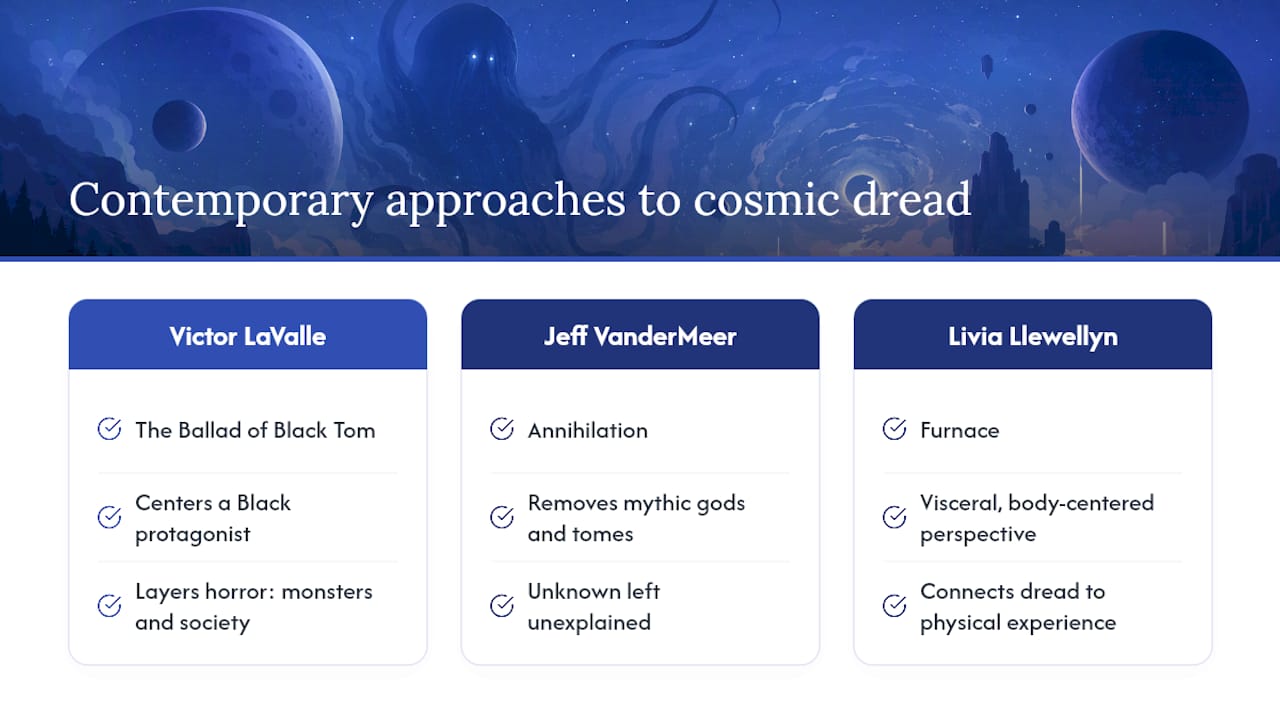
Victor LaValle (The Ballad of Black Tom) is the clearest example. By centering a Black protagonist in a Lovecraft retelling, LaValle makes the cosmic indifference of the universe feel doubly cruel: the monsters don't care about Tommy, but neither does the society around him. The horror becomes layered in a way Lovecraft's original never was.
Jeff VanderMeer (Annihilation) strips away mythology entirely. There are no named gods, no ancient tomes. Area X operates on its own logic, and the refusal to explain it is what makes the book so unsettling. VanderMeer's approach influenced a wave of writers who understood that the unknown works best when it stays unknown.
Livia Llewellyn (Furnace) brings a visceral, body-centered perspective to cosmic themes, connecting the genre's tradition of existential dread to physical experience in ways that feel genuinely new. Her work is part of a broader push, noted by critics and scholars, toward more inclusive and lyrically driven storytelling in the genre.
For readers who want to keep tracking new voices, the best new books in horror and speculative fiction continue to expand what cosmic horror can do.
Short-story collections are where cosmic horror lives
The short story is the natural form for cosmic horror. A novel has to sustain its dread across hundreds of pages; a short story can deliver a single, perfect moment of wrongness and then stop. The best collections in the genre use that compression to devastating effect.
- Thomas Ligotti, Songs of a Dead Dreamer and Grimscribe: Start with "The Frolic" and "The Sect of the Idiot." Both demonstrate Ligotti's ability to make philosophy feel physically threatening.
- Robert W. Chambers, The King in Yellow: "The Repairer of Reputations" and "The Yellow Sign" are the two essential stories. Read them back to back.
- T. E. D. Klein, Dark Gods: "The Events at Poroth Farm" is the entry point. "Children of the Kingdom" is the one that stays with you longest.
- Algernon Blackwood, collected stories: "The Willows" and "The Wendigo" are the two most anthologized, and both reward rereading.
- Ellen Datlow-edited anthologies (The Best Horror of the Year series): Datlow has edited horror anthologies for decades, and her annual collections are the most efficient way to sample contemporary voices across cosmic, weird, and supernatural fiction. Expert lists consistently recommend Datlow's anthologies as discovery tools for readers who want breadth before depth.
Reading-sequence tip: Start with one or two individual collections (Ligotti or Chambers) to calibrate your taste, then move to a Datlow anthology to sample the contemporary field. Once you've found two or three voices you respond to in the anthology, follow those authors to their novels. That path is faster and more satisfying than picking novels at random.
For writers interested in experimenting with short-form horror themselves, the microhorror writing contest at E. L. Ravenheart is a community-level entry point worth knowing about.
The classic works that built this genre
Cosmic horror didn't arrive fully formed. It developed across several decades and a handful of writers who each added something the genre couldn't do without.
| Classic Title | Author | Year | Thematic Contribution |
|---|---|---|---|
| The Willows | Algernon Blackwood | 1907 | Hostile landscape; nature as cosmic force |
| The King in Yellow | Robert W. Chambers | 1895 | Forbidden knowledge; madness through art |
| At the Mountains of Madness | H. P. Lovecraft | — | Shared mythos; pre-human civilizations; Antarctic sublime |
| The Colour Out of Space | H. P. Lovecraft | — | Alien contamination; the unknowable as physical presence |
| The Call of Cthulhu | H. P. Lovecraft | — | Cosmic indifference; ancient entities beyond human comprehension |
Suggested classic read order: Start with The King in Yellow (1895) for the forbidden-text concept, then The Willows for atmosphere, then Lovecraft's shorter works (The Colour Out of Space, The Call of Cthulhu) before tackling At the Mountains of Madness. That sequence builds your tolerance for Lovecraft's prose style gradually and gives you the context to appreciate what he was building on.
Lovecraft's influence is undeniable, but so are his limitations. His work carries racist language and worldviews that critics have documented extensively, and reading it alongside contemporary responses (LaValle, Llewellyn) gives you a fuller picture of what the genre has become.
How to get the most out of reading cosmic horror
Cosmic horror rewards a specific kind of reading attention. Rush through it and you'll miss the atmosphere that makes the dread accumulate. Here's how to set yourself up for the best experience.
Pacing and atmosphere:
- Read at night or in low light when possible. The genre is built for sensory conditions that match its mood.
- Short stories work best in single sittings. Novels like The Fisherman benefit from longer, uninterrupted sessions where the slow build can do its work.
- Resist the urge to look things up mid-read. Cosmic horror depends on the unknown staying unknown.
Content and trigger notes to check before you start:
- Lovecraft's original texts contain racial slurs and white supremacist ideology. Modern annotated editions sometimes include content notes; check the edition before purchasing.
- Furnace by Livia Llewellyn contains explicit sexual content alongside its horror. Not every reader wants that combination.
- The Croning includes disturbing imagery involving children. Worth knowing before you start.
- Songs of a Dead Dreamer and Grimscribe is philosophically bleak in ways that can be genuinely distressing for readers already dealing with depression or existential anxiety.
Discussion prompts for book clubs:
- Where does the horror in this book come from: the unknown itself, or the protagonist's response to it?
- Does the ending offer any resolution, or does it leave the cosmic threat intact? What does that choice do to the reader?
- How does the author's identity or perspective shape what feels threatening in the story?
Why readers keep coming back to cosmic horror
Cosmic horror delivers something most genre fiction can't: the feeling of being genuinely small. That sounds like a bad thing, but it isn't. There's a paradoxical relief in reading a story that says the universe doesn't care about your problems, because it also says your problems aren't the center of everything. That's the sublime at work.
"Cosmic horror is an experience of the sublime — both terrifying and exhilarating. The encounter with something vast and incomprehensible produces not just fear but a kind of awe that most fiction never reaches." — John Langan, as cited by FiveBooks expert recommendations
That framing explains why readers who love cosmic horror often describe it as the most intellectually satisfying kind of scary fiction. It's not about jump scares or gore. It's about the cognitive experience of encountering something your mind can't fully process. Ligotti's stories work this way: they don't show you the monster; they make you feel the impossibility of the monster's existence.
The genre has also become a space for writers to explore what it means to be made to feel small by forces that are very much human. LaValle's The Ballad of Black Tom uses cosmic indifference as a mirror for systemic racism. Llewellyn's work connects cosmic dread to bodily vulnerability. These aren't departures from the genre's core; they're extensions of it, and they've made cosmic horror fiction more emotionally complex than it has ever been. Readers who enjoy the philosophical scale of big-idea science fiction often find cosmic horror scratches the same itch, just from the direction of dread rather than wonder.
Key Takeaways
The single most important thing to know: start with Annihilation or The Ballad of Black Tom, not Lovecraft, and you'll find cosmic horror immediately rewarding rather than a chore to get through.
| Point | Details |
|---|---|
| Best starter reads | Annihilation and The Ballad of Black Tom are the most accessible entry points for new readers. |
| Short stories first | Ligotti, Chambers, and Datlow anthologies let you sample the genre efficiently before committing to longer novels. |
| Lovecraft in context | Read Lovecraft's foundational texts after two or three modern works so you understand both his influence and his limitations. |
| Content awareness | Check editions for trigger notes, especially for Lovecraft's original texts and Llewellyn's Furnace. |
| Thedigitalreads for ebooks | Browse the horror collection at Thedigitalreads for instant EPUB, PDF, and DOCX downloads of horror titles. |
A curator's note on where to begin
Picking a single favorite from this list is genuinely hard, but The Fisherman is the one I keep recommending to readers who are skeptical about horror fiction. It works as a grief novel, as a folk-horror story, and as cosmic horror all at once, and that layering means it reaches readers who wouldn't normally pick up something in this genre. The emotional core makes the cosmic dread land harder, not softer.
If you're building a reading path from scratch, I'd suggest this sequence: Annihilation first for accessibility, then The King in Yellow for the classic weird-fiction tradition, then The Fisherman for the full emotional range of what modern cosmic horror can do. From there, Ligotti's collected stories will feel like a natural deepening rather than a left turn.
The genre rewards patience and a willingness to sit with unresolved dread. That's not a warning; it's the appeal.
Thedigitalreads has your next cosmic horror read ready to download
If you've just finished this list and want to start reading tonight, Thedigitalreads is where to go. The horror collection offers instant downloads in PDF, EPUB, and DOCX formats, so you're reading within minutes, not days. No waiting for shipping, no subscription required.

The catalog includes free titles alongside affordable paid options, with a focus on independent authors who are pushing genre fiction in exactly the directions this article describes. Whether you want to start with a classic or go straight to a contemporary voice, you can browse the full catalog and find your next read right now.
Useful sources
- 9 Lovecraftian Horror Books Full of Cosmic Dread
- Cosmic Horror: 15 of the Most CHILLING Titles to Start You Off | Reedsy Discovery
- 25 Best Cosmic Horror Movies for Fans of the Unknown
- Horror of horrors: Is H.P. Lovecraft's legacy tainted? | NPR
FAQ
What are the best cosmic horror books for beginners?
Annihilation by Jeff VanderMeer and The Ballad of Black Tom by Victor LaValle are the strongest entry points: both are short, modern, and don't require any background in Lovecraft or weird fiction history.
What's the difference between Lovecraftian horror and cosmic horror?
All Lovecraftian horror is cosmic horror, but not all cosmic horror is Lovecraftian. Lovecraftian horror uses Lovecraft's specific mythology and narrative style; cosmic horror is the broader category defined by human insignificance and an indifferent universe.
What is the scariest cosmic horror book?
Readers and critics most often point to Thomas Ligotti's Songs of a Dead Dreamer and Grimscribe as the most psychologically disturbing, because its horror is philosophical rather than creature-based, and it offers no resolution or relief.
What good cosmic horror books go beyond Lovecraft's limitations?
The Ballad of Black Tom by Victor LaValle directly responds to Lovecraft's racism, while Annihilation and The Fisherman build on cosmic themes without relying on his mythology or worldview. The Thedigitalreads horror collection includes contemporary titles that continue this evolution.