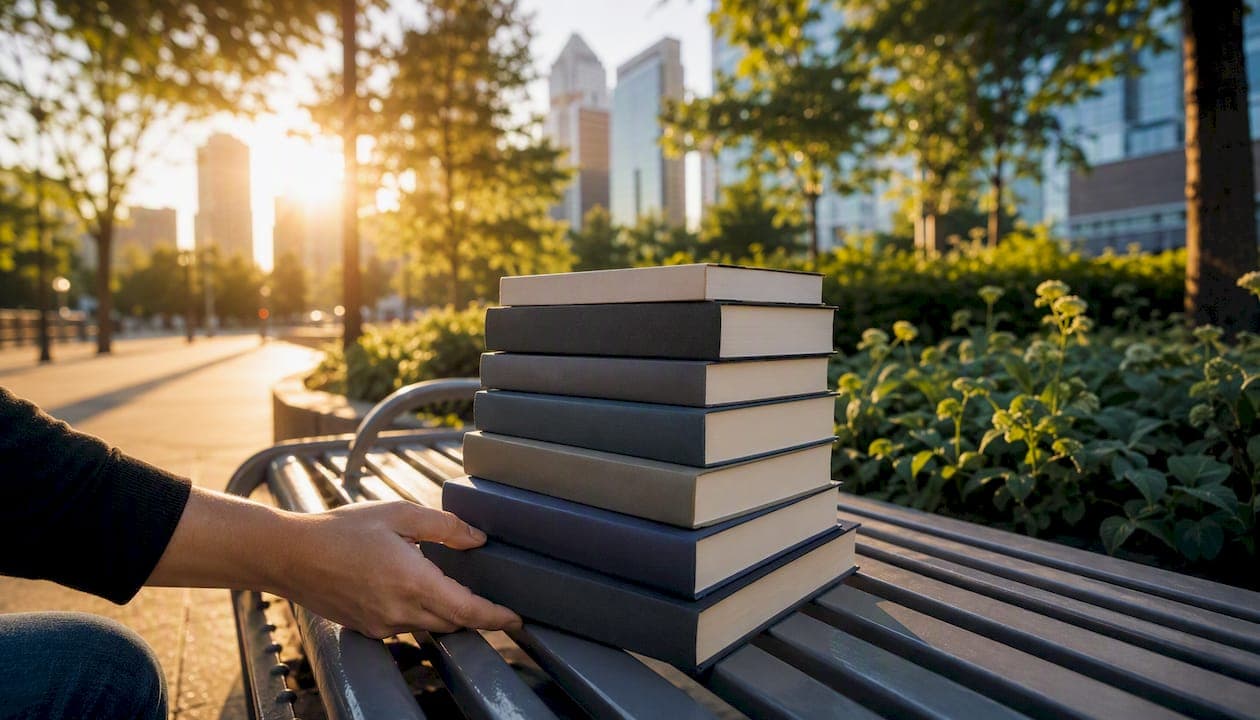
Start with these six cli-fi books and you'll have a clear, confident introduction to climate fiction as a genre: The Ministry for the Future by Kim Stanley Robinson (policy-scale, near-future, ideal if you want to think big about solutions), Parable of the Sower by Octavia E. Butler (survival and community-building in a collapsed California, essential foundational reading), Oryx and Crake by Margaret Atwood (bioengineering and corporate ruin, sharp and darkly funny), The Overstory by Richard Powers (Pulitzer Prize-winning, slow-burn literary fiction about trees and the people who fight for them), Gold Fame Citrus by Claire Vaye Watkins (drought-ravaged American West, gorgeous and unsettling), and How High We Go in the Dark by Sequoia Nagamatsu (pandemic and permafrost collapse, emotionally devastating in the best way). If you want urgency and action, start with Butler or Watkins. If you want ideas and scale, Robinson is your entry point.
Pro Tip: Pick your first cli-fi novel by mood, not by reputation. A bleak masterpiece you abandon at page 50 teaches you nothing. A hopeful, fast-paced story you finish in a weekend opens the whole genre.
Key Takeaways
The most effective way to start with climate fiction is to match your first book to your current emotional bandwidth, then let the genre's range pull you deeper.
| Point | Details |
|---|---|
| Start with six core titles | Butler, Robinson, Atwood, Powers, Watkins, and Nagamatsu each represent a different segment of the bleak-to-hopeful tonal spectrum. Pick based on your mood and emotional bandwidth. |
| Match book to mood | Use the bleak-to-hopeful spectrum and subgenre tags to pick what fits your reading state. |
| Libraries are your best discovery tool | NYPL, SDSU, and Portland Community College all maintain free, updated cli-fi reading lists. |
| Most cli-fi novels stand alone | Only Atwood's MaddAddam trilogy requires reading in order; all other titles here are standalone. |
| Thedigitalreads offers instant access | PDF, EPUB, and DOCX downloads of speculative and sci-fi titles are available at low or no cost. |
Table of Contents
- The best cli-fi books to read right now: the full curated list
- What is cli-fi, and how is it different from regular science fiction?
- Common cli-fi subgenres and the themes you'll keep encountering
- How to choose the right cli-fi book for your taste
- Notable cli-fi authors to know and a few reading-order notes
- Where to find and borrow cli-fi books
- How these picks were chosen
- Why cli-fi deserves more than a "doom reading" label
- Affordable cli-fi ebooks available at Thedigitalreads
- Sources
- FAQ
The best cli-fi books to read right now: the full curated list
This list mixes canonical titles, contemporary voices, and a few underseen gems. Each entry includes a short annotation and a genre tag so you can scan for what fits your reading mood.
-
The Ministry for the Future — Kim Stanley Robinson | Hard-science / policy cli-fi Robinson imagines a UN agency tasked with representing future generations. Dense with economics and real-world policy proposals, it's one of the most ambitious climate novels ever written. Best for readers who want to feel like the problem is solvable.
-
Parable of the Sower — Octavia E. Butler | Eco-dystopia / Afrofuturism Set in a near-future California gutted by drought and inequality, this novel follows Lauren Olamina as she builds a community from scratch. Butler's prose is spare and relentless. Read this one first if you want emotional weight.
-
Oryx and Crake — Margaret Atwood | Speculative / eco-thriller The first book in Atwood's MaddAddam trilogy. A biotech corporation engineers its way to apocalypse. Atwood writes with wit and dread in equal measure, and the world she builds feels uncomfortably close.
-
The Overstory — Richard Powers | Eco-literary Nine characters whose lives intertwine around trees and environmental activism. Powers won the Pulitzer Prize for Fiction in 2019 for this novel, according to the award's official announcement. It reads slowly and rewards patience.
-
Gold Fame Citrus — Claire Vaye Watkins | Near-future literary / climate noir The American Southwest has run dry. Two young people drift through the ruins. Watkins writes with lyrical intensity, and the novel's central image of a sand sea swallowing the desert is unforgettable.
-
Blackfish City — Sam J. Miller | Solarpunk / speculative A floating Arctic city, a mysterious woman with a polar bear, and a city fracturing along lines of inequality. Miller's novel is propulsive and warm, one of the most hopeful books on this list.
-
How High We Go in the Dark — Sequoia Nagamatsu | Eco-literary / speculative Linked stories spanning centuries, triggered by a pathogen released from melting permafrost. Nagamatsu's debut is quiet, strange, and genuinely moving. Good for readers who like literary short fiction in novel form.
-
Odds Against Tomorrow — Nathaniel Rich | Near-future thriller A risk analyst in New York who predicts disasters for a living finds himself living inside one. Rich's novel is tightly plotted and grounded in recognizable American anxiety.
-
The New Wilderness — Diane Cook | Eco-dystopia / literary A mother takes her sick daughter into a government-designated wilderness zone to escape a polluted city. Cook's prose is precise and cold. Longlisted for a major literary award in 2020.
-
The Disaster Tourist — Yun Ko-Eun | Climate noir / satirical A Korean travel company sells tours to disaster zones. When one destination is threatened with removal from the itinerary, things turn dark. Translated from Korean, this slim novel is sharp and unsettling.
-
Flight Behavior — Barbara Kingsolver | Eco-literary / realist Monarch butterflies arrive in Appalachia instead of Mexico, and a rural woman's life changes completely. Kingsolver grounds the science carefully and writes her characters with deep empathy.
-
The Water Knife — Paolo Bacigalupi | Eco-thriller / dystopia Water wars in the American Southwest, told through three characters caught between corporate enforcers and desperate refugees. Fast-paced and brutal. Bacigalupi is one of the genre's most consistent voices.
-
Station Eleven — Emily St. John Mandel | Post-apocalyptic / literary A flu pandemic collapses civilization, and a traveling theater company keeps art alive in the ruins. Less focused on climate than some entries here, but its meditation on what survives catastrophe makes it essential.
-
Migrations — Charlotte McConaghy | Eco-literary / grief narrative A woman follows the last Arctic terns on their migration in a world where most animals have gone extinct. McConaghy writes grief and beauty together in a way that stays with you.
Pro Tip: The NYPL's staff-curated list of compelling climate fiction is one of the best free discovery tools available. Librarians there frame cli-fi as emotionally engaging even when the subject matter is bleak, which is exactly the right framing.
What is cli-fi, and how is it different from regular science fiction?
Cli-fi, or climate fiction, is a subgenre of speculative fiction that places climate change at the center of its plot, characters, or worldbuilding. The term was coined by journalist The term was coined by journalist Dan Bloom around 2007. and has since been adopted by librarians, publishers, and academics as a useful organizing label. Portland Community College's research guide defines it as speculative fiction where climate change is a primary force shaping characters, societal structures, or the world itself.
What separates cli-fi from broader science fiction is specificity of concern. A traditional sci-fi novel might feature environmental collapse as backdrop. In cli-fi, the climate crisis is the story. The stakes are ecological, political, and deeply personal, often within a reader's lifetime rather than centuries away. The Ministry for the Future imagines a near-future UN body. Parable of the Sower is set in the 2020s and 2030s. Gold Fame Citrus depicts a drought that feels like it could begin tomorrow.
Cli-fi also overlaps with literary fiction more than most sci-fi subgenres do. The Overstory and Migrations would sit comfortably in the literary fiction section of any bookstore. That crossover is part of what makes the genre so accessible.
Key distinguishing features:
- Climate change or ecological collapse is the central driver of plot or worldbuilding
- Stakes are often near-future and grounded in plausible science or policy
- The genre spans from dystopian to utopian, bleak to hopeful
- Many titles cross into literary fiction, thriller, or speculative fiction territory
Smith College's Climate in Arts and History collection documents cli-fi examples across decades, showing the genre's range from early environmental novels to recent speculative works.
Common cli-fi subgenres and the themes you'll keep encountering
The genre is wide. Duke University Libraries curates cli-fi picks by vibe and subgenre to help readers find titles that match their emotional tolerance, and that framework is genuinely useful.
-
Eco-dystopia — Societies collapsed or severely degraded by climate change. Expect survival narratives, resource scarcity, and social fracture. Parable of the Sower and The Water Knife are the clearest examples. Tone: bleak to grim. Narrative focus: survival and community.
-
Eco-literary — Climate crisis filtered through character interiority, grief, and relationship. Less plot-driven, more emotionally textured. The Overstory, Migrations, and The New Wilderness live here. Tone: quiet to devastating. Narrative focus: human cost.
-
Hard-science / policy cli-fi — Grounded in real climate science, economics, or institutional responses. The Ministry for the Future is the defining example. Tone: urgent but analytical. Narrative focus: systems and solutions.
-
Solarpunk / utopian — Imagines communities that have adapted, rebuilt, or found new ways to live. Blackfish City leans this way. Tone: hopeful, sometimes idealistic. Narrative focus: community and resilience.
-
Climate noir / eco-thriller — Fast-paced plots involving corporate malfeasance, water wars, or disaster capitalism. The Disaster Tourist, Gold Fame Citrus, and Odds Against Tomorrow fit here. Tone: tense, often satirical. Narrative focus: power and consequence.
-
Mythic / surreal — Climate collapse filtered through fable, folklore, or nonlinear storytelling. How High We Go in the Dark edges into this territory. Tone: strange and elegiac. Narrative focus: meaning-making in catastrophe.
Many titles blend categories. Gold Fame Citrus is literary and noir. Oryx and Crake is speculative and satirical. Hybrid works are the norm, not the exception.
How to choose the right cli-fi book for your taste
Five questions worth asking before you pick:
- How much bleakness can you handle right now? If you're already anxious about climate news, a relentless dystopia might not serve you. Lean toward Blackfish City or Station Eleven instead.
- Do you want individual characters or big systems? Character-driven readers will connect with Butler, McConaghy, or Nagamatsu. Systems thinkers will love Robinson.
- How important is scientific realism? If you want the science to feel credible and grounded, Robinson and Bacigalupi are your writers. If you prefer emotional truth over technical accuracy, Powers or Kingsolver.
- Do you prefer a standalone or a series? Most cli-fi novels stand alone. Atwood's MaddAddam trilogy (Oryx and Crake, The Year of the Flood, MaddAddam) is the main exception worth knowing about.
- What's your preferred pace? The Water Knife and Odds Against Tomorrow move fast. The Overstory and The New Wilderness ask for patience.
Reader profiles mapped to titles:
- "I want to feel hopeful about solutions" — Start with The Ministry for the Future or Blackfish City.
- "I like eco-thrillers and fast plots" — The Water Knife or Odds Against Tomorrow.
- "I want literary fiction that happens to be about climate" — The Overstory, Migrations, or Flight Behavior.
- "I want diverse voices and Afrofuturist perspectives" — Parable of the Sower is the essential starting point.
- "I want something short and strange" — The Disaster Tourist or How High We Go in the Dark.
Pro Tip: If eco-anxiety is already part of your life, pick cli-fi by vibe first. A solarpunk or near-future literary novel that imagines adaptation and community tends to leave you energized rather than paralyzed.
Notable cli-fi authors to know and a few reading-order notes
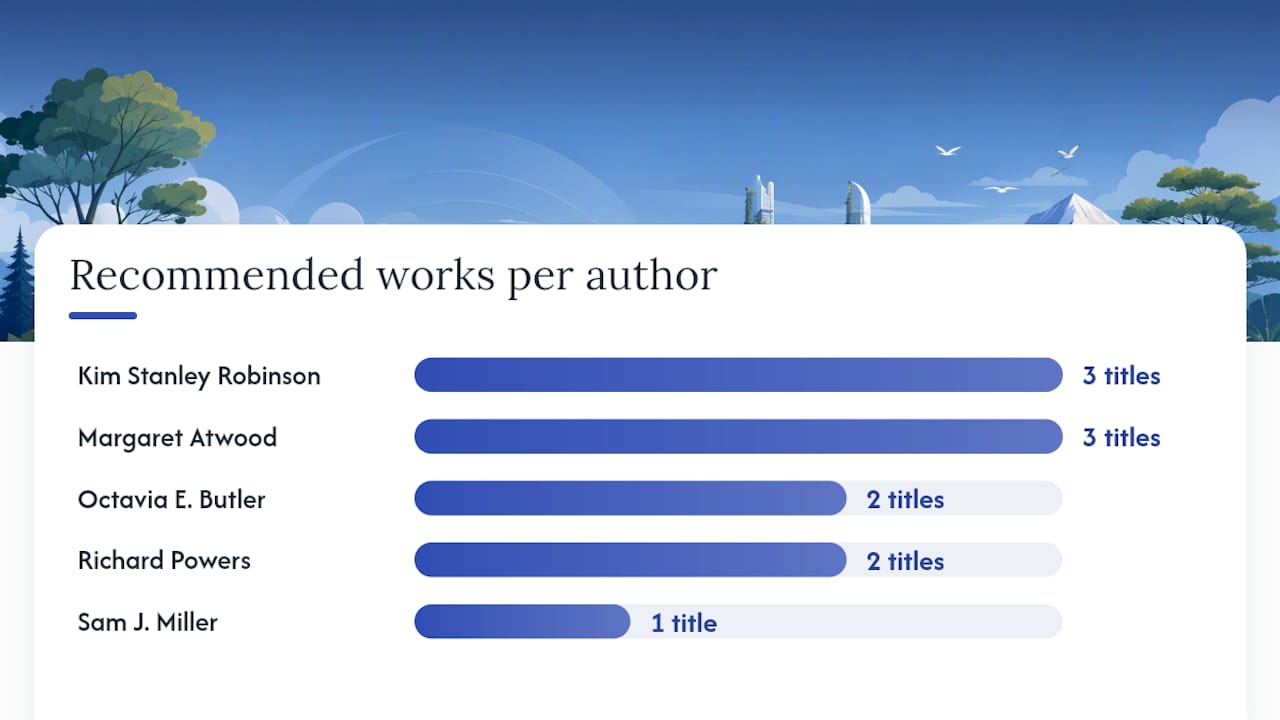
- Kim Stanley Robinson — The genre's most prolific policy-scale voice. The Ministry for the Future (2020) is the best entry point. His earlier Pacific Edge (1990) and New York 2140 (2017) reward readers who want more.
- Octavia E. Butler — Parable of the Sower (1993) is followed by Parable of the Talents (1998). Both stand alone but read best in order. Butler's work is foundational to Afrofuturist cli-fi.
- Margaret Atwood — The MaddAddam trilogy begins with Oryx and Crake (2003). Read in publication order: Oryx and Crake, The Year of the Flood, MaddAddam. Each book stands alone, but the trilogy rewards completion.
- Richard Powers — The Overstory (2018) is his cli-fi landmark. Bewilderment (2021) continues his ecological concerns with a father-son story about neuroscience and extinction.
- Claire Vaye Watkins — Gold Fame Citrus (2015) is her only novel to date. Her short story collection Battleborn shares the same desert-Southwest sensibility.
- Sam J. Miller — Blackfish City (2018) stands alone. Miller also writes short fiction with strong climate and social justice themes, often appearing in speculative fiction magazines.
- Sequoia Nagamatsu — How High We Go in the Dark (2022) is a debut. Nagamatsu's work sits at the intersection of Japanese-American literary fiction and speculative cli-fi.
For readers seeking diverse and global voices beyond the American and British canon, look for Amitav Ghosh's The Hungry Tide (India, ecological), Tlotlo Tsamaase's short fiction (Botswana, Afrofuturist), and Nalo Hopkinson's work (Caribbean-Canadian, speculative). The genre is genuinely global, and the most interesting new writing often comes from authors in the Global South writing about climate realities their communities already face. E.L. Ravenheart's exploration of atmosphere and theme in short cli-fi-adjacent fiction is worth reading for writers and readers interested in how craft choices shape climate storytelling.
Where to find and borrow cli-fi books
Discovery sources:
- Public library guides — The New York Public Library's blog and SDSU's university library guide both maintain curated cli-fi lists updated regularly. Your local library's digital catalog (Libby, OverDrive) likely has most titles on this list as free ebook loans.
- Goodreads Listopia — Search "climate fiction" or "cli-fi" on Goodreads to find community-ranked lists with thousands of ratings. Useful for discovering titles outside the canonical shortlist.
- Independent bookstores — BookPeople in Austin, TX maintains staff-recommended reading lists that regularly feature cli-fi. Most indie bookstores with an active staff blog do the same.
- Thedigitalreads — The platform's catalog includes science fiction and speculative titles available as instant PDF, EPUB, and DOCX downloads, with free and low-cost options for budget-conscious readers.
| Resource | What it offers | Best for |
|---|---|---|
| NYPL blog / library guides | Staff-curated lists, free borrowing | Trusted picks, zero cost |
| Goodreads Listopia | Community rankings, reader reviews | Discovery and social proof |
| Indie bookstores (BookPeople) | Staff picks, personal recommendations | Curated taste, local support |
| Thedigitalreads | Instant ebook downloads, indie authors | Affordable access, multiple formats |
| Libby / OverDrive | Free library ebook loans | Free reading, wide catalog |
How these picks were chosen
The titles in this article were selected using a combination of library and institutional curation (NYPL staff picks, SDSU and Portland Community College research guides), community ratings on Goodreads, and editorial judgment aimed at balancing tone, scale, and diversity of voice. The goal was a list that works for a first-time cli-fi reader and a committed genre reader equally.
Selection criteria applied:
- Appeared on at least one library or institutional curated list
- Represents a distinct subgenre or tonal register within cli-fi
- Contributes to diversity across author background, geography, and narrative approach
- Stands alone or has a clear reading-order note if part of a series
No title was included solely on the basis of sales rank or publisher prominence.
Why cli-fi deserves more than a "doom reading" label
The most common objection to climate fiction is that it's punishing to read. People assume it means two hundred pages of rising seas and collapsing governments, with no exit and no hope. That framing undersells the genre badly.
What cli-fi actually does, at its best, is give you a place to put the anxiety you already carry. Butler's Lauren Olamina doesn't survive because she's optimistic. She survives because she builds something. Robinson's Ministry doesn't promise a happy ending. It shows people arguing, failing, and trying again inside real institutions. That's not doom. That's the most honest kind of hope available.
The genre also does something most nonfiction about climate cannot: it makes you care about specific people in specific places. A statistic about sea-level rise is abstract. A character watching her childhood neighborhood flood is not. That emotional specificity is why librarians keep recommending these books, and why readers who pick up one cli-fi novel tend to read several more.
If you've been avoiding the genre because you thought it would leave you feeling worse, start with Blackfish City or Flight Behavior. Both are warm, character-driven, and genuinely engaging. The most atmospheric and immersive speculative novels tend to pull you through even the hardest material.
Affordable cli-fi ebooks available at Thedigitalreads
Thedigitalreads gives you instant access to speculative and science fiction ebooks without the wait or the markup of traditional retail. The catalog includes indie authors writing in exactly the cli-fi-adjacent space this article covers, available in PDF, EPUB, and DOCX so you can read on any device.
What you get when you shop at Thedigitalreads:
- Instant downloads in PDF, EPUB, and DOCX formats
- Free titles included alongside low-cost paid options
- Independent authors you won't find at major retail outlets
- No subscription required, pay only for what you want
Ready to read? Browse the full collection and find your next speculative or climate fiction read today.
Sources
- Home - Cli‑Fi (Climate Fiction) - Research Guides at Portland Community College
- Compelling Climate Fiction To Read Before It Becomes Nonfiction | The New York Public Library
- Celebrate Earth Month: "Hot" Climate Fiction Reads - Duke University Libraries Blogs
- Climate Change Fiction | University Library | SDSU
- Penguinrandomhouse
- The Ministry for the Future by Kim Stanley Robinson | Hachette Book Group
FAQ
What does "cli-fi" mean?
Cli-fi is short for climate fiction, a subgenre of speculative fiction where climate change is the central force shaping the story's plot, characters, or world. The term was coined around 2007 and is now used by libraries, publishers, and academics.
Which cli-fi book should a complete beginner read first?
Parable of the Sower by Octavia E. Butler is the most commonly recommended starting point. It's emotionally immediate, fast-paced, and introduces the genre's core themes of survival, community, and ecological collapse without requiring any prior sci-fi background.
Is cli-fi always depressing?
No. The genre spans from bleak eco-dystopia to hopeful solarpunk. Blackfish City by Sam J. Miller and Station Eleven by Emily St. John Mandel are both engaging and ultimately warm reads. Matching your pick to your current mood is the key.
Are there cli-fi books that focus on solutions rather than collapse?
Yes. The Ministry for the Future by Kim Stanley Robinson is the clearest example, imagining real policy mechanisms and institutional responses to climate change. Blackfish City also centers community resilience and adaptation.
Where can I find affordable cli-fi ebooks to download?
Your public library's Libby or OverDrive app offers free loans of most major cli-fi titles. For instant downloads in PDF, EPUB, or DOCX, Thedigitalreads carries speculative and science fiction ebooks at low or no cost, including titles from independent authors.